.jpg)
Fort George, Guernsey
On 27 March 1783, 500 mostly Irish soldiers of the newly raised 104th Regiment of Foot decided they had had enough of being locked inside their barracks. They demanded the gates of Fort George be left open. Their officers agreed. A few days later the same soldiers opened fire on those officers and drove them out. It took the 18th Regiment - the Royal Irish - plus the Guernsey Militia and six pieces of artillery to surround the rebels and force their surrender. Thirty-six ringleaders were arrested, the regiment was shipped to Southampton, and the 104th was quietly disbanded that May. This is what Fort George looked like before it was even finished.
A Star Built for a War That Did Not Come
Planned in 1779 during the Anglo-French War, construction began in 1780 and would not finish until 1812 - 32 years on a single fort. The British were afraid of a French landing on Guernsey, especially after the French had pulled off the unsuccessful Battle of Jersey in January 1781 at Saint Helier. The new fort was a textbook star, with bastioned walls designed to put crossing fire on any attacker. A detached redoubt, Fort Irwin, anchored the inland flank. The seaward Clarence Battery covered the approaches from St Peter Port harbor. By 1833 the place mounted 34 cannons, one carronade, and four mortars. The pikes, muskets, and swords in the armory dated from a half-dozen different campaigns. The French invasion the fort was built to repel never came.
Doyle, Duels, and a Rumored Bastard
Major-General Sir John Doyle arrived as Lieutenant Governor in 1803, declared a state of emergency in 1804, and pushed Fort George toward completion with the kind of urgency the previous twenty years had lacked. His Commander of Royal Engineers from 1803 was Lt. Col. John Mackelcan - allegedly the illegitimate son of King George III and Hannah Lightfoot, though the rumor has never been proven. Doyle drained the Braye du Valle marshes, upgraded the island roads to military specification, and ringed the coast with batteries. Duelling was illegal on Guernsey but happened anyway. In 1795, Major Byng of the 92nd Highlanders challenged a regimental surgeon to a duel on L'Hyvreuse Avenue. The surgeon had refused to stand for the national anthem. Byng died on the field.
Adlerschloss
When German forces occupied Guernsey in 1940, Fort George was renamed Stützpunkt Georgefest. The Luftwaffe built a major radar station inside the fortifications - codenamed Adlerschloss, 'Eagle Castle' - with two Freya early-warning sets, two giant Würzburg-Riese radars, and a microwave communications station. The Clarence Battery, originally built in 1780 as Terres Point Battery, was supplemented with a triple 3.7-centimeter flak battery, machine guns, and a 60-centimeter searchlight. The radar coverage was good enough that Allied bombers struggled to neutralize it before D-Day. RAF aircraft were shot down trying to silence Adlerschloss on 2 and 5 June 1944, just days before the Normandy landings. The military cemetery inside the fort holds 136 graves: British, German, and from both world wars. The Commonwealth War Graves Commission lists every one of them, regardless of nationality.
Demolished for a View
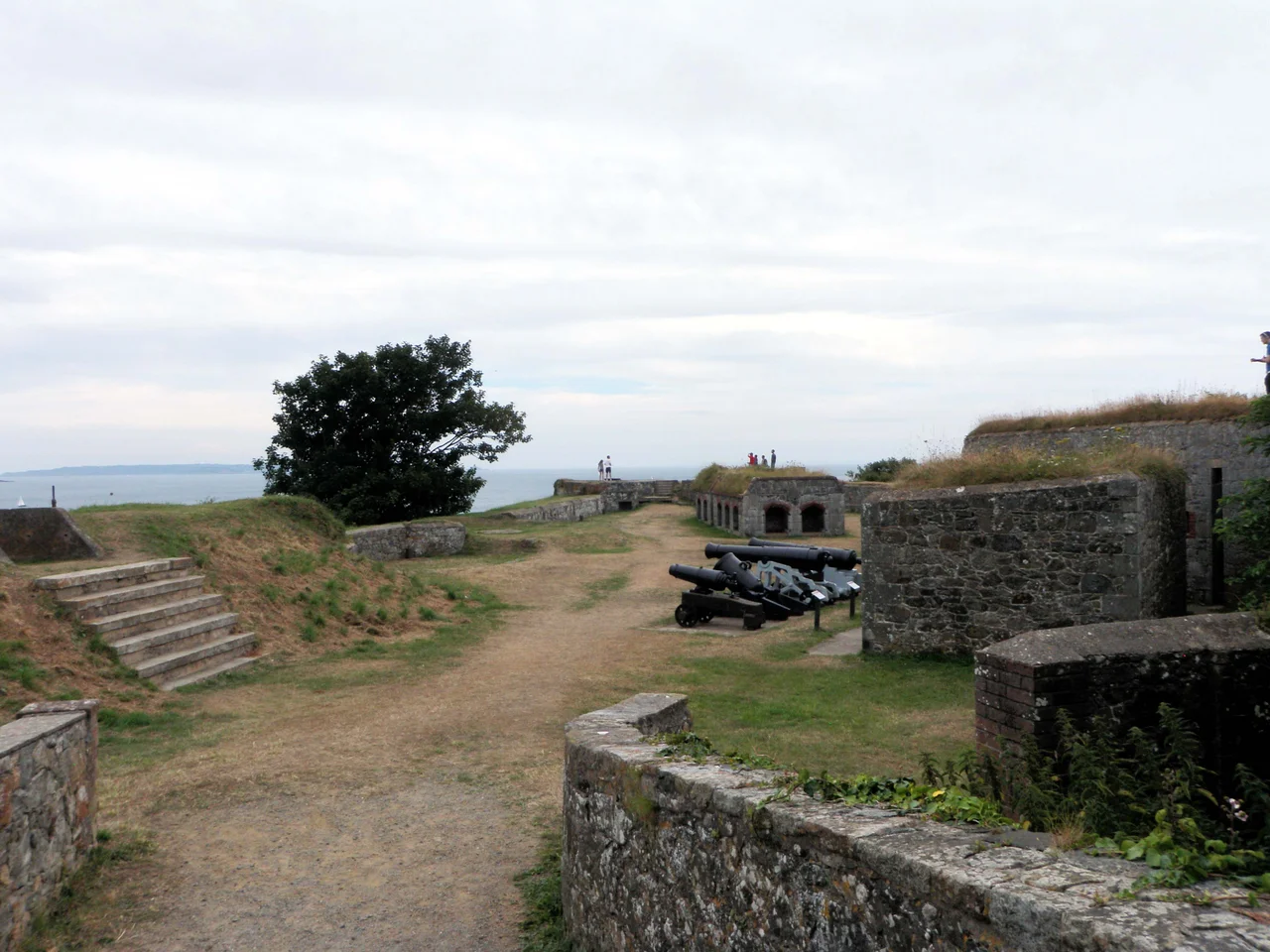
After liberation in 1945, Fort George had no obvious military future. The States of Guernsey bought the land from the Crown in 1958. In 1967 it was sold on to Fort George Developments, a company with a plan to build 120 luxury houses among the most defensible of the old buildings. Twenty-one percent of Guernsey's population signed a petition against the scheme. The petition was rejected. The barracks came down. Today the most striking thing inside the surviving curtain wall is real estate, not artillery. But the main gate still stands, with its original wooden doors and the plaque honoring Sir John Doyle, and the Clarence Battery still juts out toward the sea. From the Valette bathing places below, you can walk past the aquarium tunneled into the cliff and climb up the steps to the battery - reopened in 2025 after years of closure for landslip - and look out across the channel where the radar once watched for ghosts.
From the Air
Fort George sits at approximately 49.45°N, 2.53°W, on the high ground south of St Peter Port harbor. The original star-fort outline is partially obscured by the post-1967 luxury housing development, but the main gate, perimeter walls, and Clarence Battery on the seaward side are still legible from above. Guernsey Airport (EGJB) is about 4 km southwest. Best viewed in low sun from the east, when the bastion shadows pick out the fort's geometry against the modern roofs. Le Val des Terres, the curving coastal road opened in 1935, leads up from St Peter Port to the main gate.
Nearby Stories
- Pallot Steam, Motor & General Museum 29 km away
- HMS Affray 29 km away
- Operation Donnerkeil 29 km away
- German Submarine U-672 35 km away
- Action of 18 June 1793 60 km away
- Mont Saint-Michel: The Abbey That Becomes an Island Twice a Day 78 km away
- Basilica of Sainte-Therese, Lisieux 209 km away
- 1941 Santander Fire 642 km away