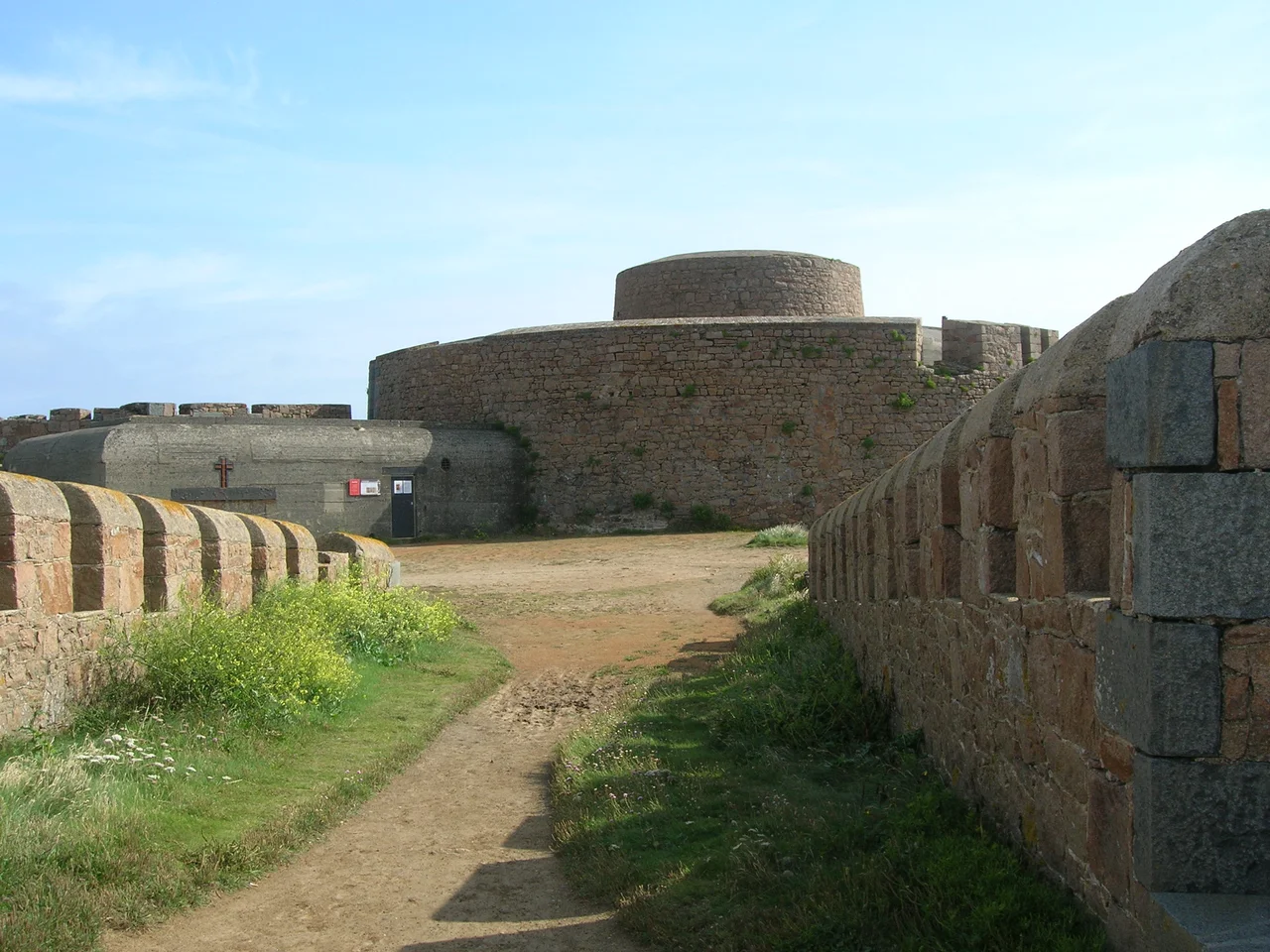

Fort Hommet
Walk out onto the Vazon Bay headland and you are walking on a stratigraphy of fear. A single low hill, exposed to the Atlantic and a short hop from the French coast, has been fortified continuously since at least 1680. There is a 1680 gun position somewhere under your feet. The squat stone cylinder above you is a Napoleonic-era Martello tower from 1804. The concrete casemates dug into the slope - half-buried, blank-faced - were poured by German engineers in 1942. Fort Hommet is what happens when one good spot for a gun is found and then never abandoned.
The First Gun
The earliest record of a fortification here dates to 1680, when one gun stood on the headland. Vazon Bay was an obvious landing beach for any French invader, and the British and Guernsey authorities knew it. After the French nearly took Jersey in 1781, defences across both bailiwicks were rushed forward. By 1795 the position had been improved with additional gun pads. By 1805 there were six guns on Hommet. The road from St Peter Port out to the fort was upgraded to military standard around 1808, partly funded by the sale of land reclaimed from the Braye du Valle marshes - one of John Doyle's many ingenious civil engineering projects.
Doyle's Field Works
The Martello tower at the heart of Fort Hommet went up in 1804, during the Napoleonic Wars and during the tenure of Lieutenant Governor John Doyle. Doyle, never a man to wait for paperwork, sidestepped the Royal Ordnance Corps entirely by classifying the construction as 'field works' and hiring a local builder named Gray to put up the tower along with two others. The three Guernsey Martellos - Fort Hommet, Fort Grey, and Fort Saumarez - are smaller than their cousins on the English coast. Each was meant as a keep at the heart of an open gun battery, with a single 24-pounder carronade on the roof. Hommet and Saumarez share an unusual feature: an exterior staircase climbing to the second floor.
Heavier Guns for a Closer Enemy
The Victorian army updated the fort to match its new artillery. In 1852, the 24-pounders were replaced in some batteries with 68-pounders and eight-inch shell guns. Barracks went up. Magazines were enlarged. The headland kept gathering iron. In World War II, after Guernsey was demilitarized and surrendered to German forces in June 1940, Fort Hommet became Stützpunkt Rotenstein - 'red stone strongpoint.' The Wehrmacht added a reinforced personnel shelter, a coastal-defence gun casemate, trenches, machine-gun pits, a Czech ZB-53 machine gun mounted in a steel ball, and a ring of minefields around the headland. The Martello tower itself, built to shoot at the French, was incorporated into a system pointed at the British.
Buried and Then Unearthed
When liberation came in May 1945, the British Army and the islanders went to work on the German structures with hammers and scrap-metal hopes. By the late 1940s the guns, blast doors, and metal fittings were gone. Many of the bunkers - including the Fort Hommet gun casemate - were buried under earth in an attempt to give the coastline back its pre-war shape. For decades they sat under turf, invisible. More recently the States of Guernsey has dug parts of the complex out again. The Fort Hommet 10.5 cm Coastal Defence Gun Casement Bunker is now open to visitors, on restricted hours. The M19 Maschinengranatwerfer bunker - a German automatic mortar emplacement - has been restored too. On 2 November 1990 the whole site, Martello tower and German concrete alike, was listed as a Protected Monument.
From the Air
Fort Hommet sits at approximately 49.47°N, 2.61°W on the western coast of Guernsey, on the headland between Vazon Bay and the smaller Albecq beach. From the air the squat circular Martello tower is the easiest feature to spot, set just back from the cliffs. The German casemates appear as low rectangular shapes in the turf. Guernsey Airport (EGJB) is 6 km southeast. Best viewed from the west, with the Atlantic behind you - in clear conditions you can see Fort Saumarez 3 km further south and Fort Grey further south still, all three Martellos in a single sweep of coast.
Nearby Stories
- Pallot Steam, Motor & General Museum 29 km away
- HMS Affray 29 km away
- Operation Donnerkeil 29 km away
- German Submarine U-672 35 km away
- Action of 18 June 1793 60 km away
- Mont Saint-Michel: The Abbey That Becomes an Island Twice a Day 78 km away
- Basilica of Sainte-Therese, Lisieux 209 km away
- 1941 Santander Fire 642 km away