.jpg)
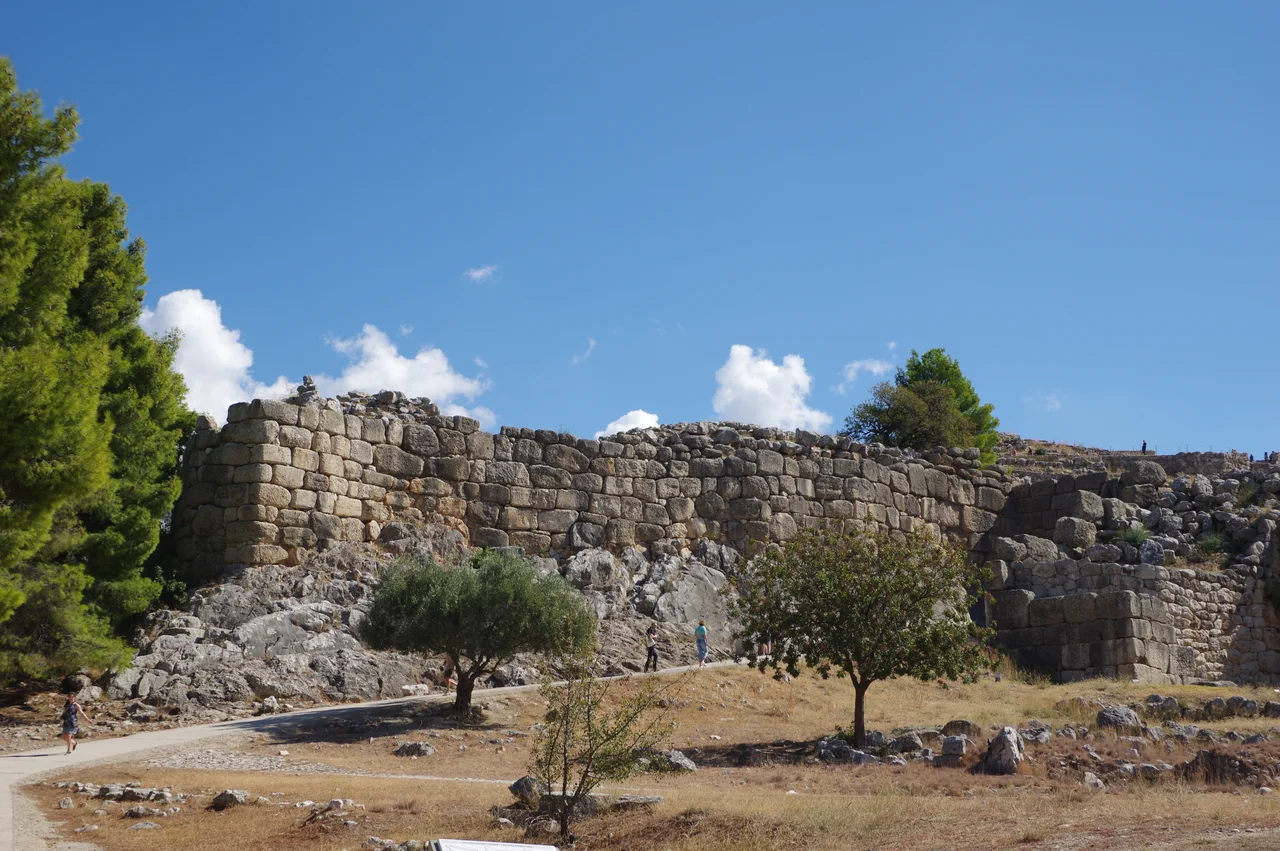
Fortifications of Mycenae
Later Greeks, confronting these walls, could not explain them. The limestone blocks were too large, too heavy, too perfectly fitted to have been raised by ordinary people. They decided giants must have built them — specifically, the Cyclopes, the one-eyed giants of mythology. The name stuck. We still call this style of construction Cyclopean masonry, a label that preserves in a single word the awe that Bronze Age engineering inspired in the people who inherited its ruins. The walls themselves have outlasted the civilization that built them, the civilization that gave them their name, and every army that has since passed through the Argolid.
Stones That Outlasted Memory
The citadel of Mycenae crowns a triangular hill between two ravines in the northeastern Peloponnese, commanding views of the Argive plain from roughly 278 meters above sea level. Its fortification walls, constructed from limestone quarried nearby, stand in some places to a height of several meters and measure up to six meters thick. The first circuit was built during the Late Helladic IIIA period — roughly the 14th century BCE. It was then expanded during the LH IIIB period, probably in the 13th century BCE, to enclose a wider area including Grave Circle A, the ring of royal shaft graves whose occupants the living Mycenaeans were not willing to leave outside the walls. The expansion reflects something beyond mere military calculation: the rulers of Mycenae were drawing a boundary that incorporated their ancestors, making the dead part of the defended city.
The Lion Gate
The main entrance to the citadel still stands. The Lion Gate, built during the LH IIIB expansion, consists of four massive limestone elements: two upright jambs, a threshold, and a colossal lintel estimated to weigh around twenty tons. Above the lintel, a relieving triangle — an opening designed to reduce the downward pressure on the lintel itself — is filled with a carved limestone slab depicting two lions facing each other across a central column. Their heads, originally carved separately in another material and long since lost, once faced outward toward anyone approaching the gate. The symbolism is disputed. Lions are thought to have still ranged in northern Greece during the Bronze Age, before retreating to Thrace by the classical period. Whether the lions above the gate represented royal power, divine protection, or simply the prestige of an animal that few people ever saw alive is something we cannot know. The design itself was likely inspired by the monumental entrance of Hattusa, the Hittite capital in central Anatolia — evidence of the long reach of Bronze Age diplomatic and cultural contact.
The Postern Gate and the Logic of Siege
A second, smaller entrance pierced the northern wall: the Postern Gate, a back door that allowed people from the surrounding area to slip inside the citadel during times of attack. The design was tactical in a specific way. Warriors defending the citadel and attacking enemies who had breached the approach would find those enemies' unshielded right sides exposed — most fighters carried their shields on their left arm, leaving the right side, the sword arm, vulnerable. Walls and gateways at Mycenae were designed with this asymmetry in mind. The citadel was not just a refuge; it was a weapons system, and every stone placement was an argument about how battles would be fought and won.
What Schliemann Found — and What Came Before Him
Heinrich Schliemann arrived at Mycenae in 1874, convinced that Homer's Iliad described real places and real people. The Greek Archaeological Society had already conducted some work at the site, and Schliemann excavated in 1876 with Panagiotis Stamatakis, a Greek archaeologist assigned to supervise. What Schliemann found inside the walls confirmed his faith in Homer to a degree that astonished the world: shaft graves filled with gold, weapons, and the death masks of men he immediately identified as Homeric heroes. The walls that enclosed those graves — the Cyclopean walls — had already been visible for three millennia. Travelers had described them. Local people had always known they were there. Schliemann simply walked through the Lion Gate and started digging.
Still Standing
The citadel of Mycenae collapsed sometime around 1200 BCE, during the wider Bronze Age collapse that brought down palace cultures across the eastern Mediterranean. The walls did not collapse with it. They were too well built. Centuries of abandonment left the site covered in debris, its gates half-buried, its internal buildings reduced to foundations. But the outer walls — the Cyclopean limestone blocks that later Greeks attributed to mythological giants — weathered all of it. Today they remain one of the best-preserved examples of Bronze Age fortification anywhere in the world. Standing inside the Lion Gate and looking out across the Argive plain, the view is not so different from what a Mycenaean guard would have seen. The plain is greener now, cultivated in different ways. But the hills are the same hills, and the stone under your feet is the same stone that bewildered every generation of Greeks who came after.
From the Air
The citadel of Mycenae sits at approximately 37.731°N, 22.756°E, crowning a hill between two ravines above the village of Mykines in the Argolid. From the air at 4,000–6,000 feet, the walls are clearly visible as a roughly triangular enclosure on the hilltop, with the Lion Gate visible on the northwestern face. The Argive plain stretches south and west. The nearest major airport is LGAV (Athens International Eleftherios Venizelos), approximately 100 km to the northeast. Corinth is visible to the north on clear days. Afternoon haze can obscure the plain; morning approaches offer the clearest views of the citadel's profile.
Nearby Stories
- Villa of Herodes Atticus 3 km away
- Sicyon 3.5 km away
- Battle of Megalopolis 4.5 km away
- Hermione: The City at the Edge of the World 7.5 km away
- Agia Lavra 7.7 km away
- Megara 13 km away
- Agistri 13 km away
- Teuthis 15 km away