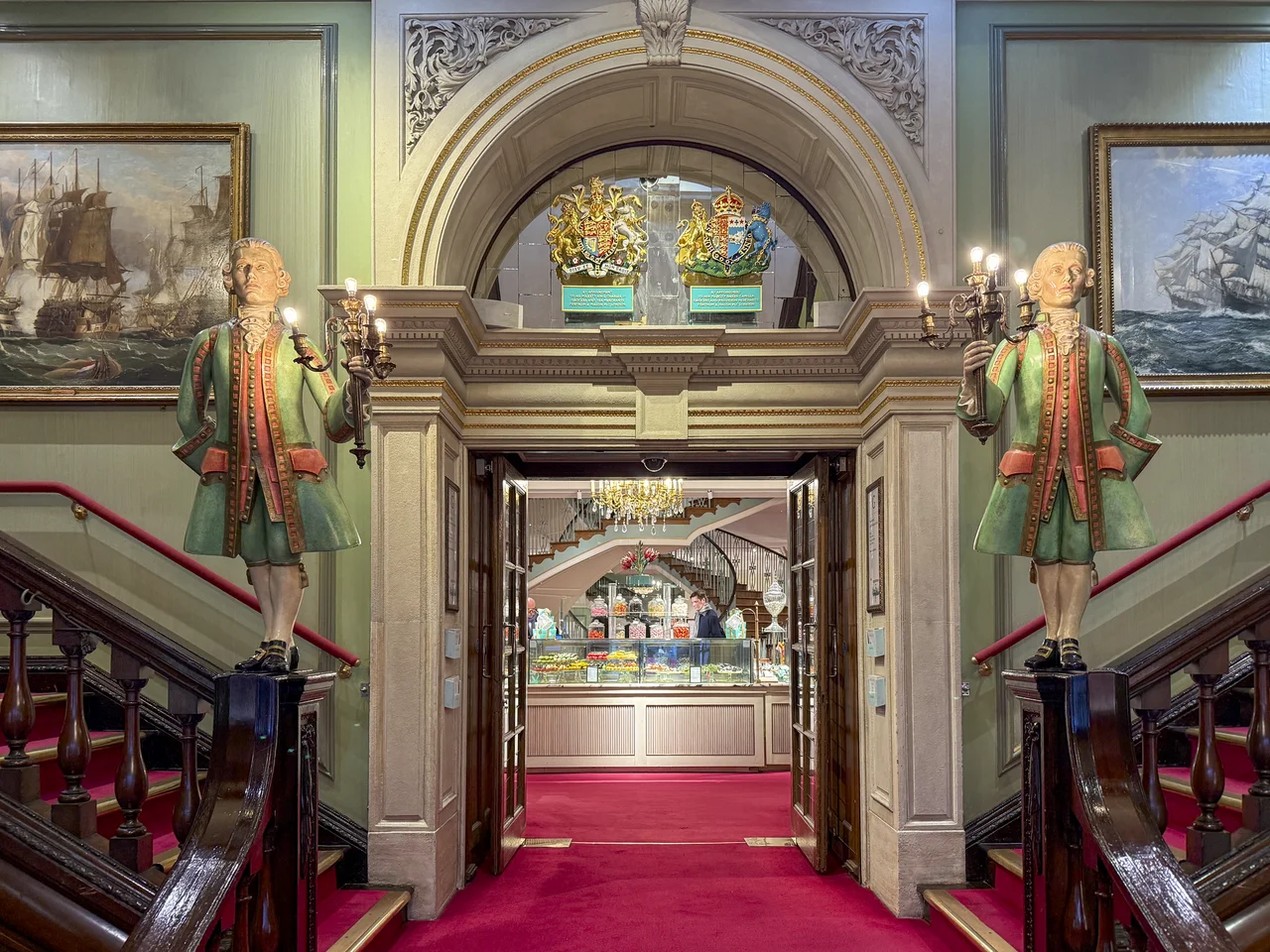

Fortnum & Mason
Every hour on the hour, four-foot models of William Fortnum and Hugh Mason emerge from a four-ton clock above 181 Piccadilly, bow to each other, and disappear again to the sound of eighteenth-century chimes. The clock was commissioned in 1964 as a tribute to two men whose unlikely partnership began with a footman selling Queen Anne's used candle stubs. The royal household insisted on fresh candles every night, and Fortnum, working in the palace, saw an opportunity in the half-burned wax. He resold it. With the proceeds he built a sideline as a grocer, then convinced his landlord Hugh Mason to go in with him. In 1707, in a small shop at St James's Market, the world's most enduring food story began.
The Footman and the Landlord
William Fortnum's start was almost accidental. Posted to the palace as a footman, he watched candles burn down each evening and saw nightly profit. The connection to royalty soon meant more than wax: when his grandson Charles entered the service of Queen Charlotte in 1761, the family's link to the court hardened into a business advantage. The store began stocking the kind of food that wealthy households couldn't easily prepare themselves. By 1738, Fortnum's was claiming credit for inventing the Scotch egg, the portable boiled-egg-wrapped-in-sausage that suited a coaching society on the move. Ready-to-eat poultry and game arrived in aspic jelly. The shop wasn't selling food so much as selling the absence of inconvenience, and that proved to be a commodity London's gentry would buy in any century.
War, Wellington, and a Nurse Named Florence
During the Napoleonic Wars, British officers in the field received dried fruit, preserves, and spices stamped with the Fortnum name. The store became the unofficial commissary of empire. By the Victorian era, court functions ordered their menus through Piccadilly, and when Florence Nightingale ran her grim wards during the Crimean War, Queen Victoria personally arranged shipments of Fortnum's concentrated beef tea to her hospitals. The same firm that supplied diamond-encrusted banquets was also feeding wounded soldiers in the Black Sea. In 1886, Fortnum's took a flyer on a new American product from a man named H. J. Heinz, buying his entire stock of five cases. They became the first store in Britain to sell tinned baked beans. The hampers, the wickerwork emblem of every Ascot and Glyndebourne picnic since, grew out of that same instinct: pack the food, send it forth, let the world taste London.
Boardroom Coup, Royal Approval
By 1951, the store had drifted, and a Canadian businessman named W. Garfield Weston staged what was openly called a boardroom coup, taking control of the company. He kept Fortnum's pointed at its identity, and in 1964 commissioned the great mechanical clock that still draws crowds to the corner of Piccadilly and Duke Street. After Weston's death in 1978, two of his granddaughters, Jana Khayat and Kate Hobhouse, took over. Royal warrants accumulated like rosettes. Queen Alexandra granted the first in 1910. George V renewed it. George VI lost his briefly in 1948 over postwar rationing politics and got it back in 1951. In March 2012, Queen Elizabeth II made her first official joint visit with Camilla and Catherine, then the duchesses of Cornwall and Cambridge. The Queen opened the Diamond Jubilee Tea Salon on the fourth floor. Three women in three generations of monarchy, all walking through the same green doors.
A Cup, A Hamper, A Conscience
Modern Fortnum's has not been spared modern arguments. From 2010, animal-welfare campaigners targeted the store over its foie gras sales, picketing the entrance with celebrities ranging from Roger Moore to Morrissey. In 2011, Westminster Trading Standards reprimanded the company for misleading customers about its welfare standards, and in December 2020 Fortnum's stopped selling foie gras altogether, replacing it with a less cruel alternative. On 26 March 2011, the store became an unlikely flashpoint of British tax politics when activists from UK Uncut broke off from a wider protest and staged a mass sit-in inside the food halls; 138 were arrested. In November 2024, the company drew sharp criticism for excluding Paralympians from an after-party following a Buckingham Palace reception for Olympians. Disabled athletes spoke publicly about the slight, calling it part of a familiar pattern. Three centuries of supplying the powerful means three centuries of being asked, occasionally, to behave better.
The Wax Still Burns
The store now stretches across seven storeys, with a tea salon, restaurants, the gentlemen's department, and seasonal hampers that ship worldwide. There are outposts at The Royal Exchange, St Pancras International, Heathrow Terminal 5, Canary Wharf, plus standalone stores in Dubai and Hong Kong. Inside the Piccadilly flagship, a £24 million refurbishment for the 2007 tercentenary preserved the eighteenth-century bones while updating the plumbing. Mr Hyde, in the 1960 Hammer film, looks around a disreputable nightclub and quips: "Rather like Fortnum & Mason. You can buy anything here." The line still works. From a footman selling secondhand candle wax to a store where the Queen opens her own tea room, the trajectory is impossibly British: opportunistic, royal-adjacent, slightly absurd, and absolutely committed to looking as if it has been there forever. Because, in the end, it has.
From the Air
Fortnum & Mason sits at 51.5083°N, 0.1384°W on Piccadilly in the St James's quarter of London's West End. Best viewed from low altitude at 1,500-2,500 feet AGL. Nearby airports include London City (EGLC) about 8 nm east, London Heathrow (EGLL) 13 nm west, and London Biggin Hill (EGKB) 12 nm southeast. The store is two blocks south of Piccadilly Circus; Green Park and Buckingham Palace lie a short walk south. Look for the distinctive green Hatchards bookshop next door and the curving Burlington Arcade across Piccadilly.
Nearby Stories
- Stevenage 5.7 km away
- Malling Abbey 5.7 km away
- 1952 Farnborough Airshow Crash 7.7 km away
- Ingatestone Hall 8.2 km away
- Hellfire Caves 9.1 km away
- The Carrington Event: The Solar Storm That Could Happen Again 9.8 km away
- Bletchley Park 16 km away
- Castle Hedingham 23 km away