.jpg)
Francis Crick Institute
When Queen Elizabeth II officially opened the Francis Crick Institute on 9 November 2016, her tour included an unusual ceremonial act: she began the sequencing of the genome of the institute's director, Sir Paul Nurse — all three billion letters of his DNA code. It was an apt inauguration for a building dedicated entirely to biological mystery. The Crick, as it is known, asks seven questions as its founding mission. Not one has yet been fully answered.
A Decade in the Making
The Crick's origins trace to 2003, when the Medical Research Council decided its National Institute for Medical Research needed to leave its Mill Hill site. What followed was years of planning, negotiations, and false starts before Prime Minister Gordon Brown announced the creation of the UK Centre for Medical Research and Innovation in December 2007. The 3.5-acre site on Brill Place, next to St Pancras railway station, was purchased in June 2008 for £85 million. Nobel laureate Paul Nurse — who had won the 2001 Nobel Prize in Physiology or Medicine — was named as the institute's first director in July 2010. Construction began in July 2011 and reached practical completion on time and within budget in August 2016, at a total construction cost of £465 million. Six partners funded the venture: Cancer Research UK, Imperial College London, King's College London, the Medical Research Council, University College London, and the Wellcome Trust.
The Building Below Ground
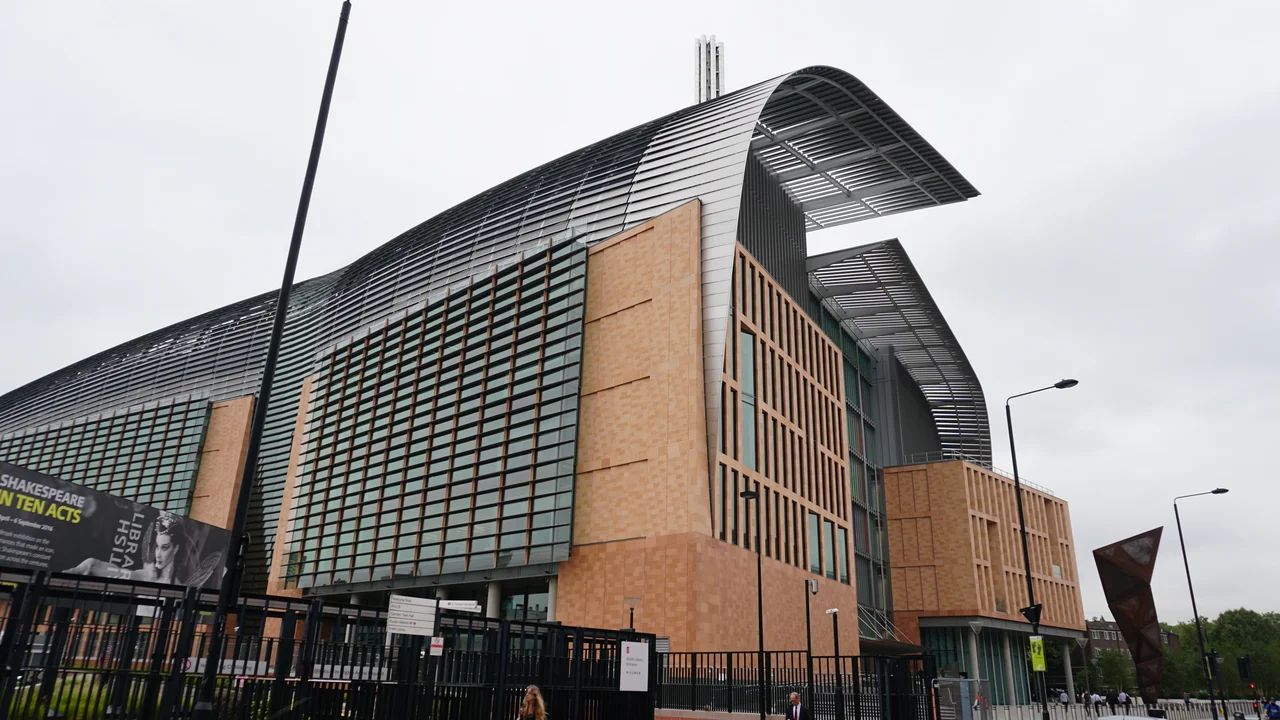
From the street beside St Pancras, the Francis Crick Institute appears as a substantial eight-storey structure. What is less obvious is how much lies underground: a third of the building descends into four basement levels, not for lack of space above but to protect sensitive equipment from vibration, electromagnetic interference, and the particular demands of high-precision science. The total internal floor area reaches 82,578 square metres, of which nearly 30,000 square metres are laboratories equipped with five kilometres of laboratory benching. Over a third of the building serves as plant rooms for the ventilation and services that biological research demands. The roof hides heating and cooling units and carries solar panels. Outside the main entrance stands Paradigm, a 14-metre sculpture of weathered steel by British artist Conrad Shawcross — one of the largest public sculptures in London.
Seven Questions
The Crick defines its scientific mission through seven questions it considers the most important in biomedical research: how organisms acquire form and function; how they maintain health as they age; how biological knowledge can improve disease diagnosis and treatment; how cancer starts, spreads, and responds to therapy; how the immune system knows when to react; how microbes and pathogens interact with hosts; and how the nervous system stores information throughout life. These questions are deliberately broad, designed to accommodate the 1,500 staff members — including 1,250 scientists — who work across disciplines that rarely occupied the same building before. GlaxoSmithKline became the institute's first commercial partner in July 2015. In 2015, Tomas Lindahl, an emeritus group leader at the Crick, shared the Nobel Prize in Chemistry for his work on DNA repair mechanisms.
Named for a Revolutionary
The institute was renamed the Francis Crick Institute in July 2011, honouring the British molecular biologist who, together with James Watson, produced the first double-helix model of DNA in 1953. Crick's discovery — built substantially on Rosalind Franklin's X-ray crystallography work — transformed biology. Naming an institution for him was both a tribute and a statement of ambition: the Crick aims to produce discoveries of comparable consequence. A portrait of Francis Crick by Irish artist Robert Ballagh was unveiled during the Queen's 2016 opening visit. The institute publishes research across all areas of biomedical science and maintains an education programme, a 450-seat auditorium, and public exhibition space open to visitors.
From the Air
The Francis Crick Institute sits at 51.532°N, 0.129°W, immediately beside St Pancras International railway station — whose distinctive Gothic Revival clock tower provides a reliable visual landmark. The institute's modern structure contrasts with the Victorian station building. Viewing altitude of 1,500 feet AGL provides a clear perspective on both buildings. Nearest airports: London City (EGLC, approximately 9nm east-southeast) and London Heathrow (EGLL, approximately 14nm west). The King's Cross rail complex immediately east of the institute is visible from altitude.
Nearby Stories
- Stevenage 5.7 km away
- Malling Abbey 5.7 km away
- 1952 Farnborough Airshow Crash 7.7 km away
- Ingatestone Hall 8.2 km away
- Hellfire Caves 9.1 km away
- The Carrington Event: The Solar Storm That Could Happen Again 9.8 km away
- Bletchley Park 16 km away
- Castle Hedingham 23 km away