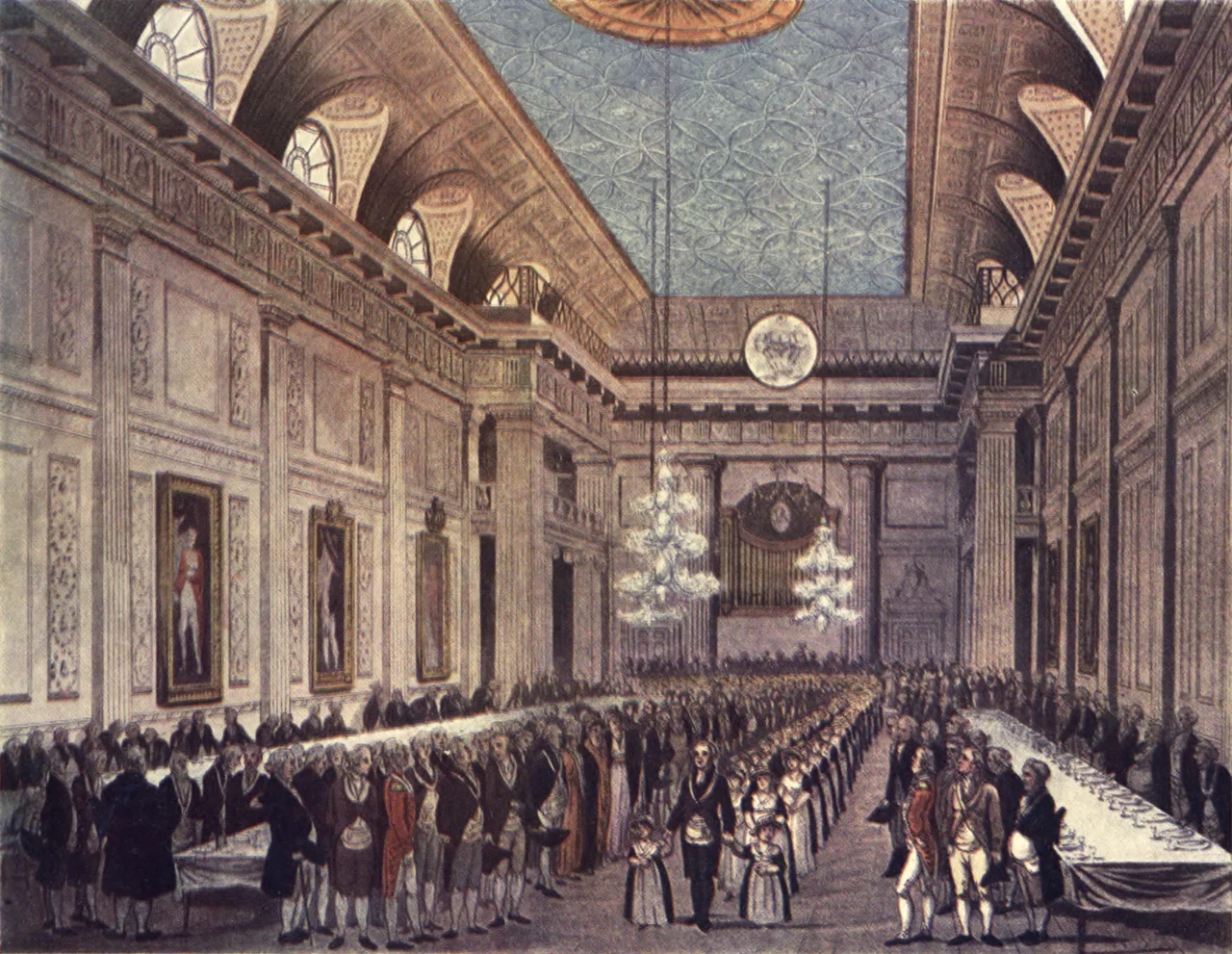
![Photo: Thomas Rowlandson (1756–1827) and Augustus Charles Pugin (1762–1832) (after) John Bluck (fl. 1791–1819), Joseph Constantine Stadler (fl. 1780–1812), Thomas Sutherland (1785–1838), J. Hill, and Harraden (aquatint engravers)[1] | Public domain](https://commons.wikimedia.org/wiki/File:Microcosm_of_London_Plate_038_-_Freemasons%27_Hall.jpg)
Freemasons' Hall, London
Walter Gilbert's bronze doors weigh a tonne and a quarter each. They open onto a chamber 123 feet long, 90 feet wide, and 62 feet high, capable of seating 1,700 people. The ceiling is a Mosaic field of cardinal virtues and Masonic symbols; behind the dais sits a Henry Willis & Sons pipe organ from 1933, restored in 2015. This is the Grand Temple at Freemasons' Hall on Great Queen Street, and almost no one walking past it on the way to Covent Garden realises what's inside. The building is a war memorial. The 3,225 Freemasons who died on active service in World War I are remembered not with a stone obelisk but with the largest Masonic complex in England, an Art Deco cathedral hiding 27 separate temples beneath one Portland stone facade.
Three Buildings, One Street
The Freemasons bought this plot in 1775, picking a house on Great Queen Street between Holborn and Covent Garden, with a second house behind it across a garden. They held a competition to design a Grand Hall linking the two structures. Thomas Sandby won it. His hall was dedicated on 23 May 1776, with the front house operating as the Freemasons' Tavern and the rear given over to offices and meeting rooms. John Soane added to the complex in 1820 (his work was later demolished in 1860). In 1846, the World Evangelical Alliance was founded in the building, an oddity given the assumptions outsiders sometimes make about Freemasonry. The original building lasted until 1862, when Frederick Pepys Cockerell renovated and extended it from designs he had drawn up decades earlier. That second building stood until 1925, when work began on the structure that visitors see today.
The Masonic Peace Memorial
Henry Victor Ashley and F. Winton Newman designed the present building between 1927 and 1933, after the Masonic Million Memorial Fund raised over a million pounds from Freemasons across England. The result was originally called the Masonic Peace Memorial. Then Hitler invaded Poland, and in 1939 the trustees quietly dropped "Peace" from the name. It became simply Freemasons' Hall. Today it is a Grade II* listed building, both internally and externally, one of the finest surviving examples of Art Deco public architecture in Britain. In 1967, to mark the 250th anniversary of the foundation of the premier Grand Lodge in 1717, a clock was installed above the main entrance, flanked by the dates "1717" and "1967." Above all this towers Prince Arthur, Duke of Connaught and Strathearn, second-youngest son of Queen Victoria, the Grand Master from 1901 to 1939, who first proposed building the memorial. His arms are stitched into the mosaic ceiling above the Grand Temple.
Twenty-Seven Doors
Beyond the Grand Temple, the building contains 26 further temples, no two identical. Temple No 10 sits beneath the great clock tower and gets extra height for an Egyptian-Art Deco hybrid with a high domed ceiling and its own Willis pipe organ. Temple No 11 was funded largely by donations from Japan and the Far East, and is dominated by stylised chrysanthemums, the national flower of Japan. Temple No 12, known as the Burma Temple, was paid for by Freemasons in British Burma and decorated with stylised Burmese artwork, with a plaque honouring those subscribers. Temple No 17, funded by Buckinghamshire Freemasons, carries a vast carved swan, the county's symbol, on one wall. The most ancient lodges in London meet here, including three of the four that pre-date 1717 itself. About 1,800 lodges and chapters meet regularly in London, and a large share of them gather under this one Holborn roof.
The Library and the Public
Anyone can walk in. Parts of the building are open daily, and admission to the Museum of Freemasonry is free. The museum was recognised by the Museums, Libraries and Archives Council in 2007 as a collection of outstanding national and international significance. Inside are Masonic clocks, jewellery, porcelain, ceremonial regalia, and a library covering Freemasonry in England and around the world, including archives of the Societas Rosicruciana in Anglia, the Oddfellows, and the Foresters Friendly Society. In 2018, what had been Temple No 23 was renamed The Kent Room and opened for public viewing. New small temples numbered 25, 26, and 27 were carved from two former residential flats. Live-in caretakers are largely gone; the building's working life has shifted entirely to its lodges, its archives, and its public visitors. The library still answers genealogical enquiries, though there is no complete public index of Freemasons.
Hollywood Comes Knocking
Film crews have noticed what most pedestrians have not. The Grand Temple stood in for The Grand Templar Hall in the 2016 Assassin's Creed movie, sporting double Templar crosses on its facade for the closing scenes. The building plays Thames House, MI5's real-world home, in the TV series Spooks and again in Spy. Agatha Christie's Poirot returned to it repeatedly. The Hitchhiker's Guide to the Galaxy used the interior as the temple where the Jatravartid people pray for the coming of the Great White Handkerchief. Sherlock Holmes, Johnny English, Doctor Strange in the Multiverse of Madness (as the Illuminati Headquarters), and four 2022 episodes of The Late Late Show with James Corden have all turned this Art Deco war memorial into something else for the cameras. Inside, the lodges keep meeting, the organ keeps playing, and the bronze doors keep swinging on their counterweights, holding a quieter purpose than the films suggest.
From the Air
Freemasons' Hall stands at 51.5151°N, 0.121°W on Great Queen Street, midway between Holborn and Covent Garden. Best viewed from 1,500-2,500 feet AGL. Nearby airports include London City (EGLC) 7 nm east, London Heathrow (EGLL) 14 nm west, and London Biggin Hill (EGKB) 11 nm southeast. Look for the distinctive square Portland stone tower with its hexagonal lantern; the Royal Opera House is two blocks south, and the British Museum is half a mile northwest.
Nearby Stories
- Stevenage 5.7 km away
- Malling Abbey 5.7 km away
- 1952 Farnborough Airshow Crash 7.7 km away
- Ingatestone Hall 8.2 km away
- Hellfire Caves 9.1 km away
- The Carrington Event: The Solar Storm That Could Happen Again 9.8 km away
- Bletchley Park 16 km away
- Castle Hedingham 23 km away