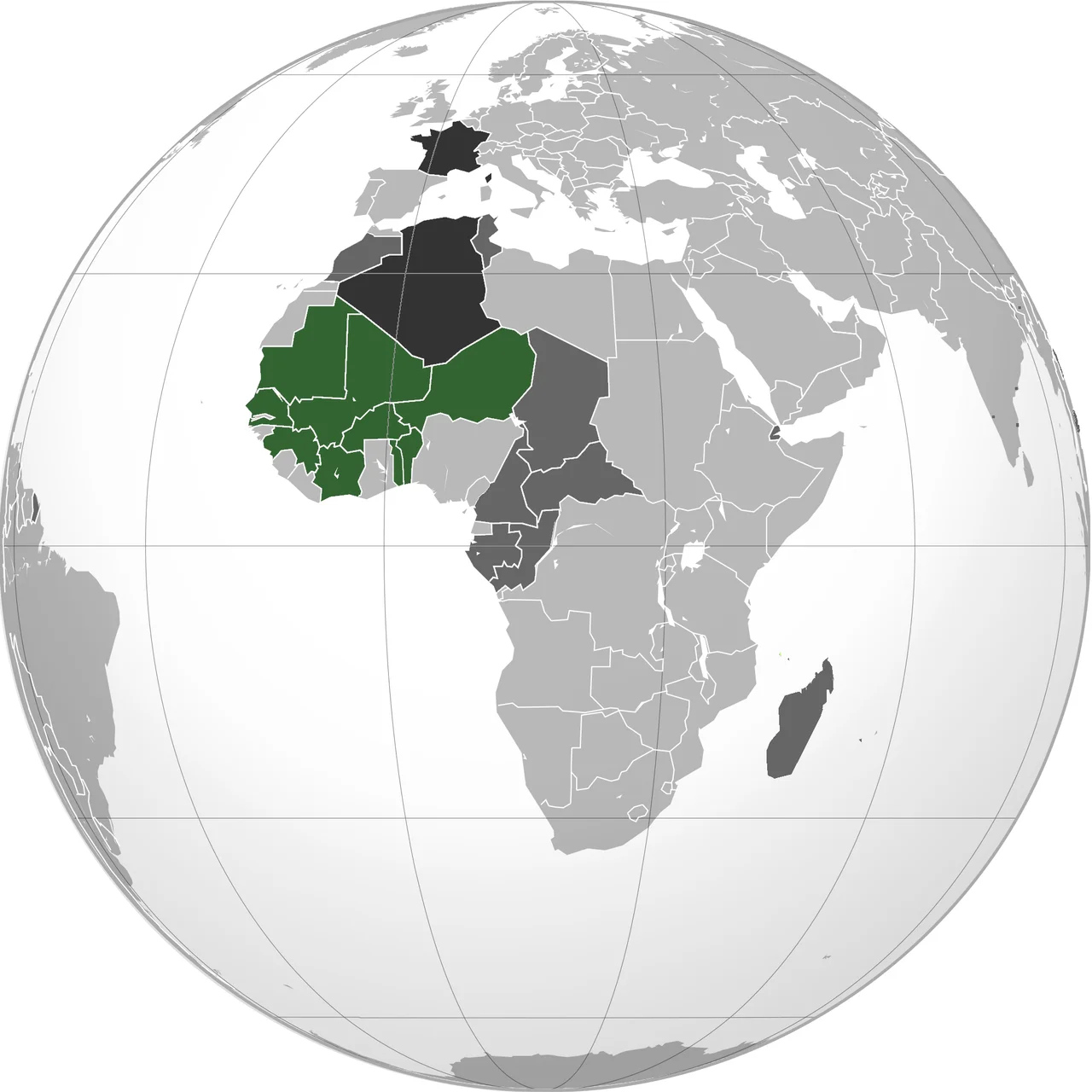

French West Africa
Eight territories, twenty-five million people, and a single point of command in Dakar. French West Africa was an empire-within-an-empire, a federation that stretched from the Atlantic surf of Senegal to the deep Sahara of Niger and covered an area eight times the size of France itself. From 1895 until its collapse in 1960, almost everyone who lived inside its borders was governed not as a citizen but as a subject - and the gap between those two words shaped sixty years of West African history.
An Empire Run From One City
The federation - Afrique Occidentale Francaise, or AOF - bundled eight colonies under one roof: Senegal, Mauritania, French Sudan (now Mali), French Guinea, Ivory Coast, Upper Volta (now Burkina Faso), Dahomey (now Benin), and Niger. On paper, only the Governor-General took orders from Paris; the individual colonies answered to him. He sat first in Saint-Louis, the oldest French foothold on the coast, and from 1902 in Dakar, which grew into the administrative heart of the whole of French West Africa. From that one city, a handful of officials presided over more than ten million people at the federation's birth and some twenty-five million by its end - a population spread across desert, savanna, and tropical forest, speaking dozens of languages, most of whom would never see the men who ruled them.
Subjects, Not Citizens
The deepest fault line ran through a single legal distinction. In four small towns of Senegal - the Four Communes - Africans could be French citizens, with the rights that implied. Everywhere else, the African population was classed as subjects under the Indigenat, a legal code dating to 1885. The Indigenat handed French administrators summary power: the right to arrest, try, punish, and imprison subjects largely at will, and to requisition forced labor - in theory a few weeks a year from able-bodied men, in practice with few real limits. Railways and roads across the federation were built by people compelled to build them; a 1904 photograph from the Guinea line shows African laborers at work under that system. For most of those twenty-five million people, French rule was not an abstraction. It was the local commander's authority over nearly every part of their lives.
The Cercle Commander
Power on the ground ran through the cercle - the basic unit of French administration, each headed by a single European officer. French Sudan, a colony the size of several European countries, was divided into fewer than a dozen of them. A cercle commander might therefore hold absolute authority over hundreds of thousands of people, isolated by distance from any check on what he did. Beneath him the French installed African chiefs - the chefs de canton and chefs de village - chosen for loyalty rather than any traditional right to rule. Where strong precolonial states resisted, the French broke them into small chiefdoms; where an elite was willing to cooperate, it was kept on under new masters. These appointed chiefs collected the taxes, recruited the forced labor, and enforced what the French called customary law, serving as the visible face of a distant power.
The End of Slavery, the Limits of Freedom
The colonial record holds genuine reform alongside coercion. Under pressure from French abolitionists, the authorities began enforcing anti-slavery laws against indigenous slaveholders between 1903 and 1905, refusing to return people who fled their owners. France officially abolished slavery across most of the federation in 1905, and in the years that followed, more than a million enslaved people walked away from their masters - many traveling great distances to return to the homes their families had been taken from. It was real liberation, and it sat uncomfortably beside a system that still requisitioned forced labor from the newly free. The same administration that ended one form of bondage built railways with another.
A Federation Comes Apart
After the Second World War, change came quickly. In 1945 Africans were elected to help write a new French constitution; in 1946 the Loi Lamine Gueye extended limited citizenship; in 1956 the Loi Cadre finally brought universal suffrage. A new generation of French-educated leaders rose into view - among them Leopold Sedar Senghor of Senegal and Felix Houphouet-Boigny of Ivory Coast, men who would become founding presidents of independent nations. The decisive moment came in 1958, when France offered its colonies a referendum on remaining within a new French Community. Every territory voted yes but one: Guinea chose independence outright. Within two years the rest followed, and the federation that had been run from Dakar for six decades dissolved into the independent states of West Africa - the same eight countries, in new and self-chosen forms, that occupy the map today.
From the Air
This article is anchored at 14.49°N, 5.66°W in central Mali - former French Sudan, near the geographic heart of the old federation. French West Africa itself spanned roughly 4,689,000 sq km, from Africa's westernmost point at Dakar to the deep Sahara of Niger, so there is no single landmark: this is a region, not a site. From altitude over central Mali, the terrain reads as Sahelian savanna threading toward the inland Niger delta. The federation's true capital and nerve center was Dakar in Senegal (airport Dakar Blaise Diagne, GOBD), far to the west on the Atlantic. For the Malian heartland shown here, the nearest major airport is Bamako-Senou International (GABS), to the southwest. Winter Harmattan haze commonly hazes the interior; clearest skies follow the summer rains.
Nearby Stories
- Dia, Mali 38 km away
- Bozo language 44 km away
- Great Mosque of Djenné 86 km away
- Nyamina 125 km away
- Lake Débo 132 km away
- Ghana Empire 206 km away
- Battle of Konna 207 km away
- Koumbi Saleh 225 km away