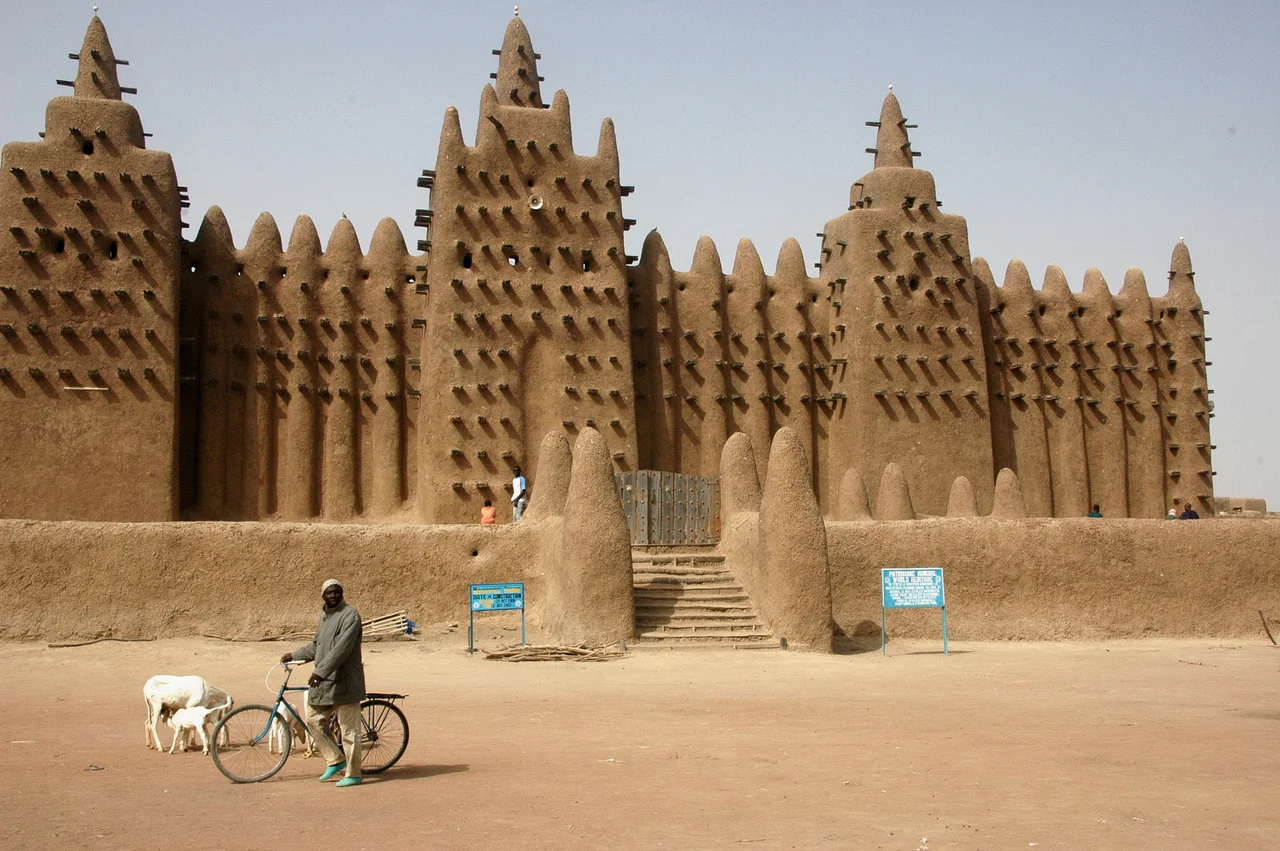

Great Mosque of Djenné
Every spring, before the rains come, thousands of people climb a building made of dirt and rebuild it with their hands. The Great Mosque of Djenné is the largest mud-brick structure in the world, and it is also one of the most fragile - a sculpture of sun-baked earth that would dissolve back into the floodplain within a few seasons if the people of Djenné ever stopped caring for it. They have not stopped in over a century. The plaster smeared across its walls each April is the same color as the riverbank it came from, and the men who climb the wooden scaffolding to apply it are often the grandsons of the men who climbed it before.
A Mountain of Earth
Rise to sixteen meters and you reach the top of the central minaret, where pinnacles crowned with ostrich eggs catch the first light. The whole mosque sits on a raised platform, three meters above the marketplace, a deliberate barrier against the Bani River when it floods. Walk the eastern prayer wall - the qibla, facing Mecca - and you pass three great box-like towers and eighteen buttresses, each tipped with a spire. The walls are sun-dried earthen bricks called ferey, bound with mud mortar and coated in smooth plaster that gives the surface its sculpted, almost molten look. Inside, ninety massive pillars hold up the roof in a dim forest of earth, lit only by small, scattered windows. The floor is sand. There is no stone anywhere in it. The entire building is the river, shaped and dried and standing upright.
The Bristling Walls
The strangest feature of the mosque is the one that makes it work. Bundles of rônier palm wood, called toron, bristle out from the walls in neat horizontal rows, projecting about sixty centimeters into the open air. They look decorative, and they are - but they are also permanent scaffolding. When the time comes to replaster, the toron become the ladder rungs that let workers reach every surface. Ceramic half-pipes jut from the roofline to throw rainwater clear of the walls, because water is the building's only true enemy. When the French journalist Félix Dubois saw the rebuilt mosque in 1910, he was appalled, comparing its cones to a baroque temple and worse. Others insisted the design was, in the words of one scholar, 'basically African.' The architect was no Frenchman: Ismaila Traoré, head of Djenné's guild of masons, renowned across the Sahel.
The Crépissage
Once a year the building becomes a festival. The crépissage is a community replastering, and in Djenné people will tell you it matters more than the great religious holidays. For days beforehand, the plaster cures in pits, where young boys are sent to wade and stomp through the mud, keeping it stirred - work and play at once. Women and girls carry water to the pits and then to the workers. On the morning of the festival, men race to be the first to deliver fresh plaster to the walls, then scramble up the toron to smear it across the mosque's face by hand. The masons' guild directs everything. The eldest members, who have done this many times across their lives, sit in places of honor in the market square and watch the town remake its mosque around them.
Ruin and Return
The current mosque is not the first. A mosque stood here as early as the thirteenth century, but by the time René Caillié reached Djenné in 1828 it had been left to ruin, abandoned to nesting swallows after the Fulani leader Seku Amadu let it decay. The rebuilding came in 1907, completed under Traoré's direction. The earth never stays still. In November 2009, after seventy-five millimeters of rain fell in a single day, the upper section of one of the great qibla towers collapsed and had to be rebuilt with help from the Aga Khan Trust for Culture. The mosque endures not because it is strong but because it is renewed - a structure held in being by the unbroken attention of the people who live beside it. It appears on Mali's coat of arms, the face of a nation built, quite literally, from the ground.
From the Air
The Great Mosque sits at 13.905°N, 4.556°W, on a raised platform above the Djenné marketplace on the Bani River floodplain in central Mali. Best appreciated at low altitude in the dry-season light (November-March), when the earthen walls glow ochre. The nearest airport is Mopti / Ambodédjo (GAMB), roughly 75 km northeast; Bamako-Sénou (GABS) lies far to the southwest. During the July-October flood the town becomes an island, and the mosque's platform reads as a pale rectangle ringed by water.
Nearby Stories
- Dia, Mali 13 km away
- Dogon Country 30 km away
- Hamdullahi 34 km away
- Bandiagara 50 km away
- Tominian 52 km away
- Bozo language 80 km away
- Markala 125 km away
- Ancient Ferrous Metallurgy Sites of Burkina Faso 138 km away