
Frescati House
On 4 November 1983, in the early hours before a Dublin winter dawn, two JCB excavators rolled across a Blackrock car park toward a stuccoed Georgian shell. The wings had already been demolished two years earlier. The remaining seven rooms still stood, still structurally sound, though stripped of their lead and chimneypieces by a decade of deliberate neglect. The first JCB nudged the wall. There was no crash. 'Masonry fell with a rustle and hiss of dust down ivy-clad walls,' wrote a witness later, 'to thud in moss.' Within the hour Frescati House was gone, and with it the last building of significance connected to the 1798 Rising, the bedroom where Lord Edward FitzGerald wrote his last letters, and the gardens where Thomas Paine had walked. By ten o'clock the rubble had been collected by lorries and dumped in Ringsend. Roches Stores got their shopping centre.
The Duchess and Rousseau
Frescati was built in 1739 for the family of John Hely-Hutchinson, Provost of Trinity College. In the 1750s he sold it to the FitzGeralds, Ireland's largest landowners, and the house became their summer retreat -- one of three principal residences, alongside Leinster House in the city and Carton House in Kildare. Emily FitzGerald, Duchess of Leinster, was the woman who shaped it. She fell in love with the place, extended it in the 1760s into a three-winged villa with bay windows over the sea views, gave it its Italian name (a deliberate corruption of Frascati, the hill town near Rome), and made it the laboratory for her unusual ideas about education. Emily was a devotee of Rousseau's Emile, the radical 1762 book that argued children should learn from the real world rather than rote books. She wrote to Rousseau himself, inviting him to Blackrock to tutor her children. He politely declined. She hired a Scottish tutor, William Ogilvie, instead -- and six weeks after the Duke of Leinster died, she scandalised her family by marrying Ogilvie. The children of those two marriages, raised on Rousseau's principles in a seaside villa with its own theatre and book room, would include some of the most consequential figures of the Irish 18th century.
Lord Edward
Edward FitzGerald, Emily's twelfth child, spent most of his childhood at Frescati and returned to it as a married man in 1793 with his wife Pamela, said to have been the illegitimate daughter of the Duke of Orleans. By then Edward was a member of the Irish parliament, an admirer of the French Revolution, and a member of the secret organisation that would become the United Irishmen. He wrote to his mother that spring: 'Wife and I are come to settle here. We came last night, got up to a delightful spring day, and we are now enjoying the little book room, with the windows open, hearing the birds sing, and the place looking beautiful... I am sitting in a bay window with all those pleasant feelings which the fine weather, the pretty place, the singing birds, the pretty wife and Frescati give me.' Thomas Paine, fresh from the second part of The Rights of Man, came to visit. Lord Cloncurry from nearby Maretimo dropped in often. The United Irishmen held planning meetings at Frescati. In 1784 Edward planted bamboo in the garden from shoots he had brought back from St Lucia. Some of those bamboo plants were still alive in November 1983.
1798
On 24 February 1798, the United Irishmen's revolutionary plans were betrayed at a Frescati meeting by Thomas Reynolds, an informer attracted by a £1,000 reward. By March, government agents had penetrated the entire Leinster committee; arrests followed. Lord Edward escaped and went on the run in Dublin. Another informer turned him in on 19 May at a house on Thomas Street. He shot one of his captors during the arrest, took a gunshot wound himself, and was carried to Newgate Prison where the British authorities refused him medical treatment. He died of his untreated wounds on 4 June 1798, aged 35. The rising broke out a few weeks later without him and was crushed by autumn. Pamela was deported. Frescati passed out of the FitzGerald family. The Provost-trained Reverend Craig ran an aggressively anti-Catholic boys' school in the house from 1804. Several of its finest chimneypieces were stripped out and sold; some were later traced to houses on Merrion Square. The house drifted through Victorian owners. The wider Frescati estate was gradually built over with terraced houses, the stable block becoming Stable Lane and then Frescati Park.
The Long Defeat
In 1970 a company called Frescati Estates Limited -- controlled by the directors of Roches Stores, then one of Ireland's largest department-store chains -- bought what remained of Frescati and applied for planning permission to demolish it. Conservationists organised quickly. The Frescati Preservation Society, chaired by the architect Desmond FitzGerald (no relation), included An Taisce, Bord Failte, the National Monuments Advisory Council, the Old Dublin Society, the Arts Council, and the Irish Georgian Society. Multiple developers offered to buy the house and restore it as part of a viable shopping development; all offers were refused. The campaign secretary, Marie Avis Walker, exploited a then-existing legal loophole to win planning permission for a shopping centre that would have preserved the house intact -- a quirk later closed by Irish parliament, but at the time it definitively proved that Roches Stores could have kept the building if it had wanted to. It did not want to. Lead was stolen from the roof; ceilings collapsed; chimneypieces vanished. In 1981, An Bord Pleanala finally permitted the demolition of the wings, on condition that the central block be restored. The wings (70 per cent of the house) came down. The restoration was ignored. In 1982, Mr Justice O'Hanlon in the High Court ruled that the situation had passed the point of no return -- explicitly noting that the developers had been 'completely indifferent to, or perhaps have even welcomed, this deterioration'. By November 1983, two JCBs finished the job.
The Boulder and the Bill
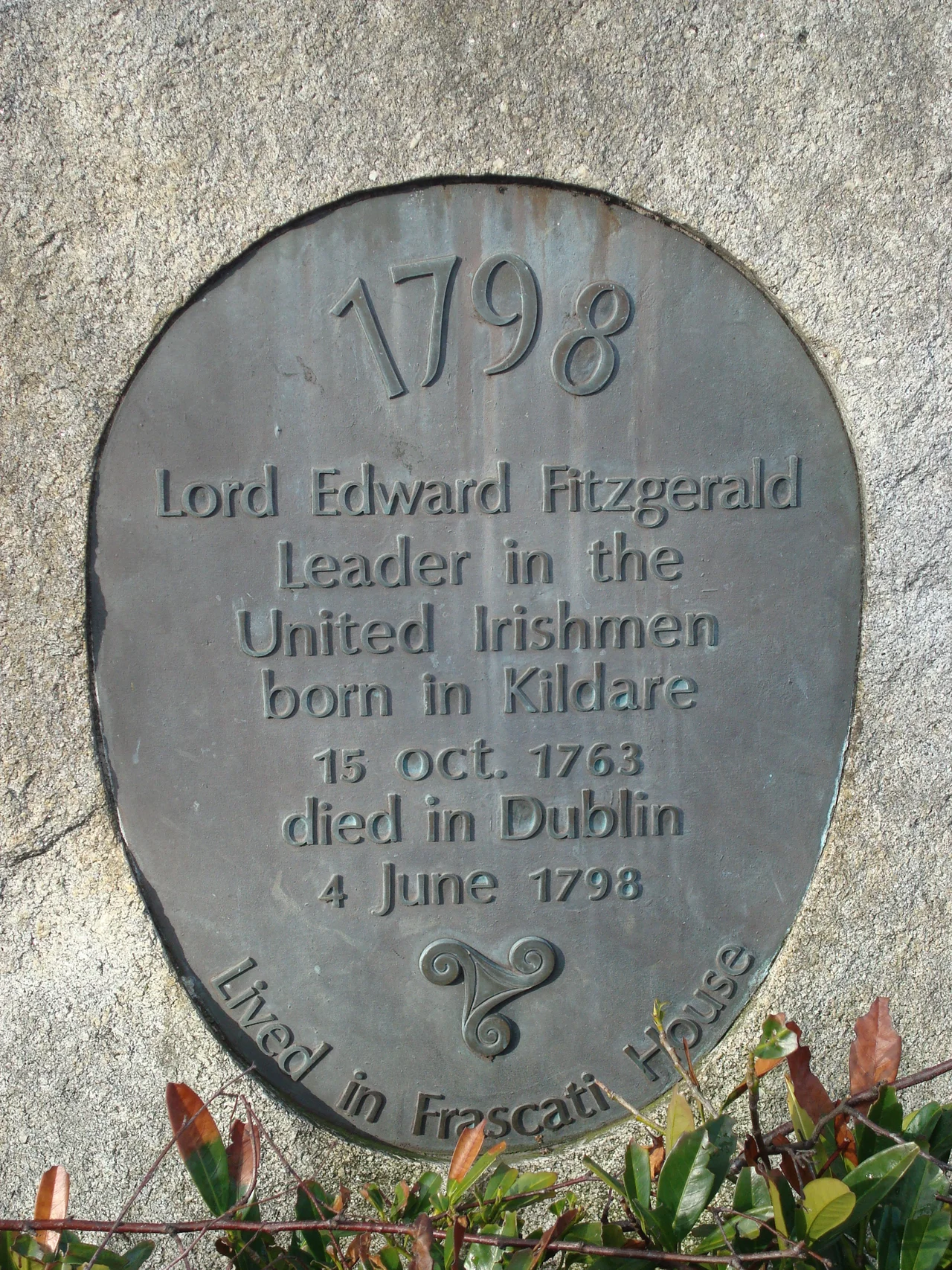
Roches Stores placed a granite boulder beside the new shopping centre entrance with a bronze plaque commemorating Lord Edward FitzGerald. The plaque contains factual inaccuracies and misspells the house name as 'Frascati'. Hedges have grown up in front of the boulder over the decades, making it nearly invisible from the footpath. Roches Stores itself ceased to exist in the 2000s. The Frascati Shopping Centre still stands. The Priory Stream that once flowed through Frescati's gardens now runs in a culvert beneath the car park. The original underground tunnel Emily built to carry seawater to her garden pool still exists somewhere beneath the site; its location is kept secret and the entrance has been blocked off. Frescati's demolition produced one lasting outcome: shame. Hundreds of historic buildings across Dublin were immediately listed for protection, and the Architectural Heritage Act of 1998 directly cited the Frescati case in establishing prison sentences and million-pound fines for owners who let listed buildings decay. The first significant prosecution under the new law forced developers to rebuild Archer's Garage, a Dublin city-centre listed building they had illegally demolished. Ireland learned. The lesson was named Frescati.
From the Air
The site of Frescati House lies at 53.301N, 6.182W in Blackrock, southeast Dublin, now occupied by the Frascati Shopping Centre on the main Blackrock Road. From altitude the site shows as a low rectangular shopping complex with car park, indistinguishable from any 1980s retail block; the historic significance is invisible from the air. The coastline of Dublin Bay lies a few hundred metres east. The Blackrock DART station is immediately south. Nearest airport: Dublin (EIDW), 14 km north-west. Look for the long curve of Dublin Bay to identify the area; the Frescati site sits on the inland side of the bay's southern arc.
Nearby Stories
- Wicklow Mountains 12 km away
- Mornington 14 km away
- German submarine U-1051 16 km away
- Abbey of Kells 18 km away
- Irish Military Intelligence Service 20 km away
- HMS Manners (K568) 37 km away
- Templemore 42 km away
- Irish Sea Bridge 43 km away