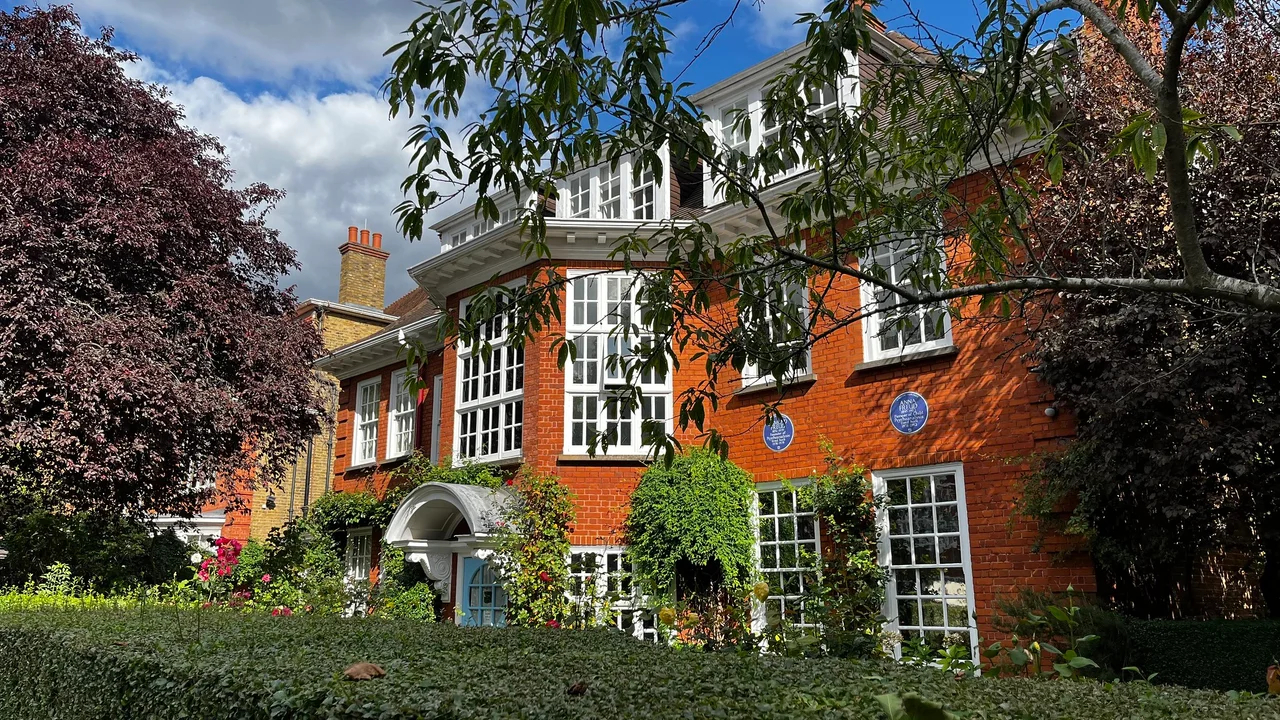

Freud Museum
Sigmund Freud was 82 years old when he arrived in London. He had fled Vienna in 1938 after the Nazi annexation of Austria, travelling first to Paris before settling at 20 Maresfield Gardens in Hampstead. He had perhaps a year to live. In that year, he completed his final book, received patients on the same couch he had brought from his Vienna practice at Berggasse 19, and sat in his study surrounded by the Egyptian, Greek, Roman, and Oriental antiquities he had collected over a lifetime. When he died in September 1939, his daughter Anna kept the house — and everything in it — exactly as he had left it.
The Last Address
The house at 20 Maresfield Gardens had only been completed in 1920, built in the British Queen Anne Revival style. A small sunroom in a more modern style was added at the rear by Freud's architect son, Ernst Ludwig Freud, in 1938 to accommodate the family's arrival. Freud was already in poor health from the jaw cancer that had afflicted him for years, and he died the following year, but the house continued as the family home. Anna Freud, who became a pioneering child psychologist in her own right, lived there until her death in 1982. It was her wish that the house become a museum, and it opened to the public in July 1986.
The Couch
The centrepiece of the museum is the psychoanalytic couch, draped in a Persian rug and cushions, on which Freud's patients reclined while he sat behind them, out of sight. The technique was deliberate: patients unable to see the analyst's face would project onto him more freely, generating the kind of material — dreams, free associations, slips of tongue — that Freud had built his career on. The couch was given to him by a patient, Madame Benvenisti, in 1890. It was restored in 2013 at a cost of £5,000. The couch made the journey from Vienna to London with the rest of the family's furniture and household effects: Biedermeier chests and tables, 18th and 19th century Austrian painted furniture, a portrait of Freud by Salvador Dalí.
The Study as He Left It
Anna Freud preserved her father's study with careful precision after his death, and the museum has maintained it since. The desk sits beneath pictures Freud arranged himself, including reproductions of Oedipus and the Riddle of the Sphinx and The Lesson of Dr Charcot. The bookshelf behind the desk holds his favourite authors — Goethe and Shakespeare but also Heine, Multatuli, and Anatole France — because Freud believed poets and philosophers had reached insights about the unconscious that psychoanalysis was still trying to articulate systematically. The library also contains photographs of the women who shaped his intellectual world: his wife Martha, Lou Andreas-Salomé, Yvette Guilbert, and Marie Bonaparte. Around the room, on every surface, stand the antiquities: over two thousand objects, representing civilizations Freud studied as obsessively as he studied the human mind.
A Place of Refuge and Reckoning
What the Freud Museum offers is not simply a view of one man's possessions, but a confrontation with historical weight. Freud's flight from Vienna was the flight of a Jewish intellectual from a civilisation collapsing into barbarism. He had dismissed early warnings, believing that his fame and Vienna's cosmopolitan culture would protect him. The Nazis had other ideas: they burned his books, interrogated his family, and ransacked his apartment. He left with his family, his life's work, and as much of his collection as could be transported. The London house became both a refuge and, in the months before his death, a place of extraordinary productivity — he completed Moses and Monotheism there, his last great work. The museum carries all of this in its quiet, sunlit rooms.
From the Air
The Freud Museum is at 20 Maresfield Gardens, Hampstead, at approximately 51.548°N, 0.178°W. It sits in a residential area of Hampstead, about half a mile southeast of Hampstead Heath. The rooftop of Royal Free Hospital on Pond Street provides a visual reference point from the air. Nearest airports: London City (EGLC, approximately 11nm east-southeast). At 2,000 feet AGL, the wooded expanse of Hampstead Heath is visible to the north, with the dense residential streets of Hampstead below.
Nearby Stories
- Stevenage 5.7 km away
- Malling Abbey 5.7 km away
- 1952 Farnborough Airshow Crash 7.7 km away
- Ingatestone Hall 8.2 km away
- Hellfire Caves 9.1 km away
- The Carrington Event: The Solar Storm That Could Happen Again 9.8 km away
- Bletchley Park 16 km away
- Castle Hedingham 23 km away