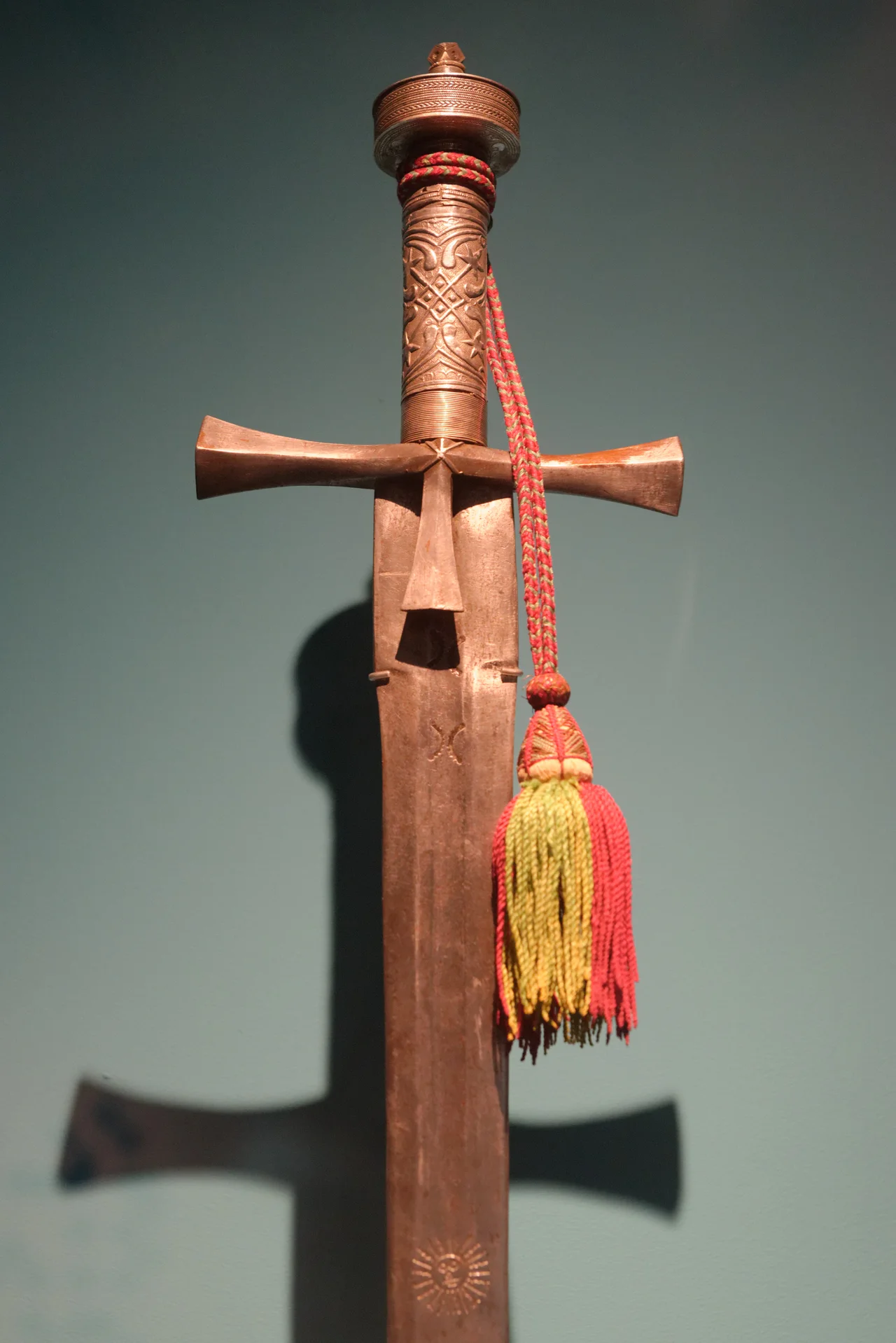

Funj Sultanate
A sultan of Sennar kept six hundred noble wives. A senior nobleman kept two hundred. A lesser lord kept thirty. These were not trophies. Under the Funj political system that governed the land between the Blue and White Niles from 1504 to 1821, a man's rank depended on which princess he had married, and every woman a nobleman received from his superior bound him in political debt. Power moved through marriage, and through the maternal uncle, and through a court ritual in which, when a sultan was deposed, his own mother's brother was the man charged with killing him. Scholars have called the Funj an African empire with a Muslim facade, and the phrase is almost right. The facade was real but the interior was its own architecture.
How a Kingdom Begins
There are two stories of the founding, and neither is fully reliable. The Funj Chronicle, compiled in the nineteenth century long after the fact, says that in 1504 the Funj chief Amara Dunqas allied with Abdallah Jammah of the Abdallabi to conquer Soba, capital of the older Christian kingdom of Alodia. Modern scholars think the Abdallabi had already taken Soba on their own and the chronicle combined two events into one. What is certain is that a new sultanate emerged from the ruins of Alodia with its capital eventually at Sennar, on the Blue Nile, and a territory that would come to stretch across modern Sudan, northwestern Eritrea, and western Ethiopia. Who exactly the Funj were is still argued. Nubians, Shilluk, a social class rather than an ethnic group, Bornu refugees, Eritrean migrants, northern Ethiopians: the candidates are many and the evidence thin. Sudanese tradition claims descent from the Umayyads, the first Islamic dynasty, which is probably genealogy retrofitted to respectability.
The Ottoman Line
In 1555 the Ottoman Empire, then pushing into the Horn of Africa, appointed Ozdemir Pasha as governor of a Habesh Eyalet that did not yet exist. His attempt to march up the Nile to conquer the Funj ended when his troops mutinied near the First Cataract. By 1570 the Ottomans had set up in Qasr Ibrim to block any Funj push into Upper Egypt. Fourteen years after that they had reached the Third Cataract and tried to take Dongola. The Funj crushed them at the Battle of Hannik in 1585, and the battlefield just south of the Third Cataract became the northern border. In the late sixteenth century the Funj pushed east into Eritrea, and the Ottomans gave up expansion altogether. The border held for three centuries.
The Court and Its Rules
The royal family traced their lineage to a legendary ancestress, and the court's succession practices kept that maternal thread taut. The sultan's successor was chosen by the royal court from among sons of previous rulers and Funj noblewomen, not simply from the sitting sultan's eldest male heir. Sumptuary laws were strict. A social distance between noblemen and commoners was mandated by custom and enforced severely: breaches were punishable by enslavement, the same institution the Funj monopolized for their external trade. The sultanate tried hardest to control slavery as an export, running annual caravans of up to one thousand enslaved people to Egypt. That monopoly worked best in the seventeenth century and only partially in the eighteenth. The human cost of this trade was enormous, and the state's political stability rested on a practice that tore families out of the south and the west in numbers that are still being counted.
A Line of Meks
The rulers of Sennar used the title Mek, which is the Sudanese Arabic rendering of the older title for king. The list runs from Amara Dunqas (reigned 1503-1533) through twenty-eight successors to Badi VII (reigned 1805-1821). In between, three kings stand out: Badi II (1644-1681), Unsa II (1681-1692), and the long reign of Badi IV (1724-1762), the era historians mark as the sultanate's peak power. The seventeenth century was when the state functioned best. By the late eighteenth century the regents of the Hamaj tribe had effectively taken control from the sultans, ruling in the name of ceremonial kings. That internal weakness was fatal. When Muhammad Ali of Egypt sent his son Ismail up the Nile in 1820, the invasion met little resistance. In 1821 Badi VII surrendered without fighting. The Turco-Egyptian conquest absorbed what the Funj had built.
What Remained
The sultanate left a lingering inheritance. Sufi Islamic orders, the holy men whose mosques and tombs now dot Sudan, traced their arrival and establishment to the Funj centuries. The market town of Sennar is still there. The Funj Chronicle survives as a document of nineteenth-century Sudan's understanding of its own past. And the political geography the Funj stabilized, the long corridor between the Blue and White Niles that now contains Khartoum, Omdurman, Wad Madani, and Sennar, is still Sudan's demographic and economic center three centuries after the last Mek laid down his sword. For a polity often dismissed as a facade, that is a substantial afterlife.
From the Air
The former Funj heartland is centered on Sennar at roughly 13.55 degrees north, 33.62 degrees east, on the Blue Nile about 260 km south of Khartoum. Khartoum (HSSK), at 15.66 north, 32.35 east, marks the northern end of the sultanate's core territory near the Nile confluence. From altitude the Blue Nile is visible as a dark line running north from the Ethiopian highlands. The Sennar Dam, completed in 1925 after the sultanate was long gone, is a landmark for locating historical Sennar.
Nearby Stories
- Kalakla 3.6 km away
- Esh Shaheinab 7.7 km away
- Naqa 39 km away
- Musawwarat es-Sufra 82 km away
- Gezira State 118 km away
- Northern Sudan 196 km away