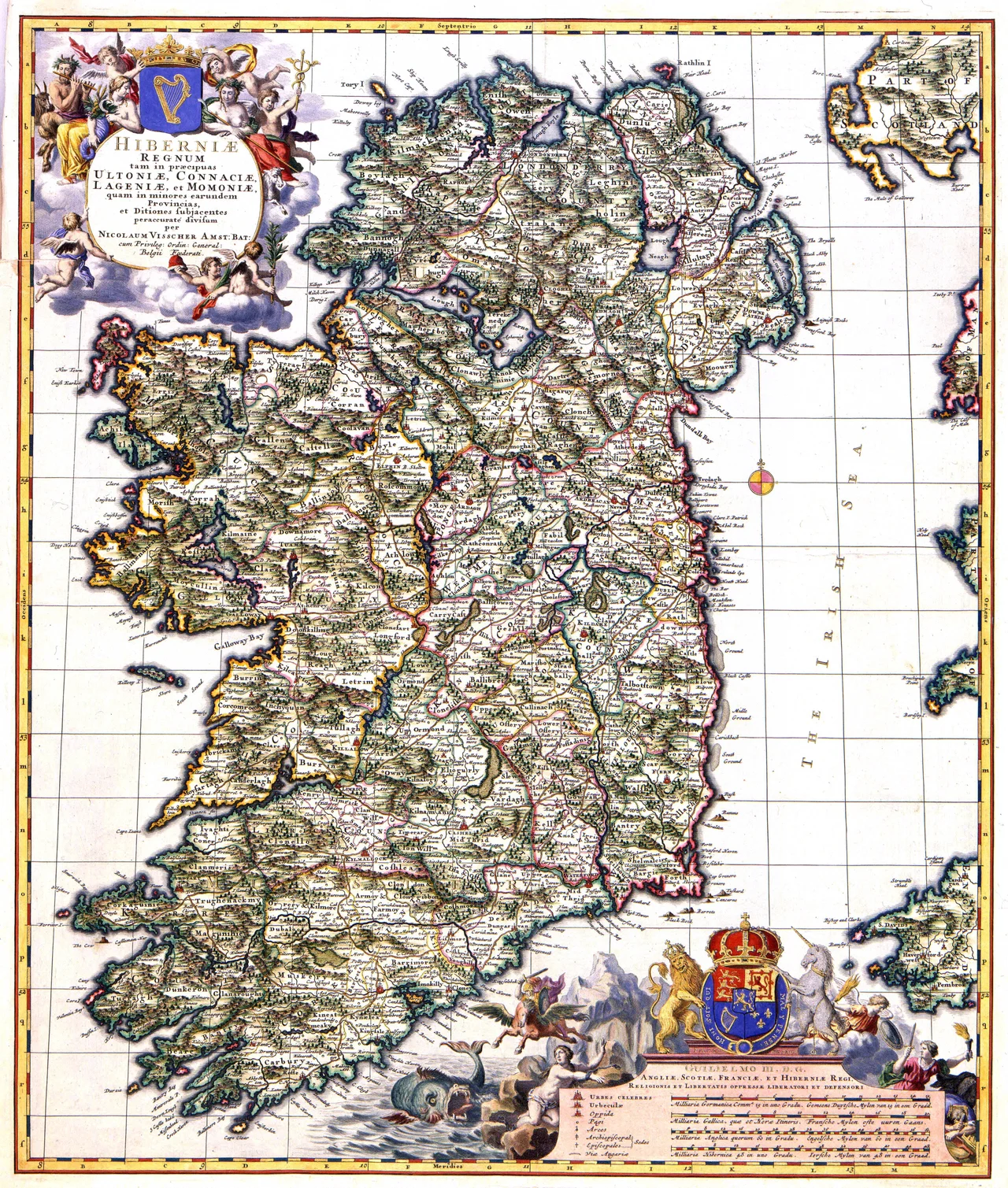

Gaelic Ireland
The Romans called them Scoti. The name first meant any Gaelic-speaking people in either Ireland or Britain, but eventually settled on the Irish alone -- before being lifted from them to label the country we now call Scotland, where their colonists had settled. The Gaels never built a single unified kingdom. For most of fifteen centuries they lived in a shifting patchwork of perhaps 150 small kingdoms, called tuatha, layered into five great over-kingdoms (Ulster, Connacht, Leinster, Munster, and the now-vanished fifth province of Mide). High Kings claimed the whole island intermittently from the Hill of Tara. None of them ruled it outright. The order survived everything the Romans, the Vikings, and the Normans could throw at it. Then, in the early 17th century, after the Battle of Kinsale and the Flight of the Earls, the English finally finished what they had been attempting for four centuries. Gaelic Ireland ended on a September day in 1607 when the last great Gaelic lords sailed from Lough Swilly into exile.
The Fine and the Tuath
The Gaelic social order rested on two interlocking units. The fine was an extended kin-group descended through male lines from a common ancestor, with the close family -- the derbfine, those descended from a common great-grandfather -- forming the core. The tuath was the territorial unit, perhaps 700 to 3,000 people, ruled by a king (ri tuaithe) who was elected from within the ruling fine according to a system called tanistry. When a king took office, his successor (tanaiste, anglicised to 'tanist') was chosen in his lifetime from among eligible relatives. The system was extraordinarily fluid: ambitious cousins competed in war and law for the right to inherit; dynasties rose and fell. Brehon Law, the elaborate legal code maintained by a hereditary class of jurists called brithem, governed it all. Brehon Law allowed women significant rights of inheritance and divorce that would not return to Ireland until the late 20th century. It survived in fragments under English rule for centuries; its full corpus, the Senchas Mar, was set down by monks in the 7th and 8th centuries and runs to thousands of pages.
The Filid and the Monks
Pre-Christian Gaelic Ireland had a literate caste called the filid -- poet-historians who learned by oral repetition, took up to twelve years to qualify, and could destroy a king's reputation with a satire so devastating it was believed to raise physical blisters. Below them were the bards (lower poets), and below them the storytellers, the seanchaidhthe. When Christianity arrived in the 5th century -- traditionally with Palladius in 431 and then Patrick, though both figures are partly legendary -- the filid kept their privileges. The monks who arrived in their wake established a literary tradition that would astonish Europe. The Book of Kells, made around AD 800 in either Iona or Kells, is the most spectacular illuminated manuscript surviving from the early medieval West. Saint Columba carried Gaelic Christianity to Iona in 563; Columbanus took it to the Frankish kingdoms in 590; in the 7th and 8th centuries, when most of Europe had forgotten how to read Greek, Irish monks were teaching it. The historian Thomas Cahill's bestseller How the Irish Saved Civilisation overstates the case, but only slightly.
Brian Boru
By the 9th century, Viking longships were burning Irish monasteries up and down the coast. Within a generation, the Vikings had become permanent: Dublin was founded by them in 841, with Wexford, Waterford, Cork and Limerick following. These were Ireland's first towns. The Irish absorbed them as the Norse-Gaels (Gall-Goidil). The most famous figure of the period was Brian Boru, born around 941 in Munster, who fought his way upward through Viking and Irish enemies alike, was acknowledged as High King by Mael Sechnaill in 1002, and styled himself Imperator Scottorum -- Emperor of the Gaels. On Good Friday 1014, at the Battle of Clontarf just north of Dublin, Brian's forces defeated a coalition of Vikings and rebellious Leinster Irish. Brian himself was killed in his tent at age 73. The battle is often portrayed as the day the Irish drove the Vikings out, but the truth is messier: the Vikings stayed, integrated, and continued to dominate Dublin's trade. What Brian's death really ended was the chance of a unified Gaelic monarchy. The High Kingship fragmented again. A century later, the Normans were able to walk in.
Norman Ireland and the Pale
In 1166, the deposed King of Leinster, Diarmait Mac Murchada, fled to England and persuaded Henry II to send troops to help him reclaim his throne. The Norman expeditionary force that landed in 1169 -- led by Richard de Clare, 2nd Earl of Pembroke, known as Strongbow -- changed Ireland forever. Strongbow married Diarmait's daughter Aoife, took the kingship of Leinster, and Henry II had to come over personally in 1171 to make sure his vassal did not establish an independent Norman-Irish state. The Lordship of Ireland was created. Yet the Norman conquest stalled. Outside a fortified zone around Dublin and the south-east -- the area that became known as 'the Pale' -- Gaelic chieftains continued to rule by Brehon law, speak Irish, and ignore the English crown. Many of the Norman lords themselves, marrying Irish women and learning the language, became (in the famous phrase of an English official) 'more Irish than the Irish themselves'. The Statutes of Kilkenny in 1366 tried desperately to legislate against this Gaelicisation, banning intermarriage and forbidding the English colonists to speak Irish. They failed. For three more centuries, the Gaelic order endured.
The Flight of the Earls
The end came in stages. Henry VIII declared himself King of Ireland (not just Lord) in 1542 and began enforcing English law and Protestant religion on a Catholic Gaelic-speaking population. The Elizabethan conquest of Munster in the 1580s broke the old Desmond Geraldines; the Nine Years' War in Ulster ended at the Battle of Kinsale on Christmas Eve 1601, where Hugh O'Neill and Hugh O'Donnell's combined Gaelic forces, joined by a Spanish expedition, were crushed by an English army under Lord Mountjoy. On 14 September 1607, O'Neill, O'Donnell's brother Rory, and ninety leading members of the Gaelic Ulster nobility boarded a French ship at Rathmullan on Lough Swilly and sailed away. They went to Rome and never returned. With their departure, the Gaelic political order ended. The land was confiscated and given to Protestant settlers from Scotland and England -- the Plantation of Ulster, whose consequences are still being negotiated four centuries later. The Irish language, Brehon law, the bardic schools, the tuatha -- all began their long retreat. They did not disappear. The Irish language still survives in the Gaeltacht regions of the west. Gaelic football and hurling are still played on Sunday afternoons. The names on the map -- Loch Garman, Corcaigh, Doire, Dun Laoghaire -- are still Gaelic words. But the order that produced them ended one autumn afternoon on a small Donegal pier.
From the Air
Gaelic Ireland is not a single location -- it is a 1,500-year civilisation that covered the whole island. The geographic centre point used for this article (53.333N, 6.250W) lies in Dublin, near the political seat of modern Ireland, but the heartlands of Gaelic kingship were elsewhere: the Hill of Tara in County Meath (53.580N, 6.612W) for the High Kingship; Cashel of the Kings in Tipperary (52.520N, 7.890W) for Munster; Rathcroghan in Roscommon (53.802N, 8.301W) for Connacht; and Emain Macha (Navan Fort) near Armagh (54.346N, 6.700W) for ancient Ulster. From altitude, the Irish landscape is still full of the ringforts, raths, crannogs and standing stones that mark the physical remains of Gaelic settlement. Nearest major airport for Dublin/Tara: EIDW. For Cashel: Shannon (EINN). For Armagh: Belfast International (EGAA).
Nearby Stories
- Wicklow Mountains 12 km away
- Mornington 14 km away
- German submarine U-1051 16 km away
- Abbey of Kells 18 km away
- Irish Military Intelligence Service 20 km away
- HMS Manners (K568) 37 km away
- Templemore 42 km away
- Irish Sea Bridge 43 km away