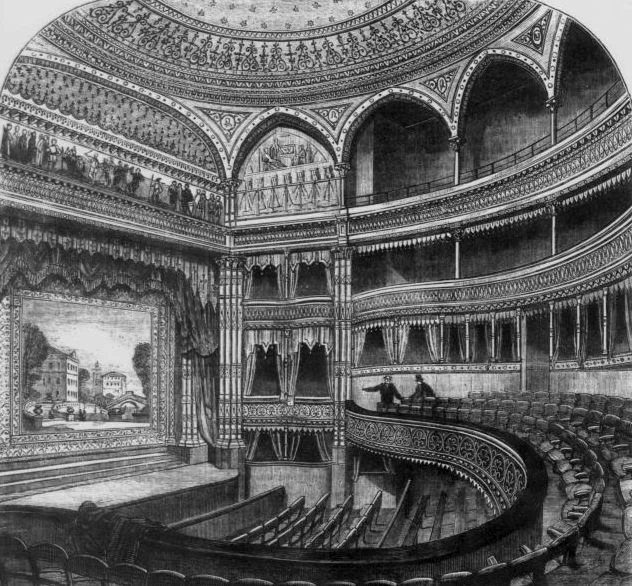

Gaiety Theatre, London
Wealthy gentlemen called them Stage Door Johnnies. They waited outside the Gaiety Theatre on the Strand night after night, hoping to escort one of the dancers to dinner at Romano's restaurant, where George Edwardes had negotiated a half-price arrangement for his girls. Some of those dinners led to marriages. Some of those marriages led to the peerage. By the 1890s, the route from a Gaiety stage to a coronet was almost a recognised career path, and the corner of Aldwych and the Strand had become the most famous stage door in the English-speaking world. Today, the One Aldwych hotel and the ME London Hotel sit where the theatre once stood. Almost nothing remains of the building itself. What remains is the shape of every musical comedy that came after it.
From Music Hall to Burlesque
The building started as the Strand Musick Hall, opened in 1864 by Bassett and Keeling on the former site of the Lyceum Theatre. It was financed by a joint-stock company, designed by the prolific theatre architect C. J. Phipps, and built with more than 2,000 seats. The proprietors did something unusual for a Victorian music hall: they banned smoking and drinking in the auditorium itself, confining those vices to adjoining saloons. A restaurant operated inside the building so patrons could eat in their evening clothes and walk straight to their seats without weathering the London drizzle. In 1868 the venue reopened as the Gaiety Theatre with W. S. Gilbert's burlesque Robert the Devil. Under John Hollingshead's management, it became the home of musical burlesque, variety, continental operetta, and four-hour evenings that mixed comedy, ballet, and Harlequinade. Hollingshead called himself "a licensed dealer in legs, short skirts, French adaptations, Shakespeare, taste and musical glasses."
Nellie Farren and Electric Light
Nellie Farren became the theatre's star "principal boy," the cross-dressed lead of burlesques in which women played men, swaggering, winking, holding the audience for over two decades. She and the comic Fred Leslie defined the house. Her husband Robert Soutar wrote and stage-managed. In the late 1870s, the Gaiety became the first theatre in London to install electric lighting on its frontstage, a hard-edged innovation that made the painted scenery look completely new. On 15 December 1880, the Gaiety presented Quicksands, the first major English-language adaptation of Henrik Ibsen, drawn from The Pillars of Society. Burlesque drew crowds, but Hollingshead also slid in works that would, decades later, reshape European theatre. His last production, Little Jack Sheppard in 1885 and 1886, was co-produced with the man who would change everything: George Edwardes.
The Birth of Musical Comedy
Edwardes had a different idea about what theatre could be. After his first hit, the comic opera Dorothy, he tried burlesque for half a decade. By the early 1890s he was ready to invent something new. He hired the young writer Adrian Ross for Joan of Arc (1891), then put him on a lighter project, In Town (1892), with stylish costumes, witty banter, and only enough plot to hang the songs on. He paired composer Ivan Caryll with Owen Hall, Harry Greenbank, Ross, and Lionel Monckton. The first true Edwardian musical comedy, A Gaiety Girl, opened in 1893, and Edwardes never looked back. The Shop Girl (1894), My Girl (1896), The Circus Girl (1896), and A Runaway Girl (1898) each ran for hundreds of performances. The Gaiety Girls themselves became famous: not the corseted veterans of the burlesque, but well-spoken young women in fashionable dresses, presented as ideal English femininity. Some became leading actresses. A few married into the aristocracy.
The New Gaiety on Aldwych
In 1903, the old Strand building was demolished as part of the road widening that created Aldwych and Kingsway. Edwardes built the New Gaiety Theatre at the corner of Aldwych and the Strand, and it opened with The Orchid. Another decade of long-running hits followed: The Spring Chicken (1905), The Girls of Gottenberg (1907), Our Miss Gibbs (1909), Peggy (1911), The Sunshine Girl (1912). To balance the "girl" musicals, Edwardes produced "boy" musicals like The Messenger Boy (1900), The Toreador (1901, which introduced Gertie Millar), and Havana (1908). When Edwardes died in 1915, the former tenor Robert Evett took over and kept the run going with Theodore & Co (1916) and Going Up (1918). Manuel Klein led the music. The audiences kept coming. But by the mid-1920s, the world that had built the Gaiety, the Edwardian world of stage doors, hampers, and Stage Door Johnnies, was already a memory.
Empty Walls
In 1939, needing refurbishment, the theatre closed. The Second World War began before any work could begin. The building stood empty through the Blitz, suffering damage from air raids. In 1946, Lupino Lane bought the shell for £200,000, hoping to rebuild and reopen the Gaiety as a centre of musical comedy. The structural problems were worse than expected, and the project stalled. The building was sold again, then demolished in 1956, replaced by an office block. In 2006, the site was purchased for a new luxury hotel, the Silken, designed by Foster & Partners. One wall of the old restaurant, which had been individually listed, was preserved within the new structure. The developers went bankrupt in 2008. The building eventually opened as the ME London Hotel in 2012, with private apartments above. The site that once defined a London evening now hosts conferences and cocktails. The Gaiety Girls live on only in photographs at the National Portrait Gallery, smiling out from their lost city.
From the Air
The former Gaiety Theatre site sits at 51.5119°N, 0.1186°W at the corner of Aldwych and the Strand. Best viewed from 1,500-2,500 feet AGL. Nearby airports include London City (EGLC) 6 nm east, London Heathrow (EGLL) 14 nm west, and London Biggin Hill (EGKB) 12 nm southeast. Look for the curve of Aldwych around Bush House; Somerset House lies one block south on the Thames, and the Royal Courts of Justice are visible to the east.
Nearby Stories
- Stevenage 5.7 km away
- Malling Abbey 5.7 km away
- 1952 Farnborough Airshow Crash 7.7 km away
- Ingatestone Hall 8.2 km away
- Hellfire Caves 9.1 km away
- The Carrington Event: The Solar Storm That Could Happen Again 9.8 km away
- Bletchley Park 16 km away
- Castle Hedingham 23 km away