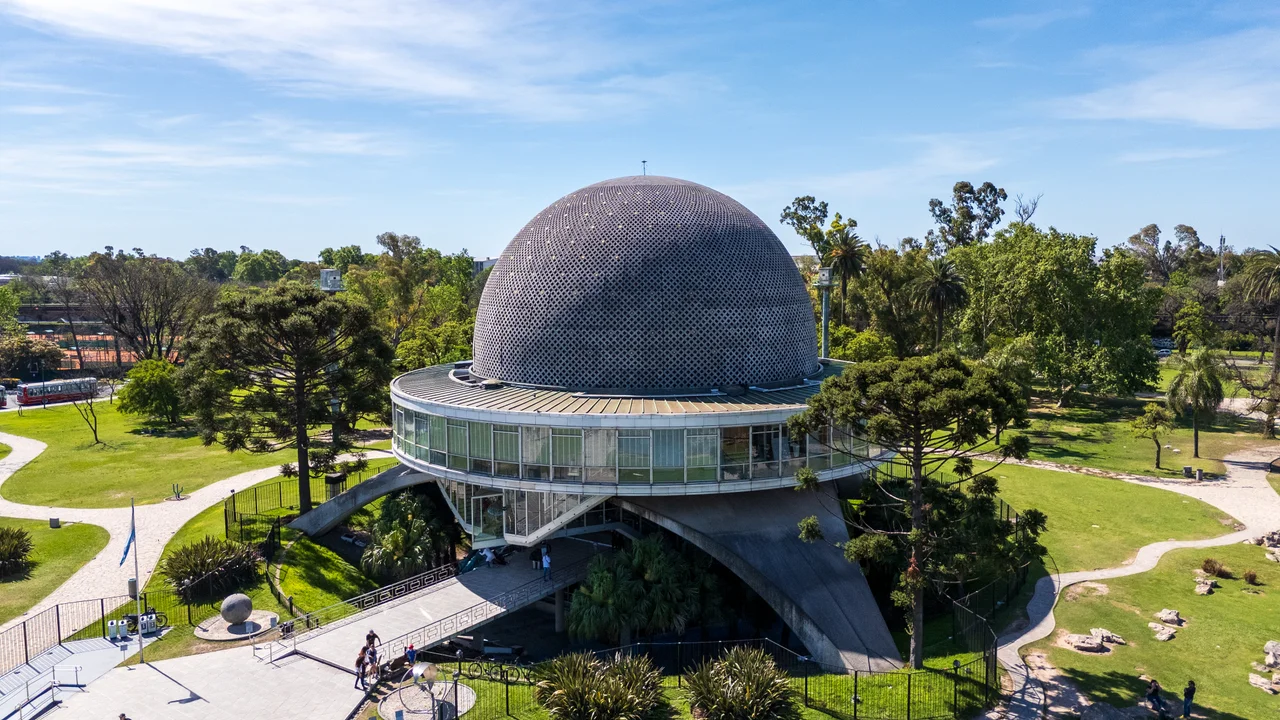

Galileo Galilei Planetarium
From across the lake in Parque Tres de Febrero, it looks for all the world like a flying saucer that touched down on the grass and decided to stay. The Galileo Galilei Planetarium is a great concrete dome balanced on three angled legs, a piece of 1960s futurism that the people of Buenos Aires simply call the Planetario. The resemblance to a spacecraft is no accident, and the story behind it is stranger than the building looks. When the science fiction writer Ray Bradbury visited in 1997, he came to a place that may, if a beloved local legend is true, have one of his own books hidden inside its structure. Beneath the dome, on a given night, the southern sky wheels overhead in artificial darkness, and a small grey stone in the museum has actually been to the Moon.
A Saucer Comes to Palermo
The idea was born in 1958, from an agreement between the Socialist councilman Jose Luis Pena and the city's Secretary of Culture, Dr. Aldo Cocca. Construction began in 1962 under the architect Enrique Jan, and the building was inaugurated on 20 December 1966. The very first show ran on 13 June 1967 for schoolchildren, when a geography and mathematics teacher named Antonio Cornejo guided them across the sky above Buenos Aires, the Argentine Antarctic, and the South Pole, and showed them how to find the Southern Cross. The doors opened to the general public on 5 April 1968. The site had a quieter history before the saucer landed: it was the ground from which the Buenos Aires Football Club and the Buenos Aires Cricket Club had been evicted in the late 1940s, the English-speaking sportsmen of an older city making way for the space age.
The Book in the Legs
Here the building's true legend lives. The architect, Enrique Jan, owned a first edition of Ray Bradbury's 1950 story collection The Martian Chronicles, and Bradbury himself liked to claim that every first edition of that book carried special protective powers. According to the tale told in Buenos Aires, Jan cut the book into three pieces and sealed one inside each of the dome's three supporting legs, a talisman buried in the concrete to keep his spaceship safe. Some say he hid the whole volume instead, tucked into the meter of space between the building's outer and inner domes. When Bradbury came to lecture at the planetarium in 1997, he was, in a sense, visiting his own buried words. Whether the story is literally true hardly matters in a building shaped like a UFO; it is exactly the kind of legend such a place deserves.
Under the Dome
Inside, the building is all about the sky. It has five floors and six staircases, and at its heart a circular room twenty meters across, seating 360 people beneath a hemispherical dome lined with reflective aluminum. For decades the show was produced by an extraordinary machine at the room's center: a star projector that once carried more than a hundred separate projectors, stood five meters tall, and weighed two and a half tons, with independent lenses for the Moon, the Sun, and the five visible planets, and twin spheres at its ends that threw 8,900 stars, constellations, and nebulae onto the dome. That mechanical giant has since been retired in favor of six modern Barco digital projectors, but the effect endures. Lie back, the lights fade, and the southern hemisphere's stars come out indoors, sharp and slow-turning in a way the city's glare never allows.
Pieces of the Sky on the Ground
The planetarium does not only project the heavens; it keeps fragments of them. Its prize is a piece of lunar rock brought back to Earth by the Apollo 11 mission and given to the planetarium by President Richard Nixon, a small grey relic of the first human steps on another world. Nearby sits a collection of marine and ammonite fossils a hundred million years old, gathered from Neuquen Province in Patagonia, the remains of creatures that swam when dinosaurs walked. And on the entrance terrace, out in the open air, rests a metallic meteorite from Chaco Province in the country's north, a chunk of iron that fell from the sky in prehistory. Moon rock, ancient sea, and fallen star, all within a few steps of a building that looks ready to fly off and fetch more.
From the Air
The Galileo Galilei Planetarium sits in Parque Tres de Febrero, the great park system of the Palermo district of Buenos Aires, at 34.5697 degrees south, 58.4117 degrees west. Its distinctive form, a domed disc raised on legs beside an artificial lake, makes it one of the more identifiable structures in the parkland when viewed from lower altitude. It lies amid the wide green of the Bosques de Palermo, with the city's rose garden, the planetarium's lake, and the broad Avenida Sarmiento close by for orientation, and the Rio de la Plata waterfront a short distance to the east. The site is roughly 3 km west of Aeroparque Jorge Newbery (ICAO SABE), the riverside airport closest to the center, with Ministro Pistarini (Ezeiza) International (ICAO SAEZ) about 26 km to the southwest. Buenos Aires lies essentially at sea level; clear daylight at low altitude gives the best view of the saucer and its park.
Nearby Stories
- Ezeiza Massacre 1.9 km away
- Luján, Buenos Aires 5.1 km away
- Curutchet House 13 km away
- Colonia del Sacramento 17 km away
- Martín García Island 28 km away
- Atucha Nuclear Power Plant 37 km away
- Lobos 43 km away
- Cry of Asencio 87 km away