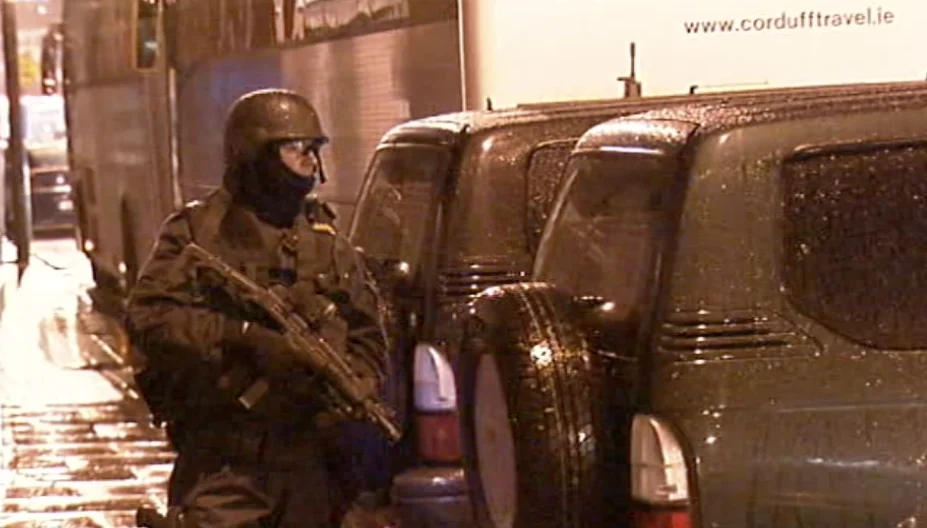

Garda Emergency Response Unit
An ordinary Garda walks the beat unarmed. That is one of the unusual facts about policing in the Republic of Ireland: the regular uniformed officer carries a baton, handcuffs and pepper spray, but no gun. The Garda Siochana -- the Guardians of the Peace, founded in 1922 in conscious contrast to the militarised Royal Irish Constabulary -- has remained unarmed for over a century. But there is one team that is the exception. The Emergency Response Unit was formed on 15 December 1977 in response to the rising tide of international terrorism in 1970s Europe. Its founding cadre had spent the previous year studying Germany's GSG 9 and Belgium's Speciaal Interventie Eskadron, the units created after the 1972 Munich Olympics massacre. Today the ERU is roughly fifty operators strong, based at Harcourt Square in Dublin, trained alongside the Irish Army Ranger Wing, and responsible for every armed police operation in Ireland that exceeds the capacity of ordinary detectives. They turn out for an average of 200 firearms incidents a year. Most weeks, they win.
Hell Week
Getting into the ERU is famously difficult. An applicant must already have served at least four years as a uniformed Garda with an unblemished disciplinary record. Then comes the two-week selection course universally called 'hell week' -- a brutal physical and psychological grind of land and water exercises, combat scenarios, sleep deprivation and timed tasks. The failure rate is around 95 per cent. Those who pass are put through further specialist training in firearms, advanced driving, hand-to-hand combat, close-quarters combat, climbing, abseiling, breaching and first aid. They must qualify three times a year on every weapon system the unit uses, complete regular fitness and psychological evaluations, and pass stringent background vetting. As a peculiar feature of their training, every ERU operator is required to experience each non-lethal weapon they carry: subjected to a Taser jolt, hit with pepper spray in the eyes, and then required to perform their next task. The unit takes the view that you should know what you are doing to other people. Pay, aside from overtime, is the same as a uniformed Garda of the same rank. People do not join the ERU for the money.
Black Uniforms, Plain Clothes
ERU operators are easy to recognise when they want to be: black tactical uniforms with GARDA and POLICE in yellow across the chest and back, ballistic helmets with visors, body armour, often a Heckler & Koch HK416 assault rifle slung across the chest and a SIG Sauer P226 9mm pistol on the hip. They are much harder to recognise when they do not want to be: roughly 80 per cent of all ERU operations are carried out in plainclothes. The unit specialises in undercover surveillance of armed gangs, infiltrating the moment of a planned robbery, and intervening when the criminals draw their weapons. Many of the unit's most controversial moments have come from exactly that pattern. The standard issue pistol is one of the few off-duty firearms in Ireland -- ERU officers carry their SIGs on weekends and holidays, even at home. The unit's vehicle pool is large and unmarked, full of modified high-performance Ford Rangers and Nissan Navaras and an armoured Stoof tactical truck delivered in late 2025. There is no permanent ERU helicopter, but the Garda Air Support Unit's AgustaWestland AW139s are available on call from Casement Aerodrome 15 kilometres south-west of Dublin.
Dominic McGlinchey and the IRA Years
The unit's defining early arrest came on Saint Patrick's Day 1984, when ERU detectives captured Dominic McGlinchey -- then commander of the Irish National Liberation Army, the splinter Republican group responsible for some of the Troubles' bloodiest attacks -- at a house in Newmarket-on-Fergus, County Clare. A gun battle preceded the surrender; an ERU officer was seriously wounded. McGlinchey was extradited to Northern Ireland, jailed, eventually freed, and was murdered in 1994 in front of his young son in a telephone box in Drogheda. Through the 1980s and 1990s, the ERU's primary remit was the IRA, the INLA and their dissident successors. In May 1998 they shot dead Real IRA member Ronan McLoughlin during the foiled attempted robbery of a cash-in-transit van in Ashford, County Wicklow, with the gang carrying an assault rifle, pump-action shotgun and imitation rocket launcher. In June 1997 they shot dead INLA member John Morris during a failed newsagent robbery in Inchicore. The unit's intelligence on dissident republicans, built up over decades, is widely credited with preventing many planned attacks on Irish soil during the Troubles.
John Carthy and Abbeylara
Not every ERU operation has been a triumph. On 19 April 2000, after a 25-hour barricaded siege at his home in Abbeylara, County Longford, a 27-year-old man named John Carthy walked out of his front door carrying a legally-held double-barrelled shotgun. He had a documented bipolar disorder and had been in dispute with his family; he held no hostages. The ERU snipers ordered him to drop the weapon. He kept walking towards the perimeter. He was shot four times by two snipers, two shots each, and died at the scene. The subsequent Barr Tribunal, chaired by a High Court judge, concluded that the ERU had acted within the law but that Carthy's life might have been preserved with better negotiation and command structures. The tribunal's recommendations transformed how the Garda handled barricaded incidents involving people in psychological crisis -- particularly the introduction of formal hostage negotiators (the Hostage Negotiation Section, now standard at every ERU callout), the systematic involvement of forensic psychologists, and a strict requirement that time be the negotiator's most valuable resource. The Carthy case haunts the unit. It is taught in training as the example of what to learn from.
The ATLAS Network
Since the early 2000s the ERU has been part of the ATLAS Network, the European Union's federation of police tactical units -- the German GSG 9, French RAID and GIGN, Dutch DSI, Italian NOCS, Spanish GEO and equivalents from every member state. The units share equipment standards, training, intelligence and personnel. Following the 2011 Norway attacks by Anders Breivik, officers from Delta, the Norwegian police tactical unit, came to Dublin specifically to receive training from the Garda ERU on improvements to barricade response after Carthy. ERU operators have trained with the FBI Hostage Rescue Team in Quantico, with the Metropolitan Police's SCO19 in London, and regularly cross-train with their counterparts in the Police Service of Northern Ireland. The unit's profile is deliberately low. Members do not appear in the media unmasked. The current commanding officer is not named publicly. The Garda Siochana, even with its specialised firearms unit, remains by international standards an exceptionally unarmed police force -- and the ERU's small, intensely trained, highly secretive presence is the reason that approach can still work.
From the Air
The ERU's main base is at Harcourt Square Garda Station in central Dublin, at 53.334N, 6.264W, a few blocks south of St Stephen's Green. From altitude this is the dense Georgian core of the city; the station itself is a modern 1980s office block, unremarkable from the air. The unit operates nationally but its support helicopters fly from Casement Aerodrome (EIME) at 53.302N, 6.451W, 15 km south-west of Dublin. The ERU also has rapid access to the Aviation Support Unit's Eurocopter EC135 and AgustaWestland AW139. Nearest commercial airport: Dublin (EIDW), 9 km north. Standard ERU response time across the Greater Dublin Area is approximately 15-20 minutes from callout.
Nearby Stories
- Wicklow Mountains 12 km away
- Mornington 14 km away
- German submarine U-1051 16 km away
- Abbey of Kells 18 km away
- Irish Military Intelligence Service 20 km away
- HMS Manners (K568) 37 km away
- Templemore 42 km away
- Irish Sea Bridge 43 km away