_p095_POST_OFFICE.jpg)
General Post Office, Dublin
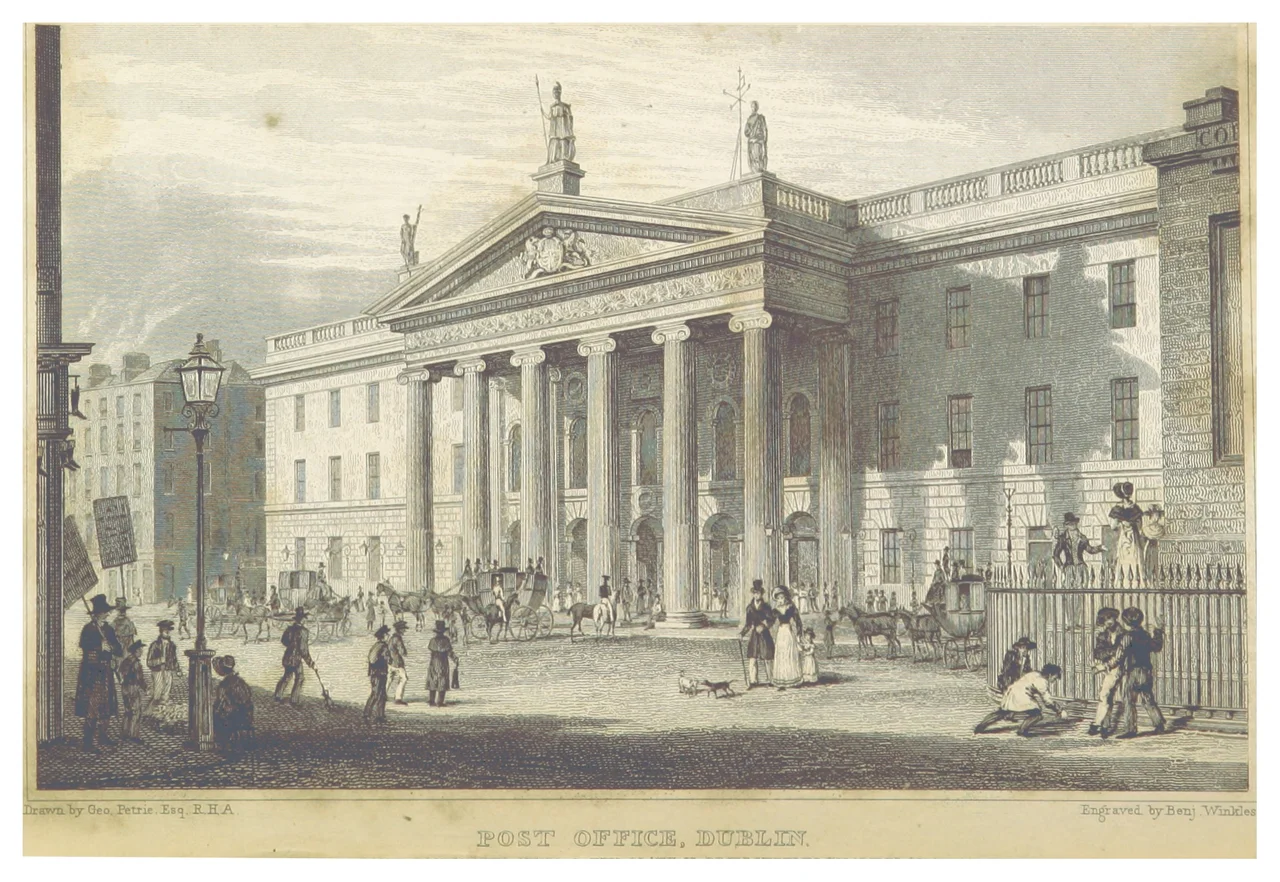
Look closely at the six columns of the portico facing O'Connell Street. The Portland stone is pitted -- not weathered, pitted. Some of the marks are small, perfectly circular; others are torn elongated craters. They are bullet holes from the week of 24 to 30 April 1916, when a building designed for sorting letters became the headquarters of a republic. The General Post Office was the last great Georgian public building Dublin ever built, completed in 1818 at a cost of around £80,000. For 98 years it had been an ordinary post office, with stamps and parcels and the occasional newsworthy event. Then a 36-year-old schoolteacher named Patrick Pearse walked out of the front door on Easter Monday afternoon, unfolded a piece of paper, and read it aloud to whatever bemused Dubliners were standing on Sackville Street. Within six days the building was a roofless shell. Within seven years Ireland was independent. Within a century the bullet-pocked portico had become the most photographed wall in the country.
Francis Johnston's Last Building
The architect was Francis Johnston, the most prolific public builder of his generation -- responsible for Saint George's Church, the Chapel Royal at Dublin Castle, and most of the surviving Georgian institutional architecture of the city. The foundation stone was laid by the Lord Lieutenant of Ireland, the Earl Whitworth, on 12 August 1814, attended by the Postmasters-General (two Irish earls, one of whom was William Parsons, the future astronomer who would build the largest telescope in the world at Birr Castle). The structure went up in just three years. The hexastyle portico -- six columns supporting an entablature with three free-standing statues above -- was carved from Portland stone. Mercury stands on the left with his caduceus and purse, the divine patron of postal couriers. Fidelity (or possibly Hecate, with her hound and key) stands on the right. In the centre stands Hibernia, the personification of Ireland, leaning on a spear with one hand and a harp in the other. The original Royal Coat of Arms of the United Kingdom that crowned the entablature was removed after independence; you can still see where it was cut away. The building cost between £50,000 and £80,000 depending on which contemporary source you trust, and opened for business on 6 January 1818.
Easter Monday
At around 12.45pm on Monday 24 April 1916 -- a bank holiday, with most of the Dublin Metropolitan Police off duty -- approximately 150 men of the Irish Volunteers and the Irish Citizen Army marched up Sackville Street and took the GPO. The defenders went without resistance; the postmaster was sent home with his hat. Within minutes, the building's windows had been smashed for firing positions, the British flag taken down, and two new flags raised on the roof: the green Irish Republic banner and the green-white-orange tricolour. Around 1pm, Patrick Pearse -- by day a teacher at Saint Enda's school, by night a poet, by Easter Monday Commander-in-Chief of the Provisional Government -- emerged onto the portico with a hand-printed paper. He read aloud the Proclamation of the Irish Republic, written largely by himself with input from the seven signatories of the Provisional Government. It addresses 'Irishmen and Irishwomen' as 'her old tradition of nationhood, Ireland, through us, summons her children to her flag and strikes for her freedom'. Most of the small crowd that gathered did not understand what was happening. Some heckled. Some applauded. Most went home. By Friday, the building was burning.
The Burning
British forces brought up an 18-pounder field gun to the corner of Sackville Street and Henry Street and began shelling the GPO. They also fired from the gunboat Helga, anchored in the Liffey, which lobbed shells into the city centre over the rooftops. By Thursday the GPO was on fire from the inside; the rebel garrison, including the dying union leader James Connolly (shot through the ankle, his wound suppurating, the foot eventually gangrenous), had retreated through tunnels knocked between buildings into nearby Moore Street. On Saturday 29 April, with the surrounding city a smoking ruin and civilian casualties mounting -- around 485 people died across Dublin that week, more than half of them civilians caught in the crossfire -- Pearse surrendered to Brigadier General William Lowe at the top of Moore Street. He was marched to Dublin Castle. Sixteen of the rebellion's leaders were shot by firing squad at Kilmainham Gaol over the following weeks, including Pearse, Connolly (strapped to a chair because he could no longer stand), and Pearse's gentle younger brother Willie, executed essentially for being a Pearse. Public opinion, initially cool toward the rebels who had wrecked Dublin and got hundreds killed, turned within weeks. By the 1918 election, Sinn Fein won 73 of 105 Irish seats.
The Long Rebuild
The granite walls of the GPO survived the burning. The interior did not. The roof collapsed; the offices were ash; the famous statues of Mercury, Fidelity and Hibernia still stood on the portico, charred but intact. For thirteen years the shell stood as a public monument to what had happened there -- a more eloquent ruin than any restoration could have managed. In 1924 the new Irish Free State began the rebuilding; the work was completed in 1929. The reconstructed interior is largely sympathetic to Johnston's original. From 1928 the building also housed the studios of 2RN, the new Irish public radio service (later Radio Eireann, then RTE), which broadcast from the GPO until 1974. In 1935, for the 19th anniversary, a bronze statue of the dying mythological hero Cuchulainn -- sculpted by Oliver Sheppard in 1911, long before the Rising -- was installed in the main hall as the Easter Rising memorial. Cuchulainn lashed himself to a stone pillar to die fighting; the symbolism was unmistakable. The statue is now in the front of the building and was depicted on the 1966 Irish ten shilling coin commemorating the fiftieth anniversary.
Witness History
An Post -- the Irish state postal service, descendant of the British Post Office that built the place -- kept its headquarters at the GPO for most of the century. The original copy of the Proclamation that Pearse read out is held nearby in the museum collection; only about 30 of the 2,500 printed survive. Ten oil paintings by Norman Teeling, commissioned for the 1996 80th anniversary, hung in the main hall until 2005. In March 2016, for the centenary, the GPO Witness History visitor centre opened -- an immersive museum experience built into the building, narrated by some of the best Irish actors of the generation. Outside, Nelson's Pillar, the 40-metre Doric column that had stood in front of the GPO since 1809 with a statue of Horatio Nelson on top, was blown up in March 1966 by Irish Republicans who objected to celebrating a British admiral on the centenary of the Rising. The Spire of Dublin -- 121 metres of polished stainless steel needle -- now stands in its place. In June 2023, An Post moved its headquarters out of the GPO entirely, to a new building at North Wall Quay. The post office counters at the GPO are still open. Tourists still photograph the bullet holes. The statues of Mercury, Fidelity and Hibernia still look down over O'Connell Street, slightly soot-stained, slightly chipped, immortal.
From the Air
The General Post Office stands at 53.349N, 6.261W on the west side of O'Connell Street in central Dublin's north inner city, immediately north of the River Liffey and across O'Connell Bridge. From altitude the building is identifiable by its grand classical portico facing onto the broad O'Connell Street boulevard, with the 121-metre stainless steel Spire of Dublin standing directly opposite -- the Spire is one of the easiest visual landmarks in the entire city. The Liffey runs east-west two blocks south; Henry Street runs west from immediately behind the building; the Abbey Theatre is two blocks south-east. Nearest airport: Dublin (EIDW), 8 km north. The GPO is on the southern approach path for arrivals to EIDW's runway 28L.
Nearby Stories
- Wicklow Mountains 12 km away
- Mornington 14 km away
- German submarine U-1051 16 km away
- Abbey of Kells 18 km away
- Irish Military Intelligence Service 20 km away
- HMS Manners (K568) 37 km away
- Templemore 42 km away
- Irish Sea Bridge 43 km away