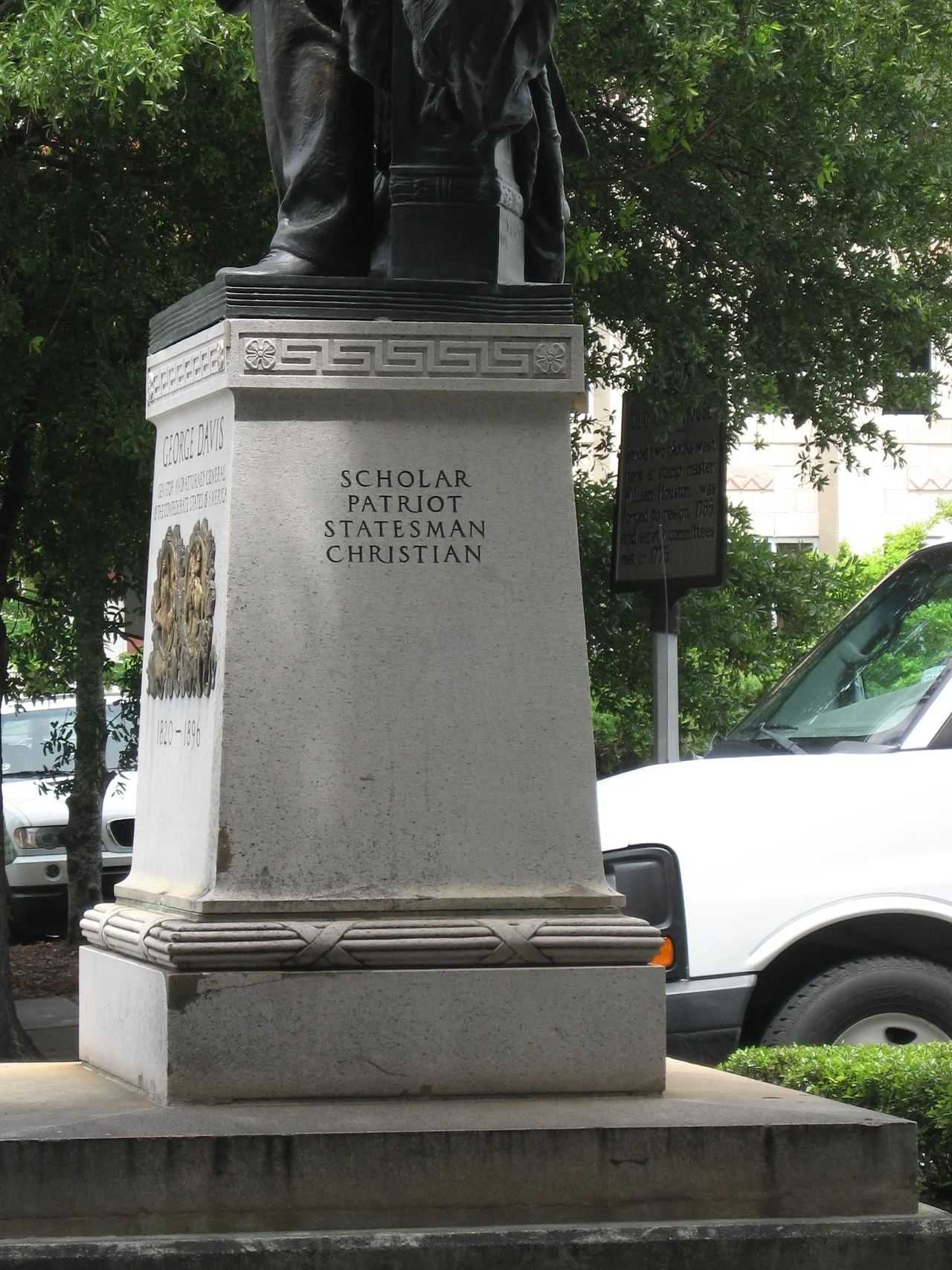

George Davis Monument
The statue stood on a grassy island in the middle of Market Street, hand on a lectern as though caught mid-speech, one block from the river. For most of its 109 years no one in passing traffic stopped to read the inscription. It honored George Davis, Confederate senator and the Confederacy's last attorney general, and it had been deliberately oriented to face west - down Market Street toward the foot of the old slave market on the Cape Fear River wharf, where enslaved men, women, and children had been bought and sold for more than a century before the city fell to Union troops in 1865. The placement was not accidental. In June 2020, in the early morning hours, a city crane lifted the bronze figure off its pedestal and trucked it away.
A Whig Who Changed His Mind
George Davis was not, by the standards of secessionist North Carolina, an obvious choice for a monument. He had been a Whig, a member of a party hostile to the Democrats who dominated the antebellum South. As late as the 1860 election he supported a pro-Union third-party candidate for president. But in February 1861 he attended the failed Washington Peace Conference, and something there - or perhaps something already inside him - shifted. On March 2, 1861, back in Wilmington, he gave a speech that left no ambiguity about why he now favored leaving the United States. The division must be made on the line of slavery, he said. The State must go with the South. He went on to serve in the Confederate Senate and, from 1864, as the Confederate States' attorney general.
A Statue Funded by Old Money
The United Daughters of the Confederacy's Cape Fear Chapter 3 began raising money for the monument in 1904. Five years of fundraising produced only about nine hundred dollars. The shortfall was made up by James Sprunt, heir to a cotton fortune. As a young man Sprunt had worked aboard blockade-running ships during the Civil War, profiting from goods slipped past the Union blockade. He paid the sculptor's travel expenses and rounded the total to $5,010. The sculptor was Francis Herman Packer, a Munich-born immigrant who had trained under both Philip Martiny and Augustus Saint-Gaudens, and who later settled in Rockville Centre, Long Island. The bronze was cast at the Gorham Manufacturing Company in Providence, Rhode Island - eight feet tall, seventeen hundred pounds, mounted on a pedestal that weighed five and a half tons and bore gilded seals of both North Carolina and the Confederacy.
Patriotism and Moderation
The dedication on April 20, 1911, drew four of Davis's grandsons and a Masonic ceremony. Judge Henry G. Connor, a sitting federal judge, gave the keynote. His words are worth quoting because they describe so precisely the Lost Cause version of history that the monument was built to enshrine. He called Davis's work to break apart the United States patriotism. He called the secession speech moderation. He told the assembled crowd to bring their sons to the spot and tell them of Davis's loyalty to high thinking and noble living. The Delgado Band was paid twenty-five dollars to provide music. The statue faced west, toward the river, toward what had been the marketplace. Each generation of Wilmington schoolchildren walked past it on the way to the courthouse, or city hall, or St. James Episcopal Parish, the oldest church in town.
Knocked Down, Put Back Up
In October 2000 a truck belonging to Hanover Iron Works backed into the statue and knocked it from its base. The bronze head was dented; the neck and right shoulder cracked. Repairs took more than a year and cost twenty-five thousand dollars. The statue went back up in February 2002, six feet from its original spot and raised on a new six-inch curb. In June 2019 a crowd gathered on a Saturday afternoon and demanded the city take it down. Five days later, on the morning of July 4, someone threw orange paint on it. The city washed the paint off and left the figure standing. That summer the conversation in Wilmington was still hypothetical. Then came 2020.
Down, Then Gone
On June 25, 2020, three Wilmington police officers were fired after a body camera caught them making what the chief called brutally racist remarks - among other things, joking about the coming need to kill Black citizens. The next morning, before dawn, the city quietly removed the Davis statue, citing the need to protect public safety and preserve important historical artifacts. The pedestal stayed in place a few days longer, draped in a black shroud that hid the Lost Cause inscriptions, then went into storage too. On August 2, 2021, the City Council voted to permanently remove the monument from public property. The United Daughters of the Confederacy's Cape Fear 3 chapter formally claimed ownership and asked the city to hold both the statue and pedestal until arrangements could be made. As of this writing, the bronze figure of George Davis is still in city storage, no longer facing the river, no longer facing anything at all.
From the Air
The former site of the monument is at the intersection of Market and Third Streets in downtown Wilmington, 34.2356N, 77.9458W, four blocks east of the Cape Fear River. Wilmington International Airport (KILM) lies six miles north. The downtown grid is easy to spot from the air - a tight cluster of low buildings between the river bend and Burnt Mill Creek. Approaches over the river offer a clear view of the historic district. Year-round visibility is generally excellent; afternoon convective weather is common from May to September.
Nearby Stories
- Ocean Isle Beach house fire 4.7 km away
- Pender County, North Carolina 6.6 km away
- Bald Head Island 13 km away
- Marine Corps Base Camp Lejeune 16 km away
- Lake Waccamaw, North Carolina 17 km away
- The Robesonian Takeover 59 km away
- Swansboro 59 km away
- Mercury-Redstone 4 726 km away