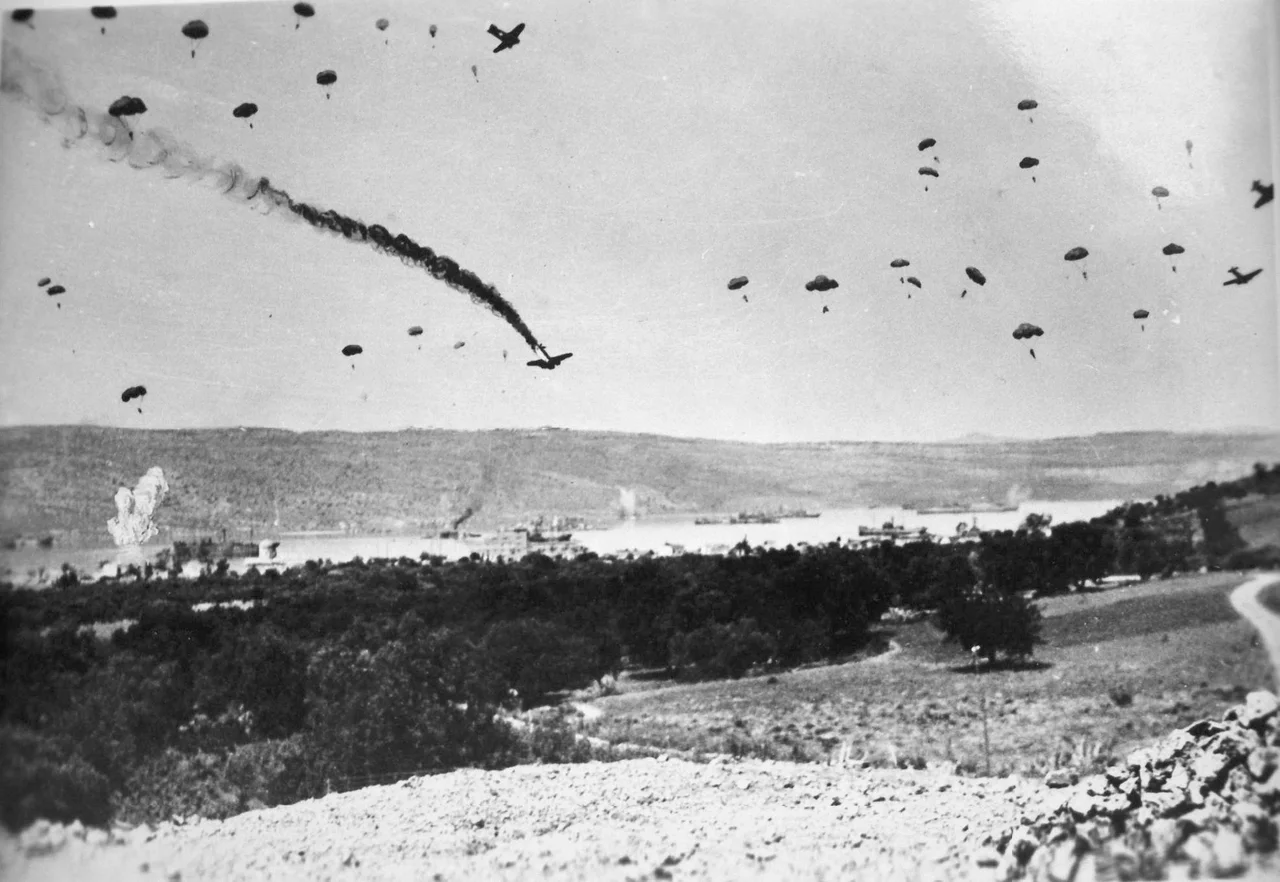

German Invasion of Greece
Greece said no first. On October 28, 1940 — a date still commemorated as Ohi Day — the dictator Ioannis Metaxas rejected an Italian ultimatum demanding free passage for troops through Greek territory. Italian forces invaded immediately through Albania. Over the following months, the Greek army drove them back, crossed into Albanian territory, and captured significant towns including Korça and Sarandë. The Greeks were outnumbered and outgunned; they won anyway. By March 1941, after Italy launched a counteroffensive that failed with 12,000 casualties in a week, Mussolini flew to Albania to observe the disaster personally. It was only then — after Greece had already humiliated one Axis partner — that Germany intervened. Operation Marita began on April 6, 1941. Three weeks later, the Wehrmacht was in Athens. What followed the military campaign was worse than the campaign itself.
The Campaign, Compressed
Germany's strategic problem was geographic. To enter northern Greece, the Wehrmacht had to cross the Rhodope Mountains from Bulgaria — terrain with few roads capable of supporting armored movement. The Metaxas Line, a system of concrete fortifications along the Bulgarian border inspired by the Maginot Line, was formidable but thinly manned: built to garrison over 200,000 troops, it held only about 70,000. The Greek command had committed the bulk of its army to the Albanian front, where it was successfully fighting the Italians, and was reluctant to withdraw — to do so would be read as a concession. This strategic split proved fatal. The Germans struck on April 6, simultaneously invading Yugoslavia and driving armor through the gaps the Yugoslav collapse opened in the Greek-Bulgarian frontier. By April 9, Thessaloniki had fallen and some 60,000 Greek soldiers had surrendered. The German thrust through the Monastir Gap in Yugoslavia outflanked the Greek forces in Albania from behind, making their position untenable. Britain, Australia, and New Zealand had sent forces — designated W Force — but they were too few, too lightly equipped, and too far from the decisive points. Thermopylae was held for days by the rearguard. Athens fell on April 27. The last evacuation ships left the Greek southern coast on April 30, carrying about 50,000 soldiers to Crete and Egypt. The Germans then took Crete in a brutal airborne assault the following month.
The Soldiers Who Refused to Surrender to Italy
One episode reveals something essential about the Greek experience of this war. When the Greek Epirus Army, trapped in Albania by the German advance, was forced to surrender, its commander Lieutenant General Georgios Tsolakoglou was determined that the surrender would go to the Germans — not to the Italians, who had failed to defeat his army in six months of fighting. He opened unauthorized negotiations with SS General Sepp Dietrich to arrange exactly that. Hitler kept the negotiations secret from Mussolini. Outraged when he found out, Mussolini ordered counter-attacks against the surrendering Greek forces; they were repulsed. It took a personal appeal from Mussolini to Hitler to arrange Italian participation in the armistice of April 23. In the terms that followed, Greek soldiers were not treated as prisoners of war — they were demobilized and allowed to go home, and officers were permitted to keep their sidearms. It was a small dignity, extracted in unlikely circumstances. The Italian army had been denied the symbolic victory it had failed to earn in battle.
Three Flags Over One Country
Following the conquest, Greece was divided among its conquerors. Germany occupied the strategically critical areas: Athens, Thessaloniki, central Macedonia, several Aegean islands, and most of Crete. Italy took the bulk of the mainland and most of the remaining islands. Bulgaria seized the northeastern corner, between the Struma River and the Evros. For the Greek population, the division meant three different occupation regimes, with different degrees of harshness and different economic policies — but all of them extractive. The occupiers requisitioned food, raw materials, and goods for their war economies. The drachma was inflated at catastrophic speed. Food imports, which Greece depended on because its mountainous terrain had never made it agriculturally self-sufficient, ceased almost entirely. The consequences were immediate and devastating. In the winter of 1941–42, a famine descended on Athens and other urban centers. Estimates of the death toll from the Great Famine of the occupation vary, but tens of thousands of people in Athens alone died of starvation, with contemporaries describing bodies on the streets. The hunger was not accidental. It was the result of German and Italian requisitioning stripping the country of food while the Allied naval blockade prevented imports. The human cost of the occupation fell hardest on those who had the least — the urban poor, the elderly, children.
Atrocities and Resistance
Alongside the famine, the occupation brought systematic violence. German reprisals for partisan activity were carried out according to explicit policies of collective punishment: hostages shot in retaliation for attacks on occupation forces, entire villages burned. The massacres at Distomo, Kalavryta, Kommeno, and other locations killed hundreds of civilians. Jewish communities — including the large and ancient Sephardic community of Thessaloniki, one of the most significant in Europe — were rounded up and deported to Auschwitz-Birkenau, where most were murdered. Approximately 60,000 to 67,000 Greek Jews were killed in the Holocaust — between 82 and 92 percent of the pre-war Jewish population of Greece; nearly the entire pre-war community of Thessaloniki did not survive. Against this, Greeks organized resistance. Multiple armed groups operated in the mountains, including the communist ELAS and the nationalist EDES, who both fought the occupiers and fought each other. British Special Operations Executive agents parachuted in to coordinate with the partisans. In November 1942, a joint operation destroyed the Gorgopotamos railway viaduct, cutting the supply line to Rommel's forces in North Africa. Resistance also took quieter forms: people who hid Jewish neighbors, who sheltered downed Allied airmen, who maintained underground presses and schools in defiance of occupation policies.
The Flag That Came Down from the Acropolis
When the first German soldiers entered Athens on April 27, 1941, they drove directly to the Acropolis and raised the Nazi flag from the Parthenon. The story most widely remembered in Greece is that of the Evzone soldier Konstantinos Koukidis, said to have been on guard duty at the flagpole. According to the account — which spread rapidly through occupied Athens and which many Greeks believed and believe still — Koukidis refused to hand the Greek flag to the invaders, wrapped himself in it, and jumped from the rock. Whether the story is historically verified or apocryphal, it expresses something true about how Greeks experienced that moment: as a desecration of something irreplaceable, followed immediately by the impulse to resist. The occupation lasted until October 1944, when the Germans withdrew as Allied forces advanced. What the occupation left behind was not only death and destruction — though there was enormous amounts of both — but also the rifts between resistance groups that would fuel a brutal civil war lasting until 1949. The Greece that emerged from occupation and civil war was a country that had been asked to absorb more violence in a decade than most nations endure in a century.
From the Air
The German invasion of Greece is anchored in the landscape of central and northern Greece, centered at approximately 38.5°N, 23.0°E. Athens International Airport (LGAV, 37.94°N, 23.94°E) is the primary hub for the region. The key terrain of the campaign is legible from altitude: flying northwest from Athens at 15,000 feet, the pass at Thermopylae appears between Mount Kallidromo and the Malian Gulf — the same narrow corridor that Greek and Allied rearguard forces held for days in April 1941. Thessaloniki lies 500 km north, at the head of the Thermaic Gulf. The Metaxas Line ran along the Bulgarian border to the northeast, through mountain ridges that remain difficult terrain today. The Monastir Gap, through which German armor outflanked the Greek-Albanian front, lies across the border into what is now North Macedonia. Piraeus, the port of Athens visible from the air as the main harbor south of the city, was bombed on the night of April 6–7, 1941, destroying the port facilities that Allied forces depended on for supply and evacuation.
Nearby Stories
- Battle of Alamana 3.6 km away
- Free and Real 5.7 km away
- Agios Thomas Tanagras 5.7 km away
- Pythian Games 11 km away
- Thespiae 12 km away
- Euripus Strait 14 km away
- French Cruiser Châteaurenault (1898) 17 km away
- Skopelos 32 km away