
German occupation of the Channel Islands
On the afternoon of 30 June 1940, a German reconnaissance pilot named Hauptmann Liebe-Pieteritz landed his aircraft on a deserted airfield in Guernsey to see whether anyone would shoot at him. No one did. He took off again, reported back to Luftflotte 3, and that evening a platoon of Luftwaffe airmen flew in by Junkers transport. A police inspector named Sculpher came to the airport carrying a letter from the bailiff. The letter declared the island demilitarized and asked the bearer to deliver it to whoever was in charge. The bearer did not speak German. This is how the occupation of the only British territory ever held by Nazi Germany began - quietly, without a shot, on a summer evening. It would last 1,775 days.
Demilitarized Without Telling the Enemy
On 15 June 1940, after the fall of France, the British War Cabinet decided the Channel Islands were not worth defending. Churchill objected, but the decision held. The islands were demilitarized - and the Germans were not told. Evacuation was hurried, chaotic, and inconsistent. Alderney's people, with no direct communication with London, were told to leave; almost all did. Guernsey evacuated 5,000 schoolchildren and 12,000 adults out of a population of 42,000. Jersey, where the government advised people to stay, evacuated only 6,600 of 47,000. On Sark, the Dame Sibyl Hathaway told everyone to stay put. Many children were separated from their parents for five years; some never saw their mothers again. Eleanor Roosevelt personally sponsored a Guernsey girl named Paulette under the Foster Parent Plan for Children Affected by War.
Life Under the New Clock
The Germans took the clocks first. The islands were forced onto Central European Time. Then came the right-hand-side driving. Then the Reichsmark, the rationing, the curfew, the radio confiscations, the language laws in schools. Weapons were surrendered in 1940. Motor vehicles were taken under forced sale. Cameras were banned in 1942. Bicycles, boats, beaches, and freedoms slowly disappeared. The bailiffs - Alexander Coutanche on Jersey, Victor Carey and later Ambrose Sherwill on Guernsey - took over the civil functions of the absent Crown representatives and tried to keep some legal distance between their people and the occupiers. Sherwill was eventually imprisoned and deported to a German internment camp for helping two British spies. Around 4,000 islanders were sentenced for breaking German laws. Roughly 570 were sent to continental prisons and camps. At least 22 Jerseymen and 9 Guernseymen never came back.
Ten Percent of the Atlantic Wall
Hitler decreed in 1941 that 10 percent of the steel and concrete used in the Atlantic Wall should go to these tiny islands. The order was kept. The German Organisation Todt brought in over 16,000 forced laborers - Russian and Polish prisoners of war, Spanish Republicans, French Jews, Belgian and Dutch civilians, and others rounded up across occupied Europe. They built tunnels, bunkers, anti-tank walls, artillery positions, observation towers, hospitals carved into the cliffs. By 1944, the tunnel works on Guernsey, Jersey, and Alderney alone had extracted 244,000 cubic meters of rock - more than the entire rest of the Atlantic Wall from Norway to the Spanish border combined. Guernsey received 616,000 cubic meters of concrete. Many of the laborers were worked to death. On Alderney, the SS-administered camps Sylt and Norderney functioned as concentration camps from March 1943; over 700 inmates died in the four Alderney camps or on the ships moving them. The Minotaur, carrying 468 Organisation Todt workers - including women and children - from Alderney to France, was hit by Royal Canadian Navy torpedo boats near St Malo on 5 July 1944. About 250 of the people aboard were killed by the explosions or drowned.
Deportations and the Jews Who Did Not Leave
On Hitler's personal order in 1942, all Channel Islanders not born in the islands - plus any man who had served as an officer in the First World War - were rounded up and deported to internment camps in southwest Germany, mostly to Biberach an der Riss, Laufen, and Wurzach. 2,300 people were taken. 45 of them died before the war ended. Guernsey nurse Gladys Skillett, five months pregnant when she was deported to Biberach, became the first Channel Islander to give birth in German captivity. A small Jewish community had remained on the islands - mostly because British law had refused to let enemy-passport-holding refugees enter Britain in 1940. Eighteen Jews registered with the German authorities on the islands out of an estimated 30 to 50. Several were ultimately deported to Auschwitz and Belsen. Most did not return. After the war, allegations that local officials had helped identify Jewish residents to the Germans were dropped without prosecution.
Resistance, Quiet and Loud
Armed resistance was effectively impossible on a small island. The penalty for sabotage was reprisal against civilians. But people did what they could. Norman Le Brocq, a young Jersey communist, ran the most active resistance network on the islands - distributing leaflets in Spanish and Russian to forced laborers to tell them about German defeats at Kursk and Stalingrad, and eventually plotting a mutiny among anti-Nazi German soldiers that liberation made unnecessary. Louisa Gould of Jersey was arrested for sheltering an escaped Russian slave worker; she died at Ravensbruck concentration camp. The Saint Saviour wireless network on Jersey hid radios under floorboards. Joseph Gillingham ran the Guernsey Underground News Service, typing up BBC bulletins until he was caught. Edmund Blampied designed Guernsey postage stamps with the script initials 'GR' for King George VI hidden in the artwork. Some islanders fraternized with German soldiers; the German command later estimated 60 to 80 children were born to island women and Wehrmacht fathers. The islanders called those women 'Jerry-bags,' and after liberation British soldiers had to physically intervene to prevent revenge attacks.
Starvation and the Vega
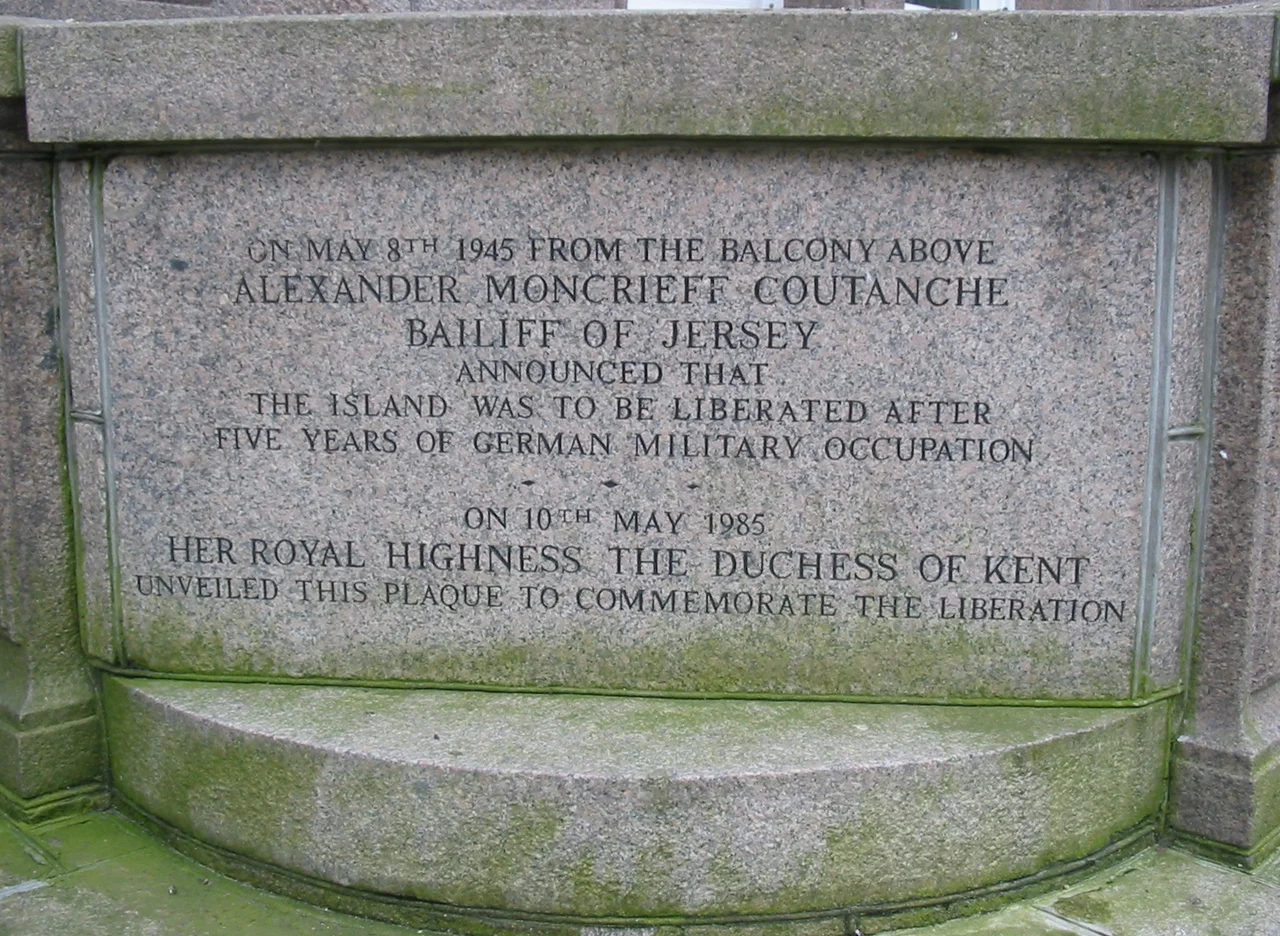
After D-Day in June 1944, the Allies decided to bypass the Channel Islands and starve them out. German supply lines through France were cut. Within months both islanders and German soldiers were close to starvation. In August 1944 the German Foreign Ministry offered to release the civilian population through the Swiss Red Cross. Churchill scrawled on the memorandum: 'Let 'em starve. No fighting. They can rot at their leisure.' The offer was rejected. After months of negotiation, the International Red Cross ship Vega finally docked in December 1944 with parcels of food, salt, soap, and medical supplies. She would make six trips in total. Liberation came on 9 May 1945, one day after VE Day. HMS Bulldog accepted the German surrender in St Peter Port at dawn. HMS Beagle reached Jersey the same day. Sark was liberated on 10 May, Alderney on 16 May - the only one of the islands where every original inhabitant had been evacuated five years earlier. Alderney still marks 15 December, not 9 May, as Homecoming Day. The Channel Islands Occupation Society now exists to preserve a history the rest of Britain was, for many decades, content not to remember.
From the Air
The German occupation centered on the Bailiwicks of Jersey (around 49.21°N, 2.13°W) and Guernsey (around 49.45°N, 2.58°W), in the English Channel near the Cotentin Peninsula. Key fortification sites still visible from the air include Batterie Mirus on Guernsey's west coast (four 30.5 cm naval guns), Battery Moltke and Battery Lothringen on Jersey, and the four Alderney camps (Lager Borkum, Helgoland, Sylt, and Norderney). The German military cemetery at Fort George, Guernsey, holds 111 German soldiers and sailors alongside British war graves. Guernsey Airport (EGJB) - where the first Ju 52 landed on 30 June 1940 - is at 49.43°N, 2.60°W. Jersey Airport (EGJJ) is at 49.21°N, 2.20°W. Liberation Day (9 May) remains the largest public holiday on both islands.
Nearby Stories
- Pallot Steam, Motor & General Museum 29 km away
- HMS Affray 29 km away
- Operation Donnerkeil 29 km away
- German Submarine U-672 35 km away
- Action of 18 June 1793 60 km away
- Mont Saint-Michel: The Abbey That Becomes an Island Twice a Day 78 km away
- Basilica of Sainte-Therese, Lisieux 209 km away
- 1941 Santander Fire 642 km away