
Glasnevin
The Protestant Archbishop of Dublin wrote a peeved letter in 1725 about Glasnevin. It was, he complained, 'the receptacle for thieves and rogues. The first search when anything was stolen, was there, and when any couple had a mind to retire to be wicked there was their harbour.' Glasnevin, on the north bank of the Tolka three kilometres from the centre of Dublin, had been a quiet monastic site since the 6th century, a battlefield in 1014, an aristocratic retreat by the 18th, and a respectable working-class neighbourhood by the 20th. The archbishop's complaint was correct as far as it went, but Glasnevin had also -- between the wickedness -- founded the largest cemetery in Ireland, raised the first botanic gardens in the country, and produced a meteorological office that is one of the most architecturally significant buildings of 1970s Dublin. It is, despite its archbishop, a serious neighbourhood.
Saint Mobhi's Monastery
The settlement begins, by tradition, with Saint Mobhi -- also called Berchan -- in the 6th century (perhaps the 5th). He founded a monastery on the north bank of the River Tolka and gathered a school of pupils around him. One of those pupils was a young man named Colum mac Felim, born around 521, better known to history as Saint Columba of Iona. Columba studied at Glasnevin until plague broke out and forced him north; he went on to found the monastery of Iona in 563, evangelise much of Scotland, and become one of the most consequential figures in early medieval Christianity. Glasnevin's monastery survived for two centuries before Viking raids destroyed it in the 8th century. By 822 the lands had become part of the grange (farm) of Christ Church Cathedral. The current St Mobhi's Church on St Mobhi Road was built in 1707 on the site of the medieval church. The street called Iona Road in Glasnevin commemorates the Scottish foundation Saint Mobhi's pupil established.
The Battle of Clontarf
On Good Friday 1014, the Tolka's south bank was the scene of one of the most famous engagements in Irish history. The High King Brian Boru and his army faced a coalition of Vikings from Dublin and Leinster Irish rebels led by Mael Morda mac Murchada. The battle was bloody: Wikipedia gives the casualties as 7,000 Danes and 4,000 Irish dead. Brian Boru himself, by then in his seventies, was killed in his tent as he prayed during the closing stages of the day. The Irish won, but the High Kingship fragmented after Brian's death, and the Vikings stayed in Dublin and integrated. A field in Glasnevin called the 'bloody acre' is traditionally identified as part of the battlefield. The actual fighting probably ranged more widely along the Tolka and across modern Marino, Fairview and Clontarf, but Glasnevin's claim to a piece of it is real enough that locals still point to it. A thousand years on the field is residential streets.
The Dead Centre of Dublin
In 1832, on land purchased for the purpose by the Catholic Emancipation campaigner Daniel O'Connell, Glasnevin Cemetery opened its gates. The cemetery -- officially Prospect Cemetery, but universally called Glasnevin -- was Ireland's first burial ground where Catholics could be interred with full rites, and it grew quickly. It now contains over 1.5 million graves, more than the entire current population of Dublin. The list of the buried reads like a textbook of Irish history: Daniel O'Connell himself, in a crypt beneath the round tower built in his memory; Michael Collins, killed in the Civil War of 1922; Eamon de Valera, the first President of an independent Ireland, beside his wife Sinead; Charles Stewart Parnell, the 19th-century parliamentary leader; Arthur Griffith, founder of Sinn Fein; the writer Brendan Behan; the soccer player Billy Whelan, killed in the Munich air disaster of 1958. The dark joke that gave Glasnevin its nickname -- 'the dead centre of Dublin' -- is older than living memory. Guided tours of the cemetery, run by the Glasnevin Trust, are now among the most popular history experiences in the city.
The Botanic Gardens
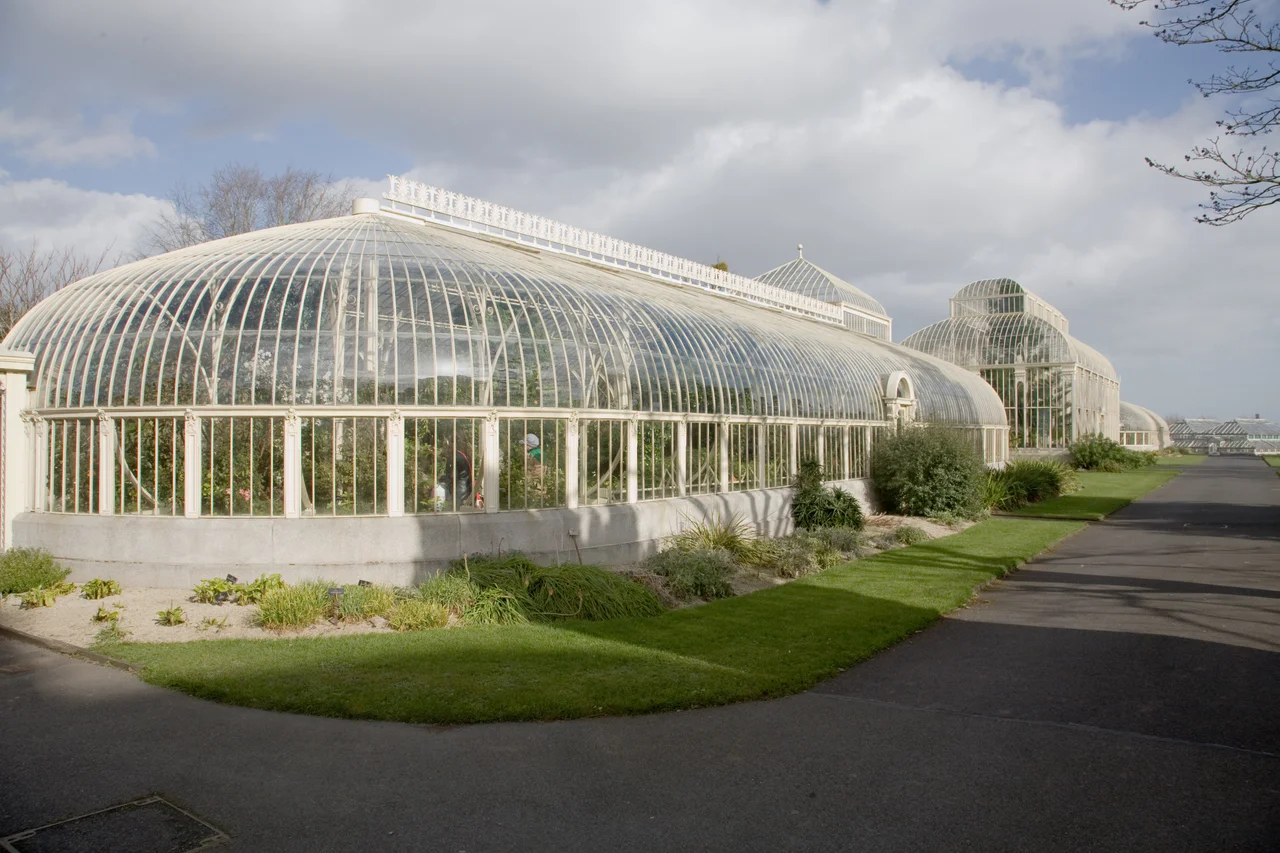
In 1795 the lands of the poet Thomas Tickell on the north side of the Tolka, immediately adjacent to where the cemetery would later be founded, were bought by the Irish Parliament and given to the Royal Dublin Society to establish Ireland's first botanic gardens. The 19-hectare gardens are one of the most beautiful spots in Dublin: a Victorian curvilinear glasshouse range designed by the ironmaster Richard Turner (who also designed the Palm House at Kew), a Great Palm House, a herbaceous border that runs for a kilometre, a herbarium of pressed plant specimens going back to the 1700s. The gardens carry one grim historical distinction: in 1845, scientists working here were the first in Ireland to identify the water mould Phytophthora infestans -- the late blight -- on potato plants. They could not stop it. The Great Famine that followed killed roughly one million people and forced another million to emigrate. The gardens' scientists worked throughout the famine to understand the disease, but the breakthroughs that finally controlled blight did not arrive until decades later. Today the gardens are a peaceful place. A small plaque records the role they played in identifying what was coming.
Met Eireann and Griffith Avenue
Modern Glasnevin layers state institutions on top of its monastic past. Met Eireann, the Irish meteorological office, occupies a remarkable pyramid-shaped building designed by Liam McCormick on Glasnevin Hill, opened in 1975 on the site of a former juvenile detention centre. The original plan called for the pyramid to be clad in Welsh slate; an indigenous Irish material was chosen instead for political reasons, but the selected stone curled and had to be replaced with metal sheeting. The building is now considered one of the most significant of its decade in Dublin. Dublin City University's main campus borders Glasnevin to the north. Enterprise Ireland, the Sustainable Energy Authority, the National Standards Authority and parts of the Department of Defence all keep offices in the neighbourhood. Running east-west through Glasnevin is Griffith Avenue, named for the Sinn Fein founder Arthur Griffith. A double row of mature lime trees lines both sides for 2.81 kilometres -- reputedly the longest tree-lined residential avenue in the Northern Hemisphere. The neighbourhood that once held 24 houses in 1667 now extends across two postal districts. The bones of the saints, the patriots, the famine dead, and the Vikings still lie under it.
From the Air
Glasnevin sits at 53.372N, 6.267W on the north bank of the River Tolka in the Northside of Dublin, roughly 3 km north of the city centre. From altitude the area is dense Edwardian and 1920s red-brick housing, recognisable from the air by three landmark features: the National Botanic Gardens (a green wedge with greenhouse structures on its eastern side), Glasnevin Cemetery (a vast walled rectangle of memorials, including Daniel O'Connell's round tower visible from a great distance), and the pyramid-shaped Met Eireann headquarters on Glasnevin Hill. Dublin City University's main campus lies immediately north. The tree-lined boulevard of Griffith Avenue runs straight east-west through the area. Nearest airport: Dublin (EIDW), 6 km north.
Nearby Stories
- Wicklow Mountains 12 km away
- Mornington 14 km away
- German submarine U-1051 16 km away
- Abbey of Kells 18 km away
- Irish Military Intelligence Service 20 km away
- HMS Manners (K568) 37 km away
- Templemore 42 km away
- Irish Sea Bridge 43 km away