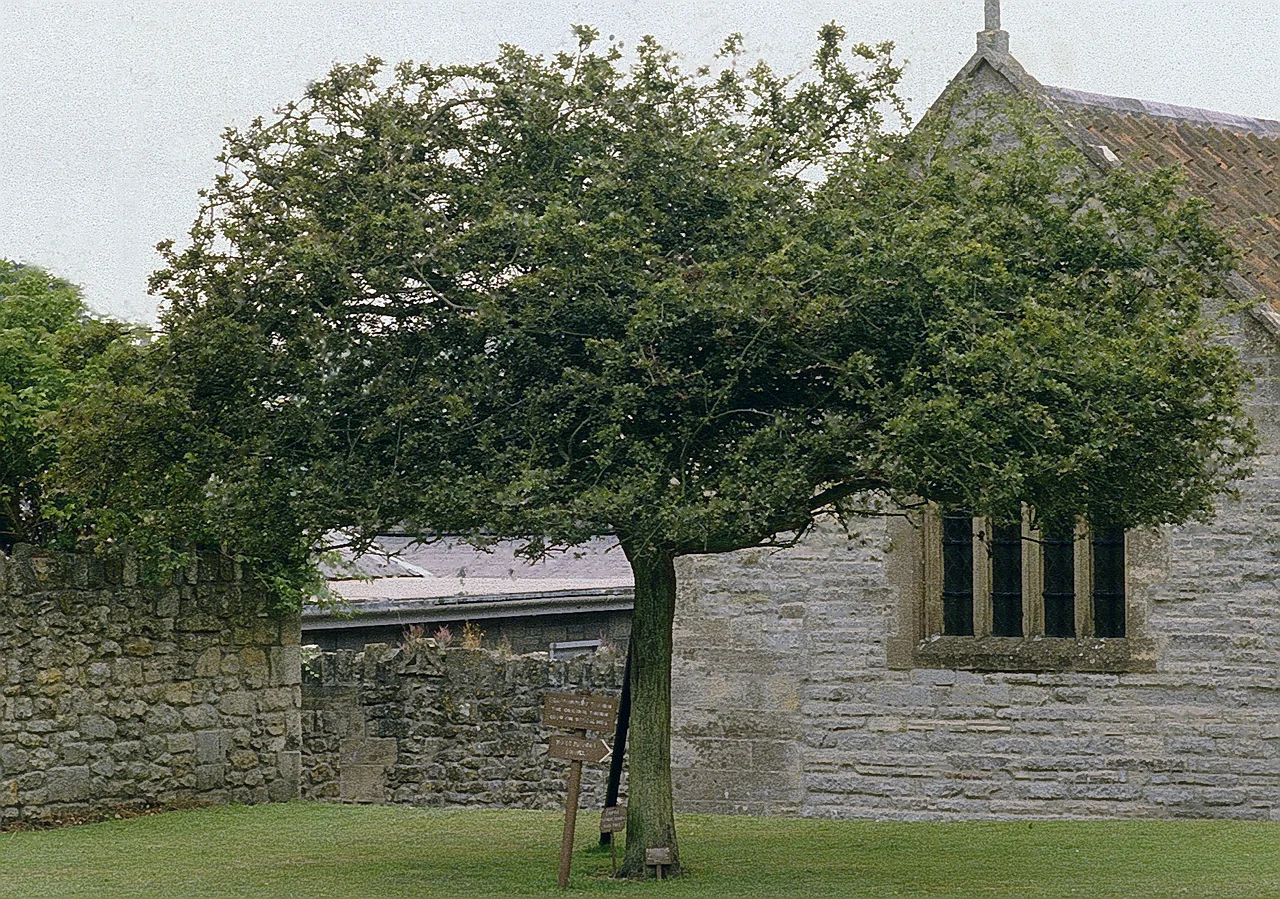

Glastonbury Thorn
Every December, an elderly pupil from St John's Infants School climbs onto a stool in a Glastonbury churchyard and snips a sprig of blossom from a hawthorn tree. The cutting is wrapped, boxed, and posted to Buckingham Palace, where it sits on the King's Christmas dinner table. This is not folklore preserved in a guidebook - it actually happens, every year. The tree the children visit is a Glastonbury Thorn, a hawthorn that flowers twice annually instead of once, and according to legend it grew from the walking staff of Joseph of Arimathea after he thrust it into Wearyall Hill nearly two thousand years ago.
A Staff That Took Root
The story is the kind of medieval origin tale that sounds embellished because it almost certainly was. Joseph of Arimathea, the man who provided Christ's tomb in the Gospels, supposedly sailed to Britain bearing the Holy Grail. Weary from his journey, he climbed the hill above what would become Glastonbury and drove his thorn-wood staff into the earth. By morning, the staff had taken root, sprouted leaves, and bloomed - in winter. The legend first appears in print in a 1520 pamphlet commissioned by Glastonbury Abbey, which was always alert to anything that proved Glastonbury was, as the pamphlet put it, 'the holyest erth of Englande.' But the tree itself was, and is, real. Crataegus monogyna 'Biflora' genuinely flowers twice a year - once in spring like an ordinary hawthorn, and once around Christmas. The botany predates the legend; the legend grew up around the botany.
Burned as a Relic
The original tree on Wearyall Hill became a centre of pilgrimage through the Middle Ages, surviving the dissolution of Glastonbury Abbey in 1539. Even after the abbey was demolished and its stones carted off to build local houses, the Thorn kept flowering at Christmas, and English Catholics took comfort in it - 'a Testimony to Religion, that it might flourish in persecution.' That sentiment did not endear it to Puritan soldiers during the English Civil War, who cut down the original tree and burned it as a 'relic of superstition.' Local gardeners, anticipating the destruction, had already taken cuttings. Mr George Chislett, head gardener at Glastonbury Abbey, learned to graft holy thorn shoots onto blackthorn rootstock, and his son Wilf eventually sent cuttings to Canada, Australia, New Zealand, and Washington. Plants grown from the tree's seeds revert to ordinary spring-flowering hawthorn. Only grafted descendants keep the Christmas trick.
December 2010
On 9 December 2010, someone climbed Wearyall Hill in the dark and sawed every branch off the replacement Thorn that had been planted there in 1951 to mark the Festival of Britain. The vandalism shocked the town. New shoots appeared in spring 2011, but they kept being cut down within days. In April 2012 the Glastonbury Conservation Society planted a freshly grafted sapling and held a consecration ceremony; sixteen days later it was snapped in half. The Wearyall Hill tree finally died and was removed by the landowner in 2019. No one was ever charged. The motive remains a mystery - religious objection, anti-establishment vandalism, or something stranger - and the empty hilltop has become one of the more melancholy sights in Somerset.
The Living Trees
The Thorn is not extinct. Grafted descendants flourish in the grounds of Glastonbury Abbey, in the churchyard of St John the Baptist on the High Street, and at the Chalice Well. The tree the schoolchildren visit each December is one of these - a survivor lineage stretching back through Mr Chislett's careful grafting to the cuttings taken before the Wearyall original was burned. The blossom presented to the monarch each Christmas is a slightly stunted version of the May flowering: smaller flowers, no haws. But it flowers. In 1965, Queen Elizabeth II erected a wooden cross at Glastonbury inscribed with words that read almost like an admission of the limits of history: 'The cross, the symbol of our faith, the gift of Queen Elizabeth II, marks a Christian sanctuary so ancient that only legend can record its origin.'
Two Bloomings
Walk through St John's churchyard on Glastonbury High Street in mid-December and look for a hawthorn covered in small white flowers. There is no other plant in England that does this. The trick is genetic - a mutation in a single hawthorn that someone, at some point, recognised was worth keeping alive. Whether that someone was a first-century traveller from Judea or a medieval Somerset gardener with an eye for the unusual is unknowable. What is certain is that someone has been propagating these trees by hand for over five hundred years, and someone is still doing it now, and the Glastonbury Thorn will probably outlast everyone reading this. A staff that grew into a tree is a fairy tale. A tree that has been propagated by patient human hands for half a millennium is a much stranger story, and more true.
From the Air
The Glastonbury Thorn trees are at 51.148 degrees north, 2.716 degrees west, in the town of Glastonbury, Somerset, on the low-lying Somerset Levels about 23 miles south of Bristol. From the air the area is identifiable by the distinctive conical shape of Glastonbury Tor a mile east. Nearest airports: Bristol (EGGD), about 22 nm north; Exeter (EGTE), 50 nm southwest. Best viewed from 3,000-5,000 feet AGL for context against the Levels and the Tor.
Nearby Stories
- New Wardour Castle 2.6 km away
- Cosmeston Medieval Village 9.6 km away
- Ottery St Mary 9.7 km away
- Royal Naval Cordite Factory, Holton Heath 9.8 km away
- Quantock Hills 11 km away
- M Shed 14 km away
- Maiden Castle, Dorset 17 km away
- Silbury Hill 20 km away