
Gloucester
Walk into the cloisters of Gloucester Cathedral and you may catch yourself looking for Harry Potter. The cloisters were used as Hogwarts corridors in three of the films, and they look exactly right because they were exactly right to begin with - fan-vaulted, late-medieval, lit by the same green-filtered light that streams through the same windows monks once walked past on their way to compline. The abbey was founded here in 681, more than thirteen centuries ago, when Saint Peter's at Gloucester began the slow business of becoming the cathedral that now stares down from postcards. Underneath it all, the Romans built first.
Edward II and the Cathedral
King Edward II is buried inside the cathedral, and the choice of tomb was, in its way, the making of the place. Edward died at Berkeley Castle in 1327, possibly murdered, and several abbeys reportedly refused the body. Gloucester's abbot took it. The shrine that grew around the tomb drew pilgrims and their money, and the money bought a startling architectural transformation - the great east window, larger than a tennis court, became the biggest stained glass in England at the time. The fan-vaulted cloisters followed, the earliest surviving example of a style that would become a hallmark of English Gothic. A scandal of a king, taken in by a single abbot, accidentally funded one of England's most beautiful churches.
Streets That Saw Romans
The four main streets - Northgate, Southgate, Eastgate, Westgate - meet at the Cross, and they have done so since the Romans laid them out. Beneath Boots on Eastgate Street, behind a glass observation panel installed in 1980, you can see Roman remains exactly where they were found in 1974. The Tolsey, the medieval town hall, used to stand at the Cross until it was replaced in 1894. The New Inn on Northgate Street, built around 1450 by a monk named John Twyning, still has its galleried courtyards and timber frame. Gloucester is one of those places where every redevelopment, every new shopping centre, every excavation for a supermarket turns up another layer. The Jellicoe Plan of 1961 tried to modernise the city centre with brutalist concrete fountains and overhead roadways. Most of that has since been quietly dismantled. The Roman streets remain.
Wet Doctor, First Sunday School
A nursery rhyme tells of Doctor Foster, who went to Gloucester in a shower of rain, stepped in a puddle up to his middle and never went there again. Nobody knows quite when or why the rhyme was written. What Gloucester does know is that the first Sunday school in England was founded here in 1780 by Robert Raikes, a local newspaperman who thought working children deserved a chance at literacy. Within a few decades there were Sunday schools across the country. Oliver Cromwell is supposed to have grumbled that Gloucester had more churches than godliness - the city had so many it inspired the old proverb 'as sure as God's in Gloucester'. St Mary de Lode claims to stand on the site of the first Christian church in Britain, built on the foundations of a Roman temple. The Bishop of Gloucester, John Hooper, was burned at the stake outside the abbey gate in 1555 under Mary I, in front of a crowd that came in their thousands.
The Docks and the Jet Age
Gloucester is fifteen miles inland from the Severn Estuary, but it has a working dock. The Gloucester and Sharpness Canal, completed in 1827, brought oceangoing vessels right into the city centre. The handsome Victorian warehouses around the dock basin now house museums, restaurants and shops, but for a century they handled timber, corn and salt. Beatrix Potter set her Tailor of Gloucester in the streets near the cathedral, and you can visit the house. A more recent chapter belongs to aviation. The Gloster Aircraft Company - renamed in 1926 from Gloucestershire Aircraft because foreign customers couldn't spell the county - built Frank Whittle's revolutionary turbojet engine into the Gloster E.28/39, the first British jet aircraft, which flew from the company's airfield at Brockworth just east of the city. The site is now a business park where the roads are named after Gloster aircraft and a pub called The Whittle marks the spot.
Rugby, Cornettos, and Festivals
Kingsholm Stadium, the home of Gloucester Rugby since 1873, is one of the loudest grounds in English club rugby. Cherry-and-white scarves fill the terraces, and the Shed - a particular section of standing supporters - has its own folklore. The city has hosted Rugby World Cup matches twice. Unilever's factory in Barnwood, opened in 1962, has at times been the largest ice cream plant in Europe, the source of every Cornetto that ever dripped down a child's wrist. The Three Choirs Festival, one of the oldest music festivals in the British Isles, rotates through Gloucester, Hereford and Worcester. The city has a Cajun and Zydeco festival in January, the longest-running in Europe. It also has the largest Halloween festival in the South West. The Severn floods periodically, sometimes catastrophically - the 2007 inundation knocked Gloucester City Football Club out of its own city for over a decade - but the city keeps rebuilding, replanning, reopening. As sure as God's in Gloucester.
From the Air
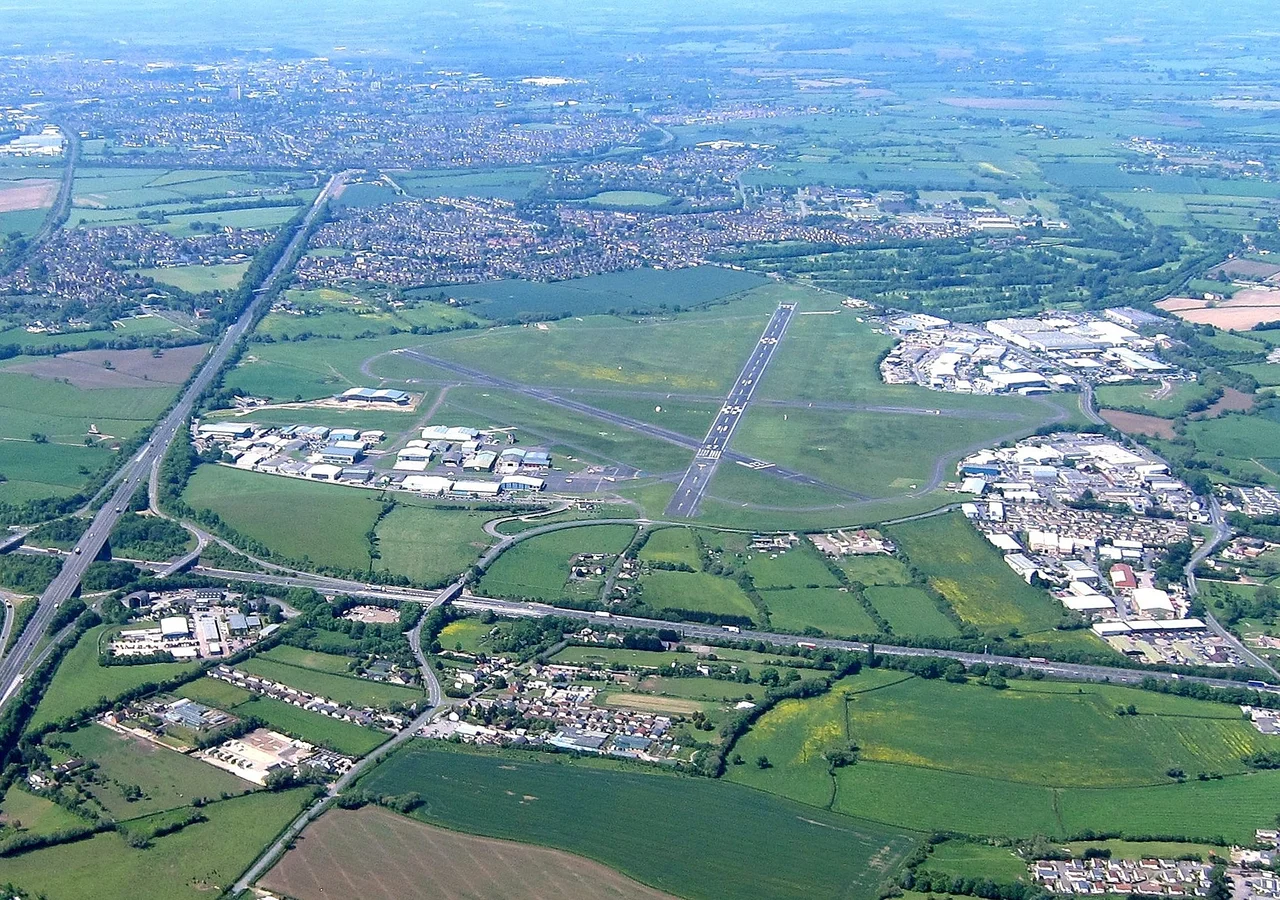
Gloucester sits at 51.865 degrees north, 2.246 degrees west, on the east bank of the River Severn just before the river widens toward the estuary. Best viewed from 3,000 to 6,000 feet. The cathedral's central tower, 225 feet high, dominates the skyline and is visible for miles - a 1966 planning rule has long protected views of it. Look for the docks immediately south of the city centre, the M5 running just to the east, and the long straight line of the Gloucester and Sharpness Canal heading southwest. Nearest airport is Gloucestershire Airport (EGBJ) at Staverton, eight miles east-northeast. Bristol (EGGD) is forty miles south.
Nearby Stories
- Grosmont Castle 4.8 km away
- Charfield Railway Disaster 9.8 km away
- Stratford-upon-Avon Canal 9.9 km away
- Droitwich Spa 11 km away
- Caerleon 12 km away
- Wigmore Castle 13 km away
- Church of the Holy Trinity, Stratford-upon-Avon 27 km away
- Marlborough Castle 29 km away