
Gold Coast
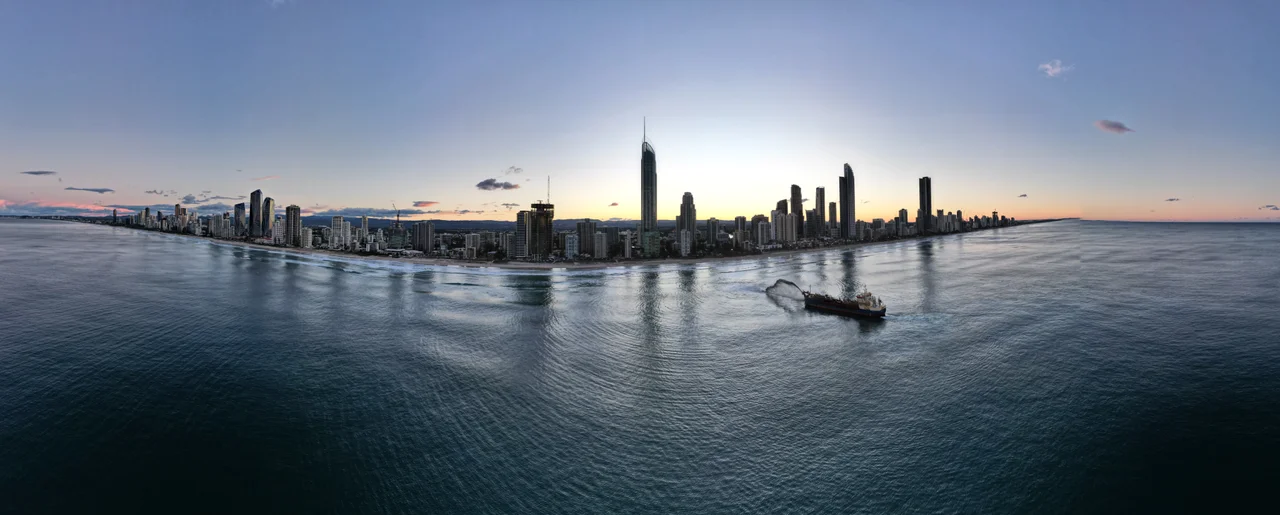
Step out onto the sand at Surfers Paradise and look back at the city, and you understand the name in an instant. A wall of glass towers rises straight off the dune line, throwing long shadows across the beach by late afternoon, while the surf rolls in unbroken and golden as far as you can see in either direction. This is the most concentrated stretch of holiday energy in Australia: 52 kilometres of ocean beach, a skyline that wouldn't look out of place in Miami, and theme parks, surf clubs and hinterland rainforest all within an hour of one another. Long before any of it, this was the country of the Kombumerri, the "Salt Water people," who have read these tides and headlands for thousands of years.
From Salt Water Country to Surfers' Paradise
The Kombumerri and their neighbours, clan groups who together spoke the Yugambeh language, lived between the Tweed and Logan rivers, and the coast still carries their names and their stories. Lieutenant James Cook charted the shoreline on 16 May 1770; Matthew Flinders sailed past in 1802; escaped convicts from the Moreton Bay settlement once hid in the scrub here. The glamour came later, and largely by marketing. In 1925 the Brisbane hotelier Jim Cavill opened the Surfers Paradise Hotel, and in 1933 he and the locals persuaded the authorities to rename the suburb of Elston "Surfers Paradise" — a name judged far more sellable than the alternatives. They were right. The brand built a city.
The Strip and the Sand
Most visitors picture the Gold Coast as one long thin ribbon of high-rises beside endless beaches, and from Surfers Paradise that picture holds. The city is now home to around 720,000 people, the largest urban area in Australia that isn't a state capital, sharing a labour market and a commuter rail line with Brisbane to the north. Surfers Paradise is the loud, bright heart of it: Cavill Avenue's souvenir shops and the back-arcade Japanese and Korean lunchboxes, surf clubs serving cheap beer and fresh fish on decks right above the breakers, and beaches patrolled between the red-and-yellow flags. Always swim between those flags — the rips here are serious, and the safest water is the water the lifesavers have chosen for you.
The Green Behind the Gold
Turn your back on the coast and a completely different Gold Coast appears. Promoted as "the green behind the gold," the hinterland climbs from the beachfront into the mountains of the Scenic Rim, draped in subtropical rainforest. The roads wind up to Tamborine Mountain with its lookouts, wineries and fudge shops, to Springbrook, to Lamington National Park, and to the Natural Bridge in the Numinbah Valley, where at night the cave ceiling glitters with glow-worms. Waterfalls, reservoirs and towering forest line the drives. It is genuinely beautiful country, and it sits a short drive from the casino floor — a contrast few cities can offer.
Theme-Park Capital
The Gold Coast is Australia's undisputed theme-park capital. Sea World perches on the Spit with its dolphins, rides and marine rescue work; Warner Bros. Movie World trades on Hollywood and Looney Tunes; Dreamworld piles on roller coasters; and Wet'n'Wild and WhiteWater World handle the water. Currumbin Wildlife Sanctuary brings koalas, kangaroos and crocodiles within reach. Several of the big parks share an owner, so combination tickets are worth chasing before you arrive. One word of caution that locals pass on: ignore the street vendors along Cavill Mall promising free park tickets, which come bundled with hours of high-pressure timeshare salesmanship. Buy from the official tourist booths instead.
Getting Around the Glitter Strip
The Gold Coast is easy to navigate once you know the spine of it. The G:Link light rail runs the length of the coast from Helensvale through Surfers Paradise to Broadbeach, with an extension toward Burleigh Heads under way; a planned extension to the airport was cancelled in 2025 following cost blowouts, leaving bus upgrades as the likely interim solution before the 2032 Olympics. A flat 50-cent public-transport fare makes hopping on trams and buses almost absurdly cheap. The airport itself is a curiosity: Gold Coast Airport straddles the Queensland–New South Wales border, so you can land in one state and step off the plane in another. From there it's about half an hour to the towers, the surf, and the long bright beach that gave the city its name.
From the Air
The Gold Coast runs along the coast around 28.0°S, 153.4°E, an unmistakable strip of high-rise towers between the Pacific surf and the green wall of the Scenic Rim hinterland. From the air the Surfers Paradise skyline, the canal estates, and the long line of beach from Paradise Point south to Coolangatta read instantly. Best viewed from 2,000–4,000 ft along the coastline. Gold Coast Airport (YBCG / OOL), straddling the QLD/NSW border at Coolangatta, is the primary field; Brisbane Airport (YBBN / BNE) lies about an hour north. Watch for fast-building summer afternoon thunderstorms rolling in from the west and sea-breeze haze along the beachfront.
Nearby Stories
- Tweed Regional Gallery 7.7 km away
- Purga Aboriginal Cemetery 19 km away
- North Stradbroke Island 21 km away
- Deebing Creek Mission 43 km away
- Bald Rock National Park 105 km away
- HMS Porpoise (1799) 636 km away
- Wreck Reefs 665 km away
- SS Elingamite: Gold, Fog, and a Captain Wrongly Blamed 1833 km away