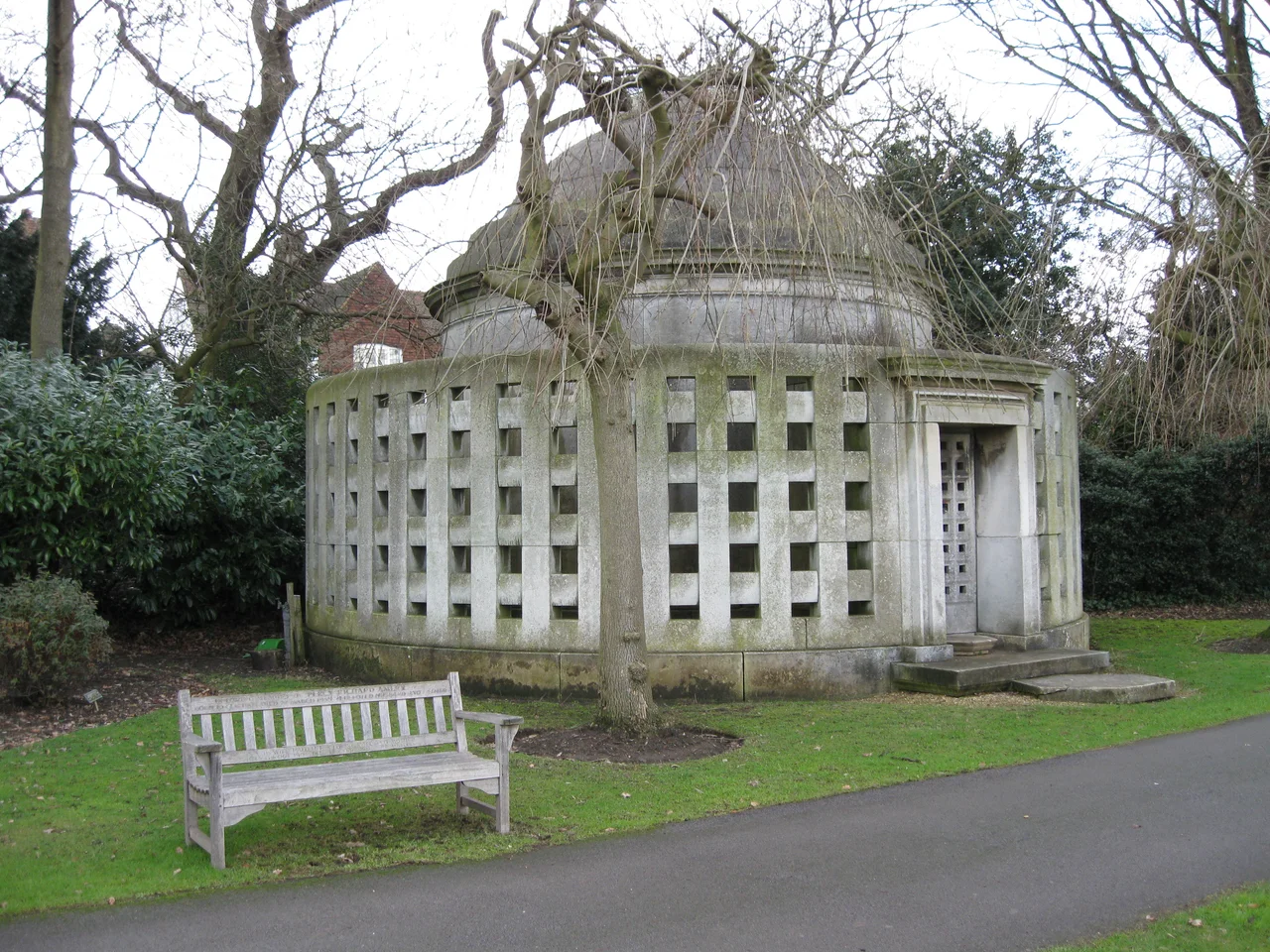

Golders Green Crematorium
A crematorium is, by definition, a place of endings. But Golders Green Crematorium in north London is also, more quietly, a kind of archive — a record of who shaped British culture across the 20th century and where their remains went afterward. Since its opening in November 1902, more than 323,500 cremations have taken place here, more than at any other British crematorium. The Italianate building set in Grade I listed gardens has received prime ministers and comedians, ballerinas and criminals, composers and playwrights. Almost none of them would have chosen Golders Green. Almost all of them ended up there.
London's First Fire
The land was purchased in 1900 for £6,000, and the crematorium was opened in 1902 by Sir Henry Thompson, surgeon and founder of the Cremation Society of England. At the time, cremation was a radical act — legally recognised in Britain only since 1884, and still viewed by many as irreligious or unnatural. Thompson had campaigned for its acceptance on public health grounds, arguing that burial was polluting groundwater. The building was designed by architect Sir Ernest George and his partner Alfred Yeates, with the gardens laid out by celebrated gardener William Robinson. The chimney was placed inside the tower, making the building's industrial function architecturally invisible. By 1939, the site was largely complete. The gardens were listed at Grade I in the National Register of Historic Parks and Gardens — one of the highest designations available.
Who Is Remembered Here
The list of people cremated at Golders Green functions as an unconventional history of British cultural life. Sigmund Freud and his wife Martha are here, as is their daughter Anna. Bram Stoker, who created Dracula, was cremated here; so was Peter Sellers, who made comedy of mortality. Marc Bolan of T. Rex, Ronnie Scott the jazz musician, Victoria Wood, Barbara Windsor, and Enid Blyton all passed through these chapels. The suffragist leader Dame Millicent Fawcett, the Russian ballerina Anna Pavlova, and the playwright Joe Orton join Kingsley Amis, Doris Lessing, and Lionel Bart — composer of Oliver! — in the Gardens of Rest. T.S. Eliot was cremated here, though his ashes were taken to St Michael's Church in East Coker, Somerset. H.G. Wells was cremated here, his ashes scattered at sea.
The War and the Marble
At the western end of the memorial cloister stands a Commonwealth War Graves Commission memorial designed by Sir Edward Maufe and unveiled in 1952. Built in Portland stone with names listed on three bronze panels, it commemorates 497 British and Commonwealth military casualties of both World Wars who were cremated at Golders Green. Their stories vary from decorated officers to ordinary servicemen, united by the fact that their families chose cremation rather than interment in military cemeteries. The memorial stands at the head of an ornamental pond, its formality contrasting with the naturalistic planting of the surrounding gardens.
A Garden of Distinctions
The gardens of Golders Green Crematorium are more than ornamental backdrop. Sculptor Henry Alfred Pegram's Into the Silent Land, a Grade II listed work, stands among the memorials. The largest sculpture portraying a person cremated here depicts Ghanshyam Das Birla, the Indian industrialist and friend of Gandhi. A Poets' Corner holds memorial plaques, including one for Vivian Stanshall of the Bonzo Dog Doo-Dah Band. The crematorium itself is secular — no single religion governs it — though at Christmas, a nativity scene appears near the Chapel of Memory. It is a place where distinctions of faith and social rank dissolve, and what remains is the simple fact of a life ended, commemorated among roses and ash trees in a north London suburb that barely existed when the building opened.
From the Air
Golders Green Crematorium is at approximately 51.577°N, 0.194°W in the London Borough of Barnet. The building's Italianate tower and surrounding gardens of 26 acres are visible from altitude among the dense residential streets of Golders Green. The nearest Underground station is Golders Green on the Northern line. Nearest airport: London City (EGLC, approximately 12nm east-southeast). At 2,500 feet AGL, the green expanse of Hampstead Heath is visible approximately one mile to the southeast.
Nearby Stories
- Stevenage 5.7 km away
- Malling Abbey 5.7 km away
- 1952 Farnborough Airshow Crash 7.7 km away
- Ingatestone Hall 8.2 km away
- Hellfire Caves 9.1 km away
- The Carrington Event: The Solar Storm That Could Happen Again 9.8 km away
- Bletchley Park 16 km away
- Castle Hedingham 23 km away