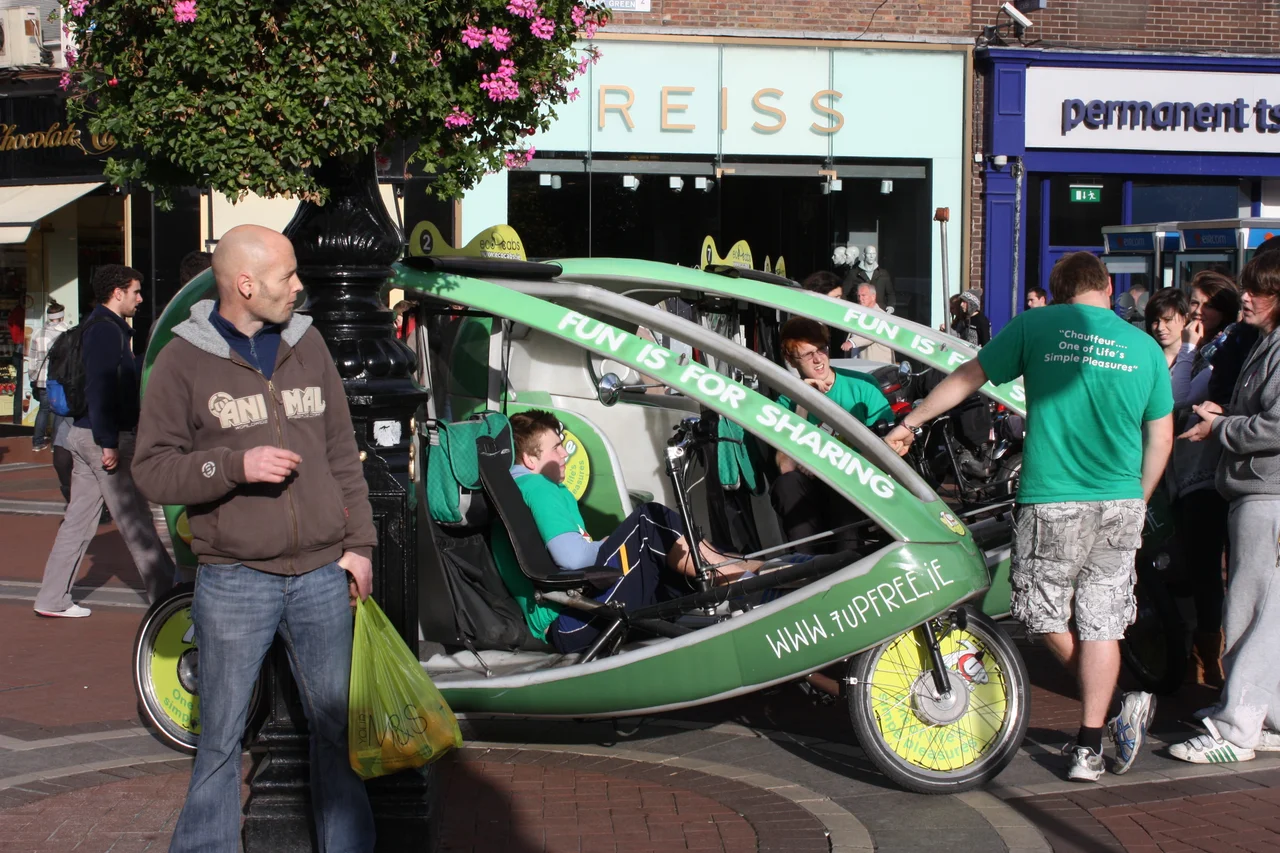

Grafton Street
The street curves because a river told it to. Beneath the paving stones of Grafton Street, the long-culverted Steyne traces the same line it cut through south Dublin centuries before there were shops here, before the pedestrian crowds, before Bono showed up on Christmas Eve with a guitar. Walk the half-kilometre from St Stephen's Green down to College Green and you are walking the channel of a vanished waterway, dressed today in granite paving and Christmas bulbs.
From Lane to Boulevard
By 1727 the development of Grafton Street was largely complete - a country path widened and built up, lined first with fashionable Georgian houses where theatre managers and novelists' families took first-floor apartments with dining rooms, bedchambers and closets. The street took its name from Charles FitzRoy, 2nd Duke of Grafton, Lord Lieutenant of Ireland from 1721 to 1724 and the illegitimate grandson of King Charles II. When Carlisle Bridge (today's O'Connell Bridge) opened across the Liffey in 1794, Grafton Street stopped being a polite cul-de-sac and became part of a great north-south thoroughfare. The residences emptied. Shops and taverns moved in. By the late 1800s almost nothing of the original residential character remained, and a street built for living had committed itself entirely to commerce.
Dear, Dirty Dublin
The Victorian century treated Grafton Street roughly. By 1849 several buildings on the street had broken windows patched with paper. In 1862 the Dublin Builder complained that the street "abounds in old premises in need of doctoring up." The dilapidation arrived alongside something darker: a heavy concentration of prostitution. In 1870 Dublin recorded 3,255 arrests for prostitution, compared to 2,183 in London and 1,617 in Manchester, and the women working Grafton Street were a significant share of that number. Tourist guides kept listing it as a fashionable destination even as moralists called it impassable. By the turn of the twentieth century the trade had migrated north of the river to the Monto district, and Grafton Street settled into a long second act as Dublin's premier address for department stores - Switzer's, Brown Thomas, the jeweller Weirs - and, eventually, the global high street names that arrived in the 1980s.
The Buskers' Mile
Pedestrianisation came in pieces. A four-week experiment in September 1971 cleared the cars temporarily; permanent pedestrianisation followed in 1982; the granite repaving and new lighting arrived in 1988. What grew in the space the traffic vacated was a sound. Since the 1980s Grafton Street has been one of the world's great busking pitches, and the list of musicians who have played here on the way to somewhere larger is a small history of Irish popular music: Damien Rice, Glen Hansard of the Frames, Paddy Casey, Mic Christopher, Dermot Kennedy. The opening scene of John Carney's 2007 film Once shows Hansard busking on this exact pavement. Each Christmas Eve, Bono leads the Big Busk to raise money for homeless charities, and in August 2024 Chris Martin of Coldplay turned up with Little Simz and Burna Boy for a promo shoot. The city regulates the magic - thirty euros for a yearly licence, sixty more if you amplify, one hour at a pitch, then a hundred metres away until the next day - but the magic persists.
Statues, Ghosts and Christmas Lights
The statue of Molly Malone stood at the top of Grafton Street for years, sheltering tourists' photos and locals' meeting plans, until 2014 when the Luas tram extension forced her around the corner to Suffolk Street. Around the corner the other way, on Harry Street, stands a bronze of Phil Lynott - leader of Thin Lizzy, Dubliner, dead at thirty-six - unveiled in 2005 and christened by Dubliners with the inevitable nickname: the Ace with the Bass. Vandals tipped him over in 2013; a truck hit him in 2017. He keeps coming back. Each December roughly three hundred thousand bulbs strung across the street form one of the city's defining sights. James Joyce sent Stephen Dedalus walking here. Patrick Kavanagh wrote of tripping lightly along the ledge in November. Ed Sheeran name-checks the street in "Galway Girl." When the Disney Store closed and Bewley's coffee house finally shuttered after the pandemic, locals mourned them as missing teeth in a familiar smile.
The Most Expensive Pavement
By 2008 Grafton Street had become the fifth most expensive main shopping street on the planet, with rents around 5,621 euros per square metre per year. By 2016 it had eased to thirteenth, at a still-startling 3,300 euros. Look closely between the international logos and the price will explain itself: this short stretch of Dublin compresses a king's grandson, a buried river, a Victorian collapse, a quiet Quaker coffee empire, and an unbroken line of musicians from the medieval pipers to whoever is busking today. The Provost's House of Trinity College still anchors the northern end. The Georgian plot widths still show on numbers 31 to 33. Number 14 keeps the window pattern of an early Dutch Billy house. The street is older than it looks, and somehow always newer than you remember.
From the Air
Grafton Street runs north-south through Dublin city centre at approximately 53.3414 degrees N, 6.2603 degrees W, between St Stephen's Green and College Green. From altitude it appears as a narrow pedestrian slot between the green square of the Green and the dark mass of Trinity College's playing fields. Dublin Airport (EIDW) lies roughly 10 km north; Weston (EIWT) sits west-southwest. Best viewed in clear morning light when low sun rakes the Georgian rooflines on either side of the street.
Nearby Stories
- Wicklow Mountains 12 km away
- Mornington 14 km away
- German submarine U-1051 16 km away
- Abbey of Kells 18 km away
- Irish Military Intelligence Service 20 km away
- HMS Manners (K568) 37 km away
- Templemore 42 km away
- Irish Sea Bridge 43 km away