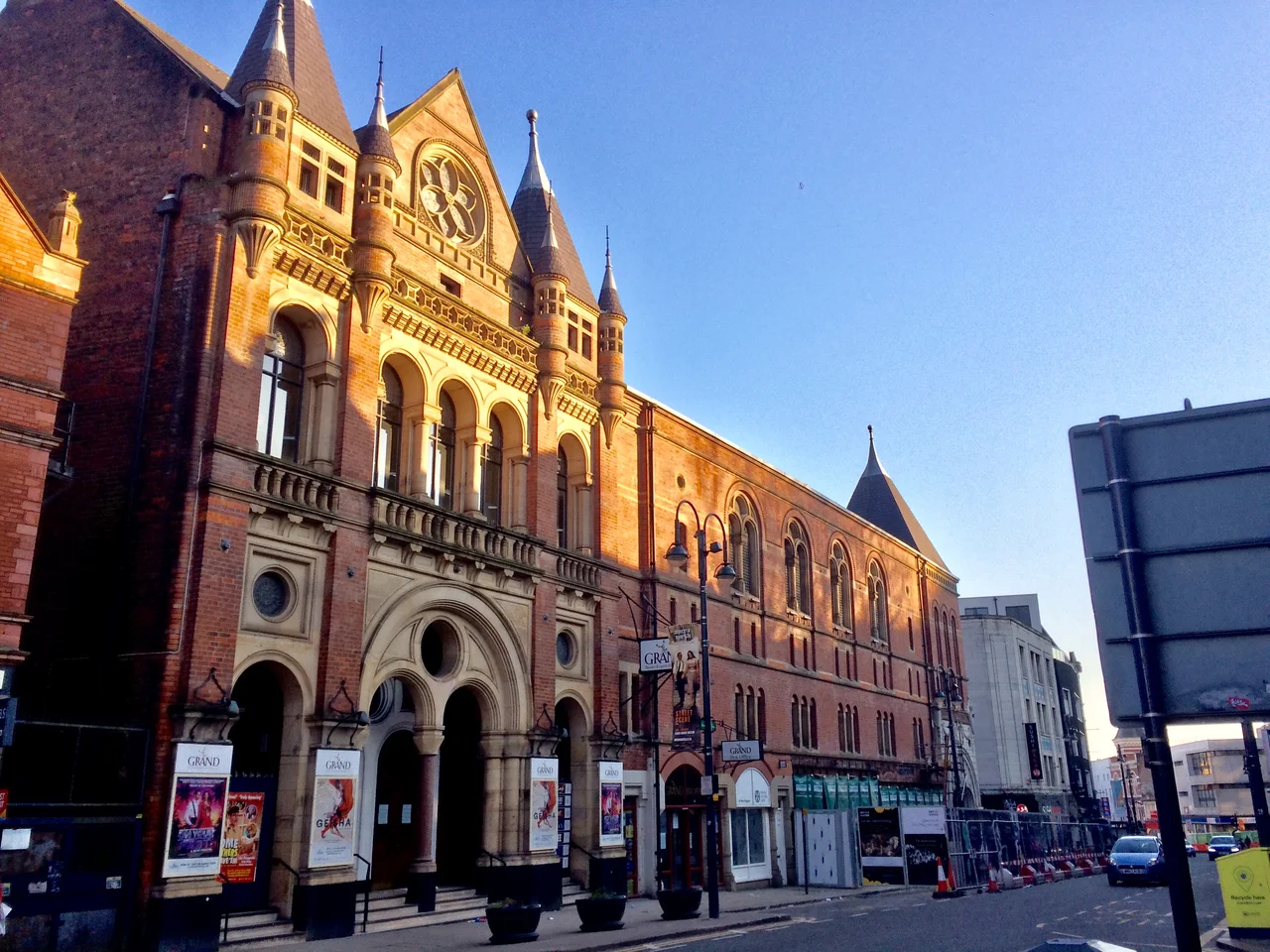

Grand Theatre, Leeds
Romanesque arches outside, Gothic fan-vaulting inside, Scottish baronial turrets on the roof. The Grand Theatre on Leeds's Briggate has never been bashful about its sources. It opened on 18 November 1878, and James Robinson Watson, the chief assistant to local architect George Corson, seems to have thrown every historical reference he could think of at the elevation. Behind the red brick and stone dressings, beneath the slate roof, sits one of the most active receiving houses outside London, home since 1978 to Opera North.
Three Buildings in One
The Grand was built as a complex, not a single auditorium. The theatre proper, six shops along the New Briggate frontage, and a set of Assembly Rooms all sat within the same High Victorian envelope, all facing the street together. The whole composition is Grade II* listed. Inside, the auditorium seats roughly 1,500, arranged in horseshoes around the proscenium and trimmed with the clustered columns and fan vaulting that Watson borrowed wholesale from medieval cathedrals. The Assembly Rooms became a cinema in 1907, the Assembly Rooms Cinema, then the Plaza from 1958. They have since come back to the theatre in a different guise.
From Pantomime to Opera North
For most of its first century, the Grand was run by the Howard and Wyndham chain, and the bill was the standard British fare of the touring era: plays, musicals, pantomime, revue. In 1970 Leeds City Council bought the building and began restoring it. Eight years later, the regional company Opera North was founded with the Grand as its home, and the theatre took on a second life as the operatic heart of the north of England. The relationship has shaped both organisations: the Grand has the stage, the pit, and the audience; Opera North has the company that fills them.
The Transformation
At the end of May 2005 the Grand closed for an estimated £31.5 million refurbishment that the theatre called, with capital-letter conviction, the Transformation. The stalls were reseated and reraked, the orchestra pit enlarged, and a state-of-the-art automated flying system installed in the grid above. Opera North gained two stage-sized rehearsal spaces and expanded offices to the south of the theatre, linked by a bridge and at street level. On 7 October 2006 the curtain came back up on Verdi's Rigoletto. A second phase restored the old Assembly Rooms as a second performance space, the Howard Assembly Room, now used for recitals, chamber operas, experimental work and education events for which the main house is too large.
What Comes Through Now
The new flying system did exactly what it was bought to do. The Grand can now host the largest West End and Broadway musicals: Phantom, Wicked, Shrek, Dirty Dancing, We Will Rock You, Oliver, Six, Priscilla, Heathers. Northern Ballet visit regularly, and Kay Mellor's Band of Gold had its world stage premiere here in November 2019. The theatre is run by Leeds Heritage Theatres, a brand launched in August 2020 that also runs the City Varieties Music Hall and the Hyde Park Picture House. The Grand closed again with the rest of British theatre in March 2020 and reopened in June 2021 with Northern Ballet's Swan Lake. The curtain has been going up six nights a week ever since.
From the Air
Located at 53.80°N, 1.54°W on New Briggate in central Leeds. From above, the Grand sits in the dense red-brick grid east of the Town Hall; look for the slate roof and the baronial turrets along Briggate. Leeds Bradford Airport (EGNM/LBA) is the nearest commercial field, 7 miles northwest. The city sits in the eastern foothills of the Pennines; visibility is best when the prevailing westerly clears the smoke and weather from the moors.
Nearby Stories
- Hovingham Hall 6 km away
- RAF Elvington 7.6 km away
- Battle of Hatfield Chase 9.1 km away
- Wentworth Castle 11 km away
- Murder of Suzanne Capper 12 km away
- Pendle Hill 13 km away
- RAF Topcliffe 15 km away
- Hawes Junction Rail Crash 26 km away