
Grange-over-Sands
There were once two Granges, and the post kept going to the wrong one. The other was a small farming hamlet in Borrowdale, near Keswick, and by the late 19th century the local vicar at this Grange - the resort one, on the north side of Morecambe Bay - had had enough. He started adding 'over-Sands' to the name. The suffix stuck. It survived him by more than a hundred years, kept on the maps and the railway tickets long after the sands themselves did something he could not have predicted: they stopped being sands at all.
A Town the Railway Made
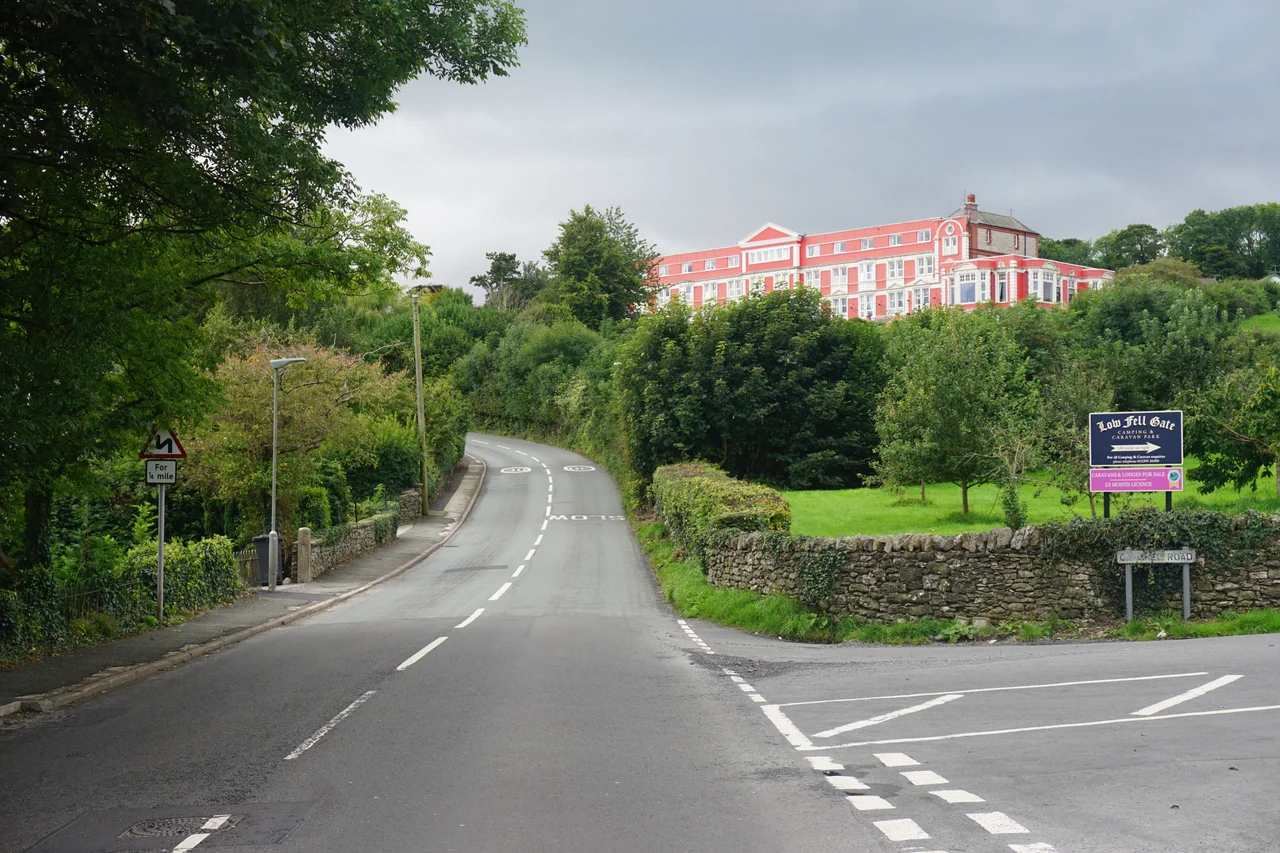
Before 1857, Grange was a fishing village clinging to the northern lip of Morecambe Bay. Then the Ulverston and Lancaster Railway pushed a line through, and a station opened on 1 September of that year. Trains brought tourists. Tourists brought money. Within a generation Grange had reinvented itself as a Victorian seaside resort on a mile-long promenade, with hotels and boarding houses lining the front and the bay glittering beneath. In 1894 the town was given the status of urban district. It joined a small wave of similar resorts on the English northwest coast, each promising sea air, spring water, and respectability. By 1932 a Grade-II-listed lido was built on the seafront - an art-deco rectangle of blue water that closed in 1993 and has been the subject of restoration campaigns ever since.
The Sands That Vanished
Grange's defining feature - the sands of the suffix - have been migrating away from the town for decades. The River Kent used to flow past the promenade. Its course gradually shifted south, abandoning the foreshore. What had been a tidal strand of mudflats and notorious quicksands became a flat green meadow grazed by small flocks of sheep. The promenade still runs the full mile, but for years it looked out across pasture rather than water. Then, in the early months of 2007, sustained easterly winds nudged the river back toward its old channel. The town has been watching the bay's mood ever since. Across the water lies the resort of Morecambe; once, before the railway, the principal route between them was a tracked crossing over the sands themselves from Hest Bank.
Sea Air and Sanatoria
The clean salt air that drew Victorian holidaymakers also drew the medical establishment. In 1891 one of the first sanatoriums in Britain was established at nearby Meathop, on the belief that the air and local spring water would help patients with tuberculosis. The town's later attempts at public swimming have been less fortunate. A 3.5-million-pound Berners Pool, designed by Hodder Associates and winner of a RIBA Design Award in 2004, opened in 2003. Running costs and structural problems forced it to close in 2006. It was demolished in 2013 and the site became affordable housing. The campaign to reopen Grange Lido has, by contrast, kept going - the derelict art-deco building opened for public tours in August 2019.
Hampsfell and Its Hospice
Above the town rises Hampsfield Fell, almost always shortened to Hampsfell. At its 727-foot summit stands the Hampsfell Hospice - a sturdy limestone tower built in 1846 by the vicar of Cartmel as shelter for walkers caught in bad weather. The eastern doorway carries a line from Homer: RODODAKTYLOS EOS, 'rosy-fingered Dawn.' Painted boards inside praise the view and welcome visitors. Up a flight of stone steps onto the roof, a crude alidade lets you sight nearby peaks and identify them. Alfred Wainwright devoted a chapter to Hampsfell in his Outlying Fells of Lakeland. The summit is fringed with the strange shattered geometry of limestone pavement.
A Quieter Coast
Today Grange has 4,279 residents, give or take, and serves as a base for visitors who want southern Lakeland without the Lakeland crowds. There is an ornamental duck pond, a traffic-free promenade, hotels and B&Bs, and a steady stream of walkers heading for the limestone pavements of Hampsfell or south to the marshes. Holker Hall sits a few miles west; Cartmel and its priory are a short drive northwest. The town shares its parish church and primary school with one of the prettiest stretches of the Cumbrian coast. In December 2019 National Geographic published a piece encouraging readers to 'resist the lure of the Lake District' and explore this gentler coastline instead. The article recommended Grange. The town, in its quiet way, agrees.
From the Air
Grange-over-Sands sits at 54.19N, 2.915W on the north shore of Morecambe Bay in southern Cumbria. From altitude the mile-long promenade and the wooded bulk of Hampsfell directly behind the town are the clearest landmarks. The shifting tidal channels of the Kent estuary spread out to the south. Nearest airports are Walney Island (EGNL) about 18 nm west, Carlisle Lake District (EGNC) 45 nm north, and Blackpool (EGNH) 32 nm south. Recommended viewing altitude 2,000-3,000 ft AGL; the Lake District fells push higher to the north.
Nearby Stories
- Red Tarn 4.2 km away
- Fleetwood Lifeboat Station 4.3 km away
- St Bees Priory 5 km away
- Brough Castle 9.5 km away
- Sawley Abbey 9.8 km away
- Hawes Junction Rail Crash 15 km away
- Egremont Castle 28 km away
- Celtic Array 63 km away