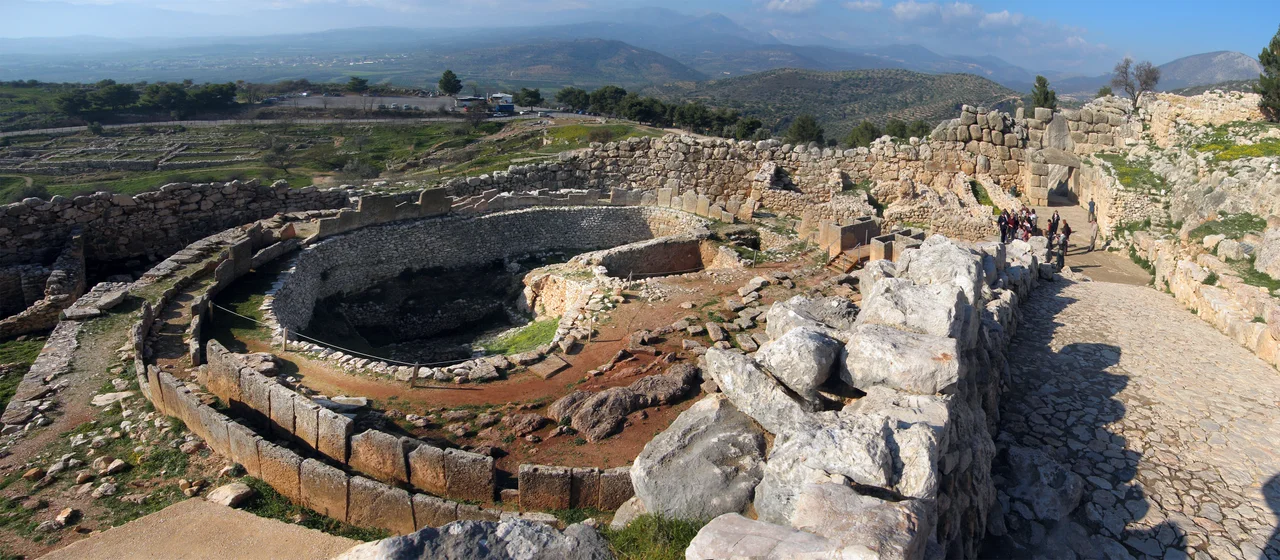

Grave Circle A, Mycenae
Heinrich Schliemann believed Homer. Not metaphorically, not as a scholar entertaining a hypothesis, but with the conviction of a man who had taught himself ancient Greek by reading the Iliad aloud until he wept. In 1876, he sank his spades into the acropolis of Mycenae and found, within a circular enclosure southeast of the Lion Gate, six shaft graves packed with gold. He telegraphed the King of Greece. He claimed he had looked upon the face of Agamemnon. He was wrong about the identity — the burials predate the Trojan War by at least two centuries — but about everything else he was spectacularly, world-changingly right.
Six Graves Inside a Circle
Grave Circle A is a roughly circular enclosure 27.5 meters in diameter, defined by a double ring of limestone slabs set upright in the ground. It sits within the citadel walls of Mycenae, which were deliberately extended during the 13th century BCE to enclose this burial ground — a decision that reveals how important the Mycenaean rulers considered the dead inside. The circle contains six shaft graves. The smallest measures 3 by 3.5 meters; the largest, 4.5 by 6.4 meters. Their depths range from one to four meters. Over each grave, a mound of earth was piled, and carved stone stelai were erected above to mark and memorialize the occupants. The graves date to the 16th century BCE, placing them squarely in the early Mycenaean period, when this civilization was consolidating power across the Greek mainland.
What They Buried With Their Kings
The grave goods found in Grave Circle A tell a story about power, identity, and the world these people inhabited. Men went to their graves with weapons — decorated daggers with blades inlaid with gold, silver, and niello, objects too beautiful to use in battle and too elaborate to be anything but art. A scepter from Grave IV, ornamented in gold, signals the political authority of whoever carried it. Women received jewelry: gold pins, rings, necklaces. Swords, spears, and bronze vessels accompanied the men. Bulls' heads with double axes among the grave goods carry unmistakable Minoan influence — at the time these graves were dug, Mycenae had not yet conquered Minoan Crete, but it clearly admired Cretan craftsmanship. The objects in Grave Circle A represent what scholars call an 'international style': motifs and techniques drawn from Minoan Crete, the Near East, and Egypt, filtered through a distinctly Mycenaean aesthetic that favored hunting and combat scenes over the natural world the Minoans preferred.
Schliemann's Excavation
The 1876 excavation at Mycenae was the first modern archaeological dig in Greece. Schliemann worked alongside Panagiotis Stamatakis, the Greek archaeologist appointed by the Greek government to supervise the work — a supervision that frequently put the two men at odds, since Schliemann's methods were driven by his desire to find treasure rather than to document context. What he found exceeded even his expectations. Gold death masks covered the faces of the male burials. One mask, with a strong-featured bearded face, he declared the Mask of Agamemnon and telegraphed the news across Europe. Stamatakis, more cautious, was right to be skeptical of the identification. The burials in Grave Circle A date to the 16th century BCE. The Trojan War, if it happened at all, is traditionally placed in the 13th or 12th century BCE. The man whose face the gold preserves was not Agamemnon — but he was a Mycenaean king, and that turns out to be remarkable enough.
The Dead and Their City
Perhaps the most telling fact about Grave Circle A is where it sits. When the fortification walls of Mycenae were expanded in the 13th century BCE, the builders could have left the old burial ground outside the new perimeter. Instead, they shifted the circuit walls outward to enclose it, incorporating the graves of ancestors who had been dead for two centuries into the defended space of the living city. The grave stelai above the shafts were reset at a higher level to remain visible after the ground level was raised. This was not a logistical convenience. It was a statement: these dead were not merely remembered, they were citizens. The authority of the living rulers drew on the prestige of the buried ones, and the Cyclopean walls that the Cyclopes allegedly built wrapped around both with equal care.
From the Air
Grave Circle A lies within the acropolis of Mycenae at approximately 37.731°N, 22.756°E, in the northeastern Peloponnese. From the air at 3,000–5,000 feet, the citadel's triangular outline is clearly visible on its hilltop, with the circular enclosure of Grave Circle A identifiable just inside and southeast of the Lion Gate. The village of Mykines lies below. The nearest major airport is LGAV (Athens International Eleftherios Venizelos), approximately 100 km to the northeast. The Argive plain lies to the south and west, and the Corinthian Gulf is visible on clear days to the north. Morning flights offer the best light on the hill's eastern face.
Nearby Stories
- Villa of Herodes Atticus 3 km away
- Sicyon 3.5 km away
- Battle of Megalopolis 4.5 km away
- Hermione: The City at the Edge of the World 7.5 km away
- Agia Lavra 7.7 km away
- Megara 13 km away
- Agistri 13 km away
- Teuthis 15 km away