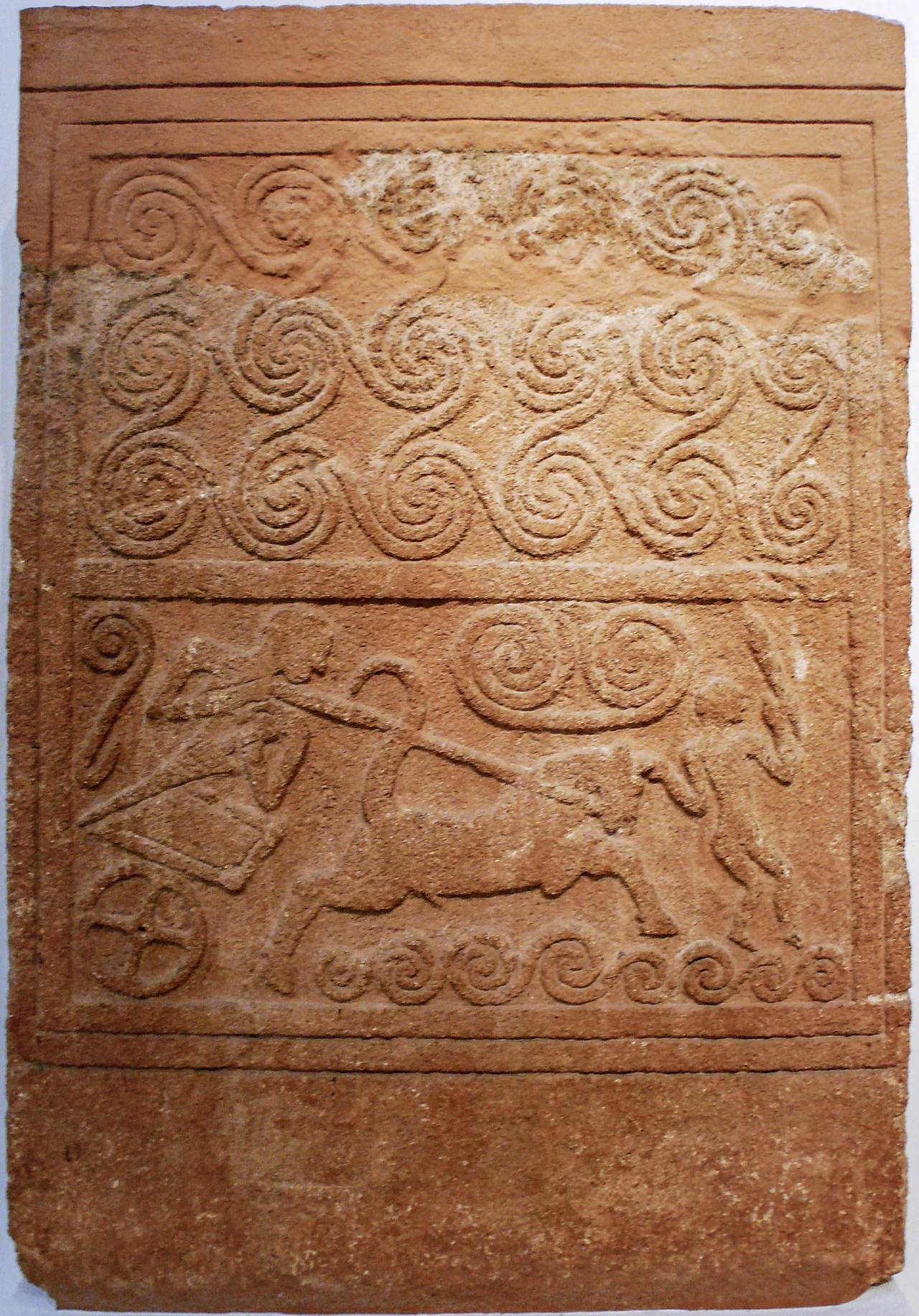

Grave Stelai from Grave Circle A, Mycenae
They stood above the graves like sentinels. Upright rectangular slabs of oolitic limestone, some carved with galloping horses and wheeling chariots, others with spiraling abstract designs, they marked the burial places of Mycenaean rulers across a span from roughly 1600 to 1500 BCE. The men who raised these stelai above Grave Circle A were not yet Greeks in any classical sense — they lived a thousand years before Pericles, three centuries before the Trojan War. But they had something to say about power and death, and they said it in stone.
What the Carvers Made
At least 21 stelai have been recovered from Grave Circle A, with 12 preserving enough relief carving to read clearly. All were cut from oolitic limestone, the same material used throughout Mycenaean construction. Most were upright rectangular slabs, some quite large, some fragmentary. The carvings divide roughly into two visual languages. Figurative panels show chariots in motion — horses at full gallop, drivers leaning forward, wheels rendered as circles with spokes — alongside hunting scenes with armed men pursuing prey. Abstract panels frame these scenes with borders of spirals and wave patterns, designs also found in Minoan art and across Bronze Age Mediterranean cultures. Three stelai specifically depict chariot scenes. Others show only fragments: a horse's head, a pair of feet, the arc of a wheel. Stele VI, sometimes called the 'Horsey' stele, shows four rearing horses stacked vertically, their bodies overlapping in a composition that reads as either confusion or energy depending on your generosity toward the carver.
Reading the Chariots
Scholars have argued for decades about what the chariot scenes mean. The most common interpretation reads them as evidence of a warrior culture — a civilization that valued combat, prized horsemanship, and commemorated its elites by depicting them in the activities that defined elite status. Chariots in the Bronze Age Near East and Egypt were primarily military vehicles, symbols of prestige and instruments of war. By depicting chariots above graves, Mycenaean carvers were advertising the social position of the dead. The stele was a small thing compared to what came later. Scholars note that the shaft grave stelai, intimate markers maintaining ties among the elite, were eventually superseded by the tholos tomb — a far more monumental form of burial that made its claims on the landscape from a distance rather than a few feet above the ground. The stelai mark a transitional moment: memory was becoming architecture.
Reset and Remembered
When Mycenae's fortification walls were expanded in the 13th century BCE to enclose Grave Circle A, the stelai that stood above the shafts were not abandoned. They were carefully reset at a higher ground level, maintaining their visibility above a new fill layer. Someone — some official, some priest, some descendant — cared enough about the graves below to preserve the markers above them. This is not a small thing. The burials were by then two centuries old. The stelai were already antiques. Their preservation tells us that the Mycenaeans understood they were maintaining a connection to a specific past, not just a vague ancestral tradition. The graves below the stelai were part of a living political argument about legitimacy and continuity.
Where They Are Now
Most of the stelai from Grave Circle A are now held at the National Archaeological Museum of Athens, where they can be seen alongside the gold grave goods Schliemann unearthed in 1876. Some stelai remain at the site. To stand at Mycenae today, near the spot where the stelai once stood, and to know that their carved surfaces once caught the Argolid light the same way — horses and spirals casting shadows at sunrise — is to close a gap that three and a half millennia would seem to make impossible. The carvers who made them could not have imagined where they would end up. But they built to be seen, and they still are.
From the Air
The stelai originally stood within Grave Circle A on the acropolis of Mycenae at approximately 37.731°N, 22.756°E, northeastern Peloponnese. From the air at 3,000–5,000 feet, the citadel is visible as a hilltop enclosure above the village of Mykines. The stelai themselves are now held at the National Archaeological Museum of Athens and cannot be seen from altitude at Mycenae. Nearest major airport is LGAV (Athens International Eleftherios Venizelos), approximately 100 km to the northeast. Approach from the northeast along the Corinthian Gulf corridor offers the clearest views of the Argolid landscape that these carvings depicted.
Nearby Stories
- Villa of Herodes Atticus 3 km away
- Sicyon 3.5 km away
- Battle of Megalopolis 4.5 km away
- Hermione: The City at the Edge of the World 7.5 km away
- Agia Lavra 7.7 km away
- Megara 13 km away
- Agistri 13 km away
- Teuthis 15 km away