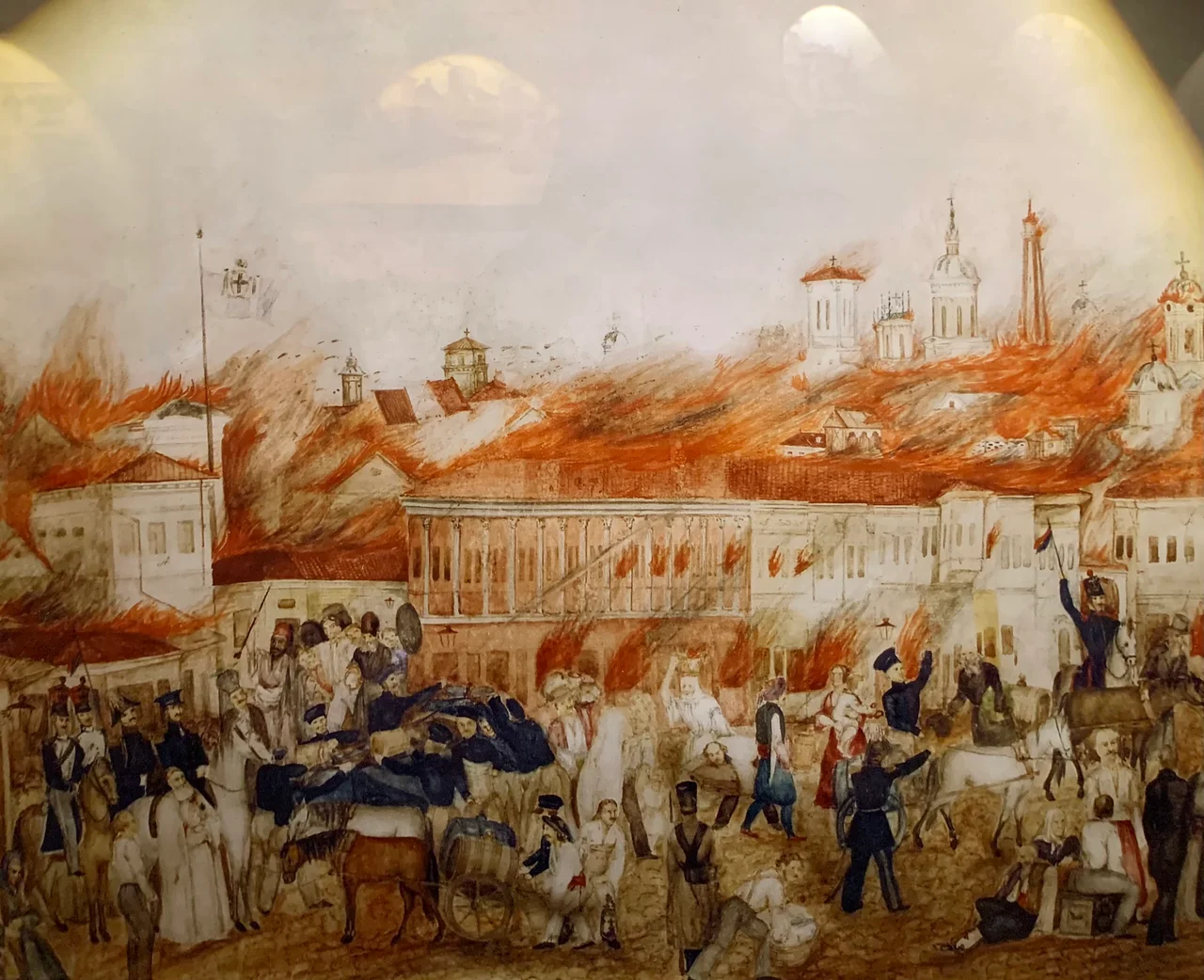

Great Fire of Bucharest
The wind that day had a name. Bucharest residents called it the austru, the dry southern wind that bullied across the Wallachian plain in spring, and on 23 March 1847 it found a spark and turned it into the largest fire the city had ever seen. By the time the flames died, 1,850 buildings were gone. Around 10,000 people had nowhere to sleep that night. Prince Gheorghe Bibescu would later describe the burned ground as the most populated and richest part of Bucharest, which is another way of saying that the fire took the lives most people had spent their whole lives building.
Wood and Wind
Bucharest in 1847 was a city of wood. The Phanariote and early Wallachian eras had layered timber houses along narrow lanes, each crowded against the next, the way cities grow when land is precious and lumber cheap. Authorities had worried about fire for generations. Watch posts had stood near the Aghia's residence and the Spatar's quarters since the 18th century. Under the Organic Regulations of the 1830s, a modern fire brigade had been organized with Western European pumps. None of it was enough on a day when the austru blew at full strength. The fire spread in a triangle from where it began. One vertex pointed toward Curtea Veche, the old princely court, and the artillery building on Pusscaria Square. The other reached north toward Lipscani, the merchants' street, and the Inn of St. George with its monastery.
What Was Lost
The list reads like a survey of everything a 19th-century European city might value. New and Old St. George's Churches. The Papazoglu Inn. Hanul lui Zamfir. Baratia, the Catholic mission. The artillery depot. The Strada Frantuzeasca, the French Street. The Strada Smardan, then called Strada Nemteasca, the German Street. Targul Cucului, the Cuckoo's Market, where commerce had hummed for generations. Mahalaua Stelei. Udricani. Lucaci. Saint Friday and Saint Stephen, the parish churches that anchored neighborhoods. The official damage figure came to 100 million lei, but no ledger captures the smaller losses: a craftsman's tools, a family's documents, a wedding chest carried out of one country and into another. About 10,000 people lost their homes. Most were artisans, shopkeepers, and laborers whose livelihoods burned with their workshops.
The Slow Work of Help
Money came in from everywhere a Wallachian state could squeeze it. The Romanian Orthodox Church Metropolis pledged a quarter of its annual income, 500,000 lei. The National Bank gave its full annual income, 220,000 lei. Greek-owned monasteries on Romanian soil contributed 700,000 lei. The treasury opened its reserve fund for 300,000 lei. Clerks and soldiers gave a month's wages, contributing another 300,000 lei. The City Hall added 180,000. A merchants' commission was charged with distributing the funds and oversaw mandatory contributions from clerical salaries and church incomes, which caused friction with the poor craftsmen who felt the levies were hurting them more than helping. Some petitioners refused the charity altogether, the records suggest, because accepting felt worse than rebuilding alone. By April 1848, the commission's final report tallied 3,195,759 lei distributed to 2,887 households. Fifty-two people had still refused their share.
Major Borroczyn's New City
Out of the ash came an opportunity to design Bucharest the way 19th-century planners thought a capital should look. Major Rudolf Arthur von Borroczyn, head of the technical section of the rebuilding commission, kept the medieval street grid but pushed the lanes wider and imposed building rules that would slow the next inferno. Out went the dense wooden houses. In came two-story brick structures with shops and warehouses on the ground floor and family quarters above, in the style merchants had brought back from Vienna and Pest. Walk Lipscani today and you see Borroczyn's Bucharest: stone and brick, pediments and ironwork balconies, the bones of a 19th-century commercial city laid over the burned outline of an older one. The fire did not just destroy a third of Bucharest. It set the template for the modern city the Romanian capital became.
What the Maps Remember
Streets still carry the names that burned. Strada Smardan and Strada Franceza run where the German and French commercial streets ran in 1847. Curtea Veche stands as a ruin you can visit, the medieval princely court where Vlad the Impaler once issued his most famous documents. Lipscani is a pedestrian zone now, full of restaurants and bars, and at night the wooden Bucharest is impossible to picture. But on the morning of 23 March every year, anyone who knows the date knows what the wind once did here, and how a city had to learn the hard way how to build itself in stone.
From the Air
Located at 44.43 degrees north, 26.10 degrees east, in central Bucharest, Romania. The historic district sits in the Wallachian Plain, with the Dambovita River curving through. Henri Coanda International Airport (LROP) lies 16 kilometers north; Aurel Vlaicu (LRBS) is 8 kilometers north. From cruising altitude Bucharest spreads as a roughly oval city on a flat plain, with the Carpathian foothills visible 100 kilometers to the north on clear days.
Nearby Stories
- National Transport Museum, Bulgaria 34 km away
- Slanic Mine 68 km away
- Sinaia 79 km away
- Great Basilica, Pliska 87 km away
- Sinaia Monastery 108 km away
- Holy Forty Martyrs Church, Veliko Tarnovo 115 km away
- Shumen Fortress 126 km away
- Danube Delta 227 km away