
Great Mull Air Mystery
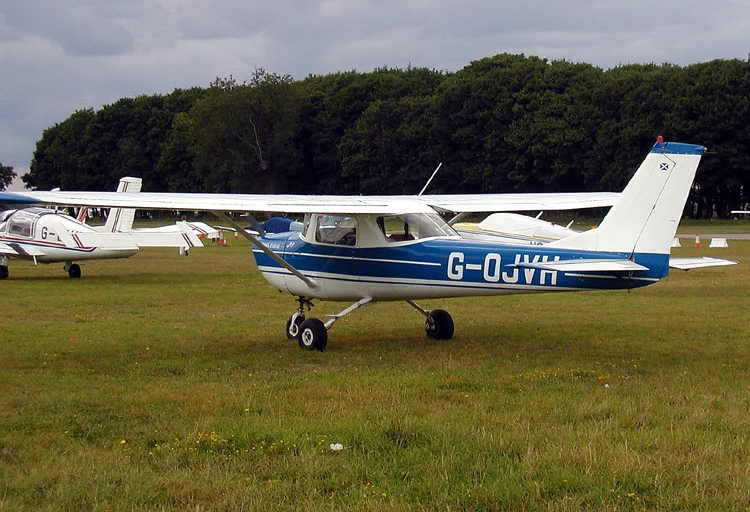
Peter Gibbs flipped the landing lights of his Cessna F150H off, then on, then off again. The witness, Howitt, was watching from a car parked beside Glenforsa's grass airstrip on the north coast of Mull. There were no runway lights. The night was moonless. It was Christmas Eve, 1975. Gibbs took off anyway, climbed into the dark above the airfield, and disappeared behind a line of trees. Howitt dipped the car's headlights toward the sea, hoping to catch a reflection. Nothing. The search that followed was described in newspapers as huge. It extended through the Christmas holiday and into the new year. Gibbs was not found. The plane was not found. Four months later, in April 1976, a hillside walker discovered a body. The body was Gibbs. The plane has never been satisfactorily explained.
Glenforsa, Christmas Eve
Glenforsa Airfield was built by the Royal Engineers between May and August 1965, the only fixed-wing air ambulance evacuation facility on Mull. The strip is grass, a single 780-metre run along the flat ground beside the Sound of Mull. In 1975 it had no runway lighting of any kind. Pilots flying in or out after dark relied on landing lights, headlights from cars positioned along the strip, and weather conditions clear enough to see the ground. Peter Gibbs was a businessman, the managing director of a property development company called Gibbs and Rae, and an experienced pilot. His Cessna F150H bore the registration G-AVTN and was painted red and white. On the morning of 24 December 1975, Gibbs and his partner Felicity Grainger had flown from Mull to Broadford on Skye, spent the day looking at properties they were considering buying, and returned to Glenforsa in the late afternoon. The decision to fly again that night, alone, on a moonless evening, was his own. No one ever established why he made it.
Off, On, Off
Witnesses described the landing-light sequence in detail. The plane was on the strip, engine running. The lights flicked off. Then on. Then off again. Gibbs lined up and took off into the dark, climbing over the airstrip and then beyond it. Howitt, watching from a parked car, saw the plane disappear behind a row of trees. He dipped his car's headlights toward the water immediately beyond, expecting to see a reflection if the aircraft had ditched into the Sound. He saw nothing. The search began that night. By Christmas morning a coordinated effort involving aircraft, ground parties, and shore searches was underway. It continued through the holiday and into January. No wreckage was found in the Sound, on the surrounding shores, or anywhere within plausible flying range. The Cessna had gone.
April on the Hillside
In April 1976, four months after the disappearance, a hillside walker found Gibbs's body on a slope near the airfield. The remains were heavily decomposed; the clothing was effectively all that was holding them together. The body lay facing due north, the orientation suggesting Gibbs had been walking downhill when he stopped. There were no visible injuries. The body was taken to Glasgow for post-mortem examination. Forensic tests detected no salt deposits or marine organisms on the clothing or boots, which would have been expected if Gibbs had swum ashore from a ditched aircraft. The post-mortem revealed no obvious cause of death. The mystery was now twofold: where the plane had gone, and how Gibbs had reached the hillside uninjured and yet died there. No theory has accounted for both questions at once.
The Plane on the Sea Bed
In 2004, divers searching the sea bed of the Sound of Mull found the wreck of the Cessna F150H. The windscreen was missing. Both cabin doors were locked. No remains of any passenger or pilot were inside. The discovery added a new piece of evidence without resolving anything. If Gibbs had been on board when the plane went into the water, how did he get out through a locked door? If he had ditched the plane offshore, swum to land, and walked uphill, why were there no marine traces on his clothing? The plane had clearly entered the sea. Gibbs had clearly walked some distance on land. The two facts have never been satisfactorily joined. BBC Radio 4 returned to the case in 2015 for an episode of Punt PI; The Independent revisited it in 2004; Mull's historical and archaeological society has assembled the available evidence in detail. None of the inquiries has solved it. The hillside, the locked doors, and the missing windscreen remain what they were on Christmas Eve 1975: questions without answers.
From the Air
Coordinates 56.517°N, 5.913°W near Glenforsa Airfield on Mull's north coast. The grass strip remains active for light aircraft; pilots should consult current NOTAMs as facilities and lighting may have changed since the 1975 incident. Best viewed at 800-1,500 feet AGL with the Sound of Mull immediately to the north, Salen village to the west, and the hills inland to the south. Nearest paved airports: Oban (EGEO) 15 nm southeast on the mainland, Tiree (EGPU) 40 nm west. Glenforsa's grass surface, sea-level location, and surrounding terrain demand careful weather assessment, particularly in low cloud or after dark.
Nearby Stories
- Castle Tioram 1.9 km away
- Cairnburgh Castle 3.3 km away
- Lunga, Firth of Lorn 7.2 km away
- Bonawe Iron Furnace 8.8 km away
- West Highland Museum 11 km away
- Inveraray Castle 12 km away
- Bullough Mausoleum 22 km away
- Dubh Artach 23 km away