
Greece in the Roman Era
Horace said it plainly, in Latin, in a line that has rattled through history ever since: Graecia capta ferum victorem cepit — captive Greece took captive her fierce conqueror. Rome marched into the Greek peninsula in 146 BC, sacked Corinth, and planted its legions across the ancient land of philosophy and gods. Then something unexpected happened. The defeated people began to defeat their victors — not with swords, but with ideas, language, literature, and art. For six centuries, the story of Greece under Rome is the story of a paradox: a conquered civilization that never quite submitted.
The Conquest That Cut Both Ways
The Roman takeover was neither swift nor bloodless. For decades the Republic had been dismantling Greek power piece by piece, defeating the Kingdom of Macedon in a series of Macedonian Wars and checking Greek ambitions at every turn. The decisive blow fell in 146 BC at the Battle of Corinth, when the Roman consul Lucius Mummius razed that proud city to the ground and scattered its people into slavery. Macedonia became a Roman province. Southern Greece came under Roman hegemony, though certain city-states avoided direct taxation and kept a shadow of autonomy. Even that shadow would shrink. In 88 BC, Athens and allied cities rose in revolt and were crushed by the general Lucius Cornelius Sulla. The civil wars that followed left Greece physically and economically devastated — fields burned, cities stripped, populations reduced to poverty. Augustus reorganized the peninsula as the province of Achaea in 27 BC, and under his steady administration the long recovery began.
The Empire Athens Built Inside Rome
Roman nobles who sneered at Greeks as backwards and petty were, in the next breath, hiring Greek tutors for their children and furnishing their libraries with Greek manuscripts. The educated elite spoke Greek as a mark of sophistication. Scipio Africanus studied Greek philosophy and regarded Greek culture as an example to be followed. Homer's epics inspired Virgil's Aeneid; Seneca the Younger wrote in styles borrowed from Athens. Greek physicians such as Galen conducted their careers in Rome itself. The Greek language became the lingua franca of the empire's entire eastern half. When Nero visited Greece in 66 AD, he performed at the Ancient Olympic Games — bending the rules that excluded non-Greeks — and was declared victor in every contest. The following year he proclaimed Greek freedom at the Isthmian Games in Corinth, a theatrical gesture that said as much about Roman admiration as it did about power.
Hadrian's Gift to Athens
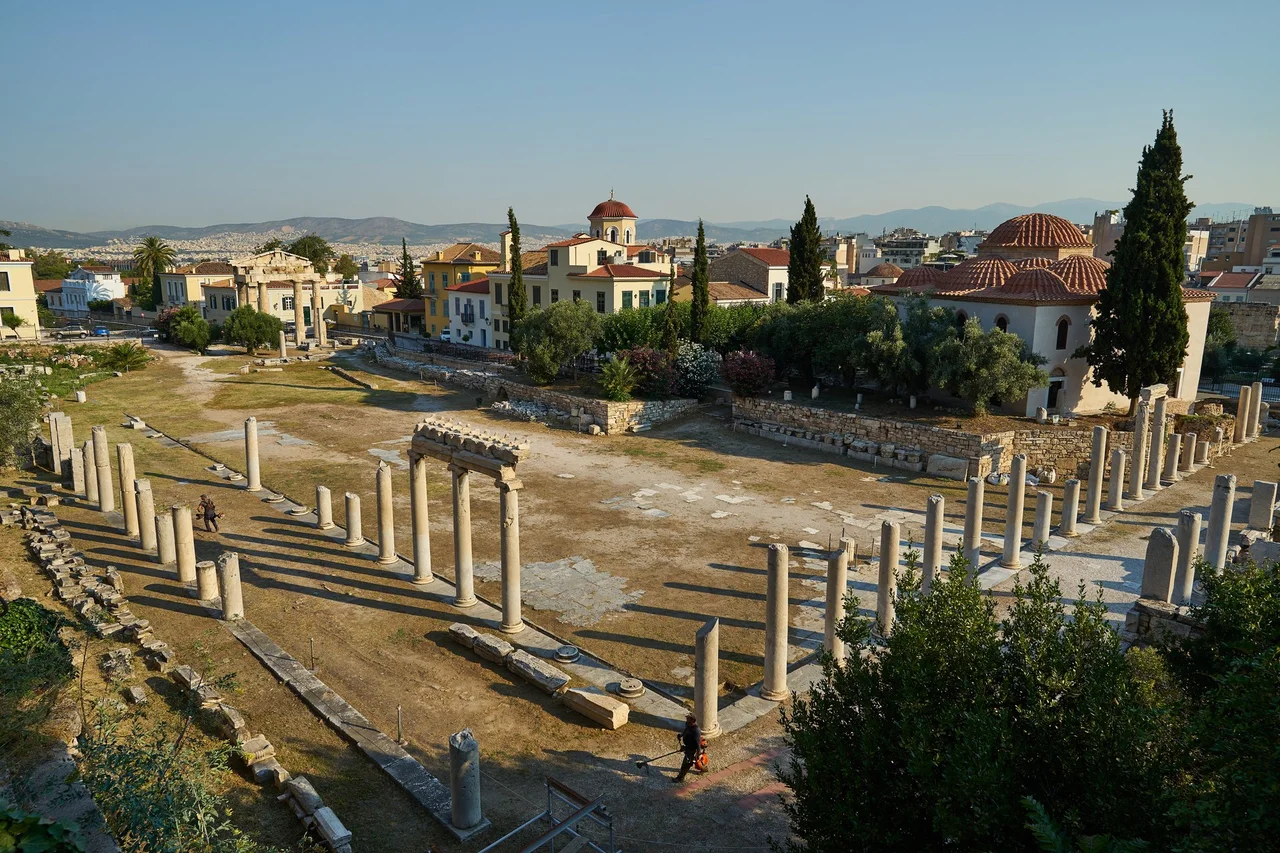
No emperor embodied Rome's love affair with Greece more completely than Hadrian. Before becoming emperor he had served as eponymous archon of Athens — an honorary magistrate of the very city Rome had subdued. He saw himself as an heir to Pericles. His contributions to Athens were enormous: the Library of Hadrian, one of the grandest buildings the city had ever seen; the completion of the Temple of Olympian Zeus, a project that Athenian tyrants had begun roughly 638 years earlier but abandoned for fear that building on such a scale would cause hubris. The Athenians repaid him with the Arch of Hadrian, whose two inscriptions neatly divided the city between past and future — one face reading "This is Athens, the ancient city of Theseus," the other, "This is the city of Hadrian, and not of Theseus." That arch still stands today, at the edge of the Plaka district, a stone seam between two worlds. Julius Caesar had earlier begun the Roman Agora in Athens; Augustus finished it. Marcus Agrippa built an odeon in the heart of the ancient agora. The Pax Romana was, for Greece, the longest peace in its recorded history.
Christianity Comes to the Agora
The Roman era also brought the faith that would reshape Greece's next two millennia. The Apostle Paul of Tarsus preached in Philippi, in Corinth, and on the Areopagus hill in Athens — where he addressed Athenian philosophers directly, citing their altar "To an Unknown God." Thessaloniki soon became one of the most thoroughly Christianized cities in the empire. By the 4th century, Emperor Constantine had not only legalized Christianity but moved the capital of the Roman world from Rome itself to Byzantium, renaming it Constantinople in 330 AD. Greece moved from province to heartland. When Theodosius I died in 395 AD and the empire formally split, the eastern half — Greek-speaking, Greek-thinking, Greek in its bones — endured as the Byzantine Empire for nearly a thousand years more.
Late Antiquity and the Long Survival
Older histories painted late antique Greece as a landscape of ruin and depopulation, but modern archaeology has revised that picture substantially. Contemporary texts such as Hierocles' Syndekmos counted approximately eighty cities on the Greek peninsula, and the polis as an institution remained prosperous into the 6th century. Greece was, in those centuries, one of the most economically active regions in the eastern Mediterranean. Invasions did come — Heruli, Goths, Vandals, Visigoths under Alaric, who looted Athens, Corinth, and the Peloponnese around 395 to 397 AD before being driven out. But the peninsula recovered, as it always had. In the early 7th century, Emperor Heraclius changed the empire's official language from Latin to Greek — a formal recognition of what had always been true on the ground. Captive Greece had, in the end, outlasted her fierce conqueror.
From the Air
Greece in the Roman era is anchored to central Greece at approximately 38.50°N, 23.00°E — the broad plain of Boeotia and Attica stretching south toward Athens. From cruising altitude, look for the distinctive gulf of Corinth splitting the Peloponnese from the mainland. The Acropolis of Athens is visible on clear days as a pale rectangular outcrop above the city's urban grid. The nearest major airport is Athens International (LGAV), Eleftherios Venizelos, located at 37.936°N, 23.944°E, approximately 23 km southeast of the city center. Approach from the west at 5,000 feet reveals the coastal plain, the Saronic Gulf, and the mountains of Attica framing Athens from the north and east.
Nearby Stories
- Battle of Alamana 3.6 km away
- Free and Real 5.7 km away
- Agios Thomas Tanagras 5.7 km away
- Pythian Games 11 km away
- Thespiae 12 km away
- Euripus Strait 14 km away
- French Cruiser Châteaurenault (1898) 17 km away
- Skopelos 32 km away