
The Greek Dark Ages
Sometime around 1180 BC, the palaces went dark. At Mycenae, Tiryns, Pylos — the great fortified centers whose kings Homer would later immortalize — the administrative machinery that had organized Bronze Age civilization ground to a halt. The Linear B script, which Mycenaean bureaucrats had used for generations to keep records of grain, oil, wool, and weapons, ceased to be inscribed. Within a generation or two, no one remembered how to read it. The knowledge vanished so completely that modern scholars could not decipher the script until 1952. What came next was not simply a political crisis or a change of rulers. It was a collapse — four centuries of population decline, shrinking settlements, forgotten technologies, and a world contracting inward. Historians call it the Greek Dark Ages.
When the Palaces Fell
The collapse was not isolated to Greece. Around 1200 BC, civilizations across the eastern Mediterranean came under enormous stress simultaneously. The Hittite empire in what is now Turkey disintegrated; cities from Troy to Gaza were destroyed or abandoned; Egypt's New Kingdom fell into the disorder of the Third Intermediate Period. On the Greek mainland, Mycenaean palaces began failing around 1200 BC, with the process concluding over subsequent decades. The reasons remain debated — internal tensions that rejected palatial authority, regional conflicts between Mycenaean polities, climate change, disruption of trade networks, or the shadowy "Sea Peoples" who appear in Egyptian records. Most likely it was a combination, a cascade of stresses that pushed an interconnected system past the point where it could recover. The population of Greece declined. Villages shrank to clusters of forty or fifty families. The world of organized state armies, kings, officials, and long-distance trade simply disappeared.
Life in the Shadow Centuries
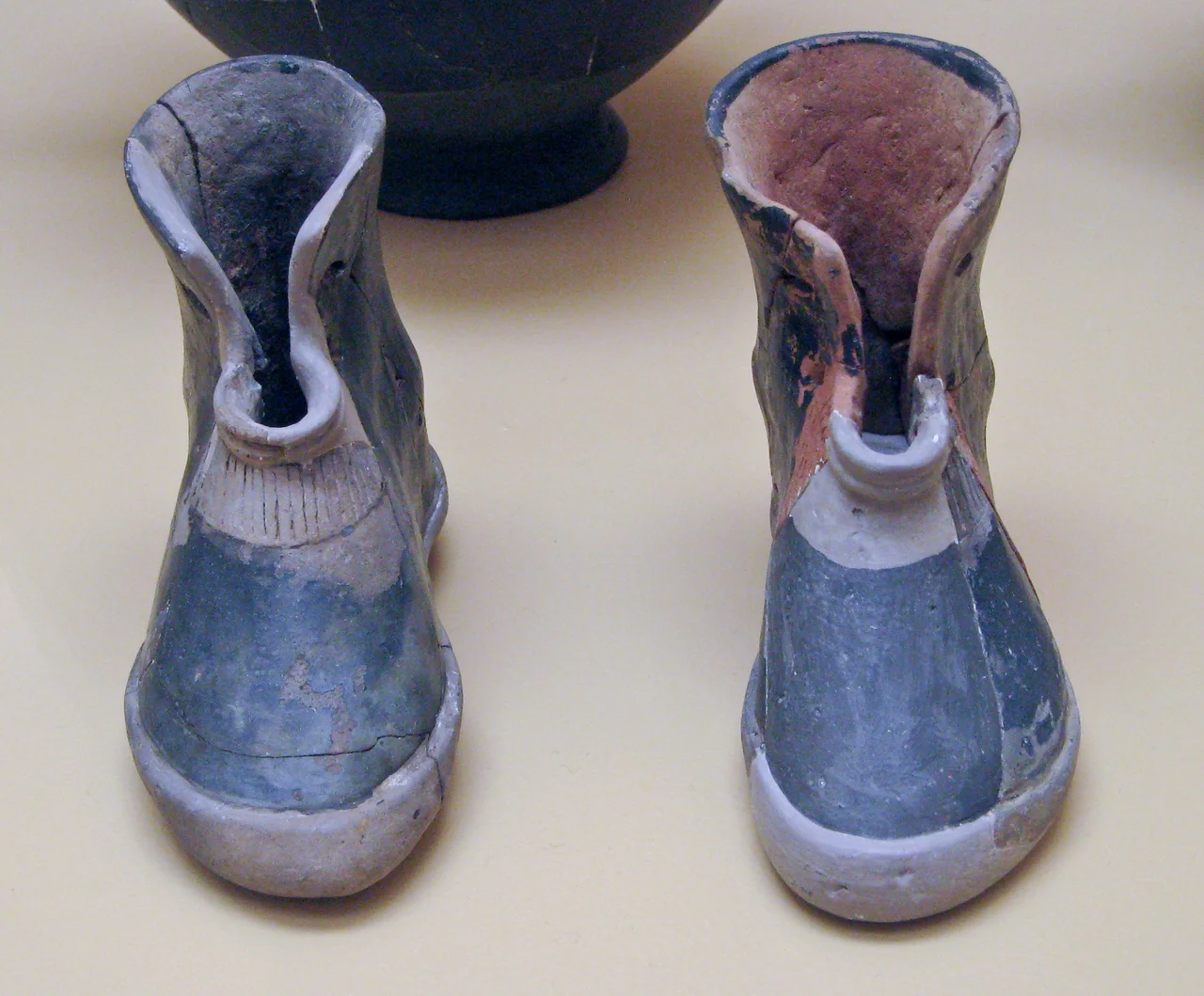
Calling these centuries "dark" has become controversial among archaeologists, because the darkness was uneven and the evidence is sparser than the absence of civilization. Some regions recovered faster than others. Attica, Euboea, and central Crete kept trading when the mainland languished. The settlement of Lefkandi on Euboea, with its double bay suited to sea traffic, grew quickly in the postpalatial period and maintained connections that others had lost. Everyday life continued: people farmed, wove cloth, made pottery, smelted iron. In fact, iron-smelting — learned from Cyprus and the Levant — spread rapidly in this period, making edged weapons available to warriors who could not have afforded the costly bronze of the palace age. Pottery styles simplified, losing the figurative decoration of the Mycenaean period and retreating to geometric lines and curves. It was technically simpler work, but it was still work — still craft, still culture, still community.
The Burial at Lefkandi
In 1981, excavators on Euboea unearthed something that rewrote the assumptions about Dark Age Greece. Beneath a roughly circular mound at Lefkandi, they found the largest tenth-century BC building yet known from Greece: a long narrow structure, 50 metres by 10 metres, containing two burial shafts. In one shaft lay four horses, apparently sacrificed. In the other, a cremated man buried with his iron weapons and, beside him, an inhumed woman adorned with extraordinary wealth. The man's bones rested in a bronze jar from Cyprus, its rim decorated with hunting scenes in cast relief. The woman wore gold coils in her hair, rings, gold breastplates, and an heirloom necklace of Cypriot or Near Eastern origin made 200 to 300 years before her burial. An ivory-handled dagger lay at her head. The building was demolished shortly after the burial, and its debris used to cover the grave in a mound. For the next century or so, other wealthy community members were buried near the eastern end of that mound — as if near the grave of a saint. The Lefkandi burial confirmed that some parts of Dark Age Greece remained wealthy, connected, and socially complex, even as others contracted into subsistence farming.
The Return of the Written Word
By the 8th century BC, the recovery was visible across Greece. Cemeteries at Athens and Lefkandi, sanctuaries at Olympia and the newly founded oracle at Delphi, were rich with offerings — including amber and ivory from distant regions, bronze tripods, elaborate metalwork. Pottery decoration grew elaborate again, now including figured scenes that echo the stories Homer would eventually set down. Communities developed governance by aristocratic councils rather than by a single chief. And somewhere around 800 BC, a Greek with firsthand knowledge of the Phoenician alphabet adapted it for the Greek language, adding vowels to create what became the first fully alphabetic writing system. The new alphabet spread quickly. It was used not only for Greek but for Phrygian and other eastern Mediterranean languages, and as Greek colonies pushed west to Sicily and Italy, variants of the alphabet traveled with them — eventually giving rise to the Latin letters used to write this sentence. The first Olympics were held in 776 BC. The Iliad and the Odyssey were composed. The darkness had lifted.
What the Dark Ages Made
There is a temptation to see the Greek Dark Ages purely as loss — and the loss was real. The centralized palace economies never returned. Elaborate Mycenaean burial customs disappeared. The strict class hierarchies and hereditary rule of the Bronze Age were forgotten. But in their place grew something new. The small, localized communities of the Dark Ages were the seedbeds of the Greek polis — the city-state — with its emphasis on civic participation, shared law, and the kind of active citizenship that would eventually produce Athenian democracy. The collapse of the old order was total enough that what grew back was genuinely different. James Whitley, writing on the period, observed that the Dark Age of Greece is not a fact of history but a conception — shaped by the dazzling civilizations that bracketed it on either side. What those centuries actually contained was a long, difficult, often invisible process of reinvention, from which Greece emerged not as a pale echo of its former self but as something the world had not yet seen.
From the Air
The Greek Dark Ages are anchored to the Greek mainland, centered near 38.50°N, 23.00°E — a geography that encompasses Boeotia, Attica, and the Peloponnese where the collapse was most profound and most studied. The island of Euboea, site of the pivotal Lefkandi excavations, lies just off the eastern coast of the mainland, visible from the air as a long narrow island northeast of Athens. The nearest major airport is Athens International (LGAV), Eleftherios Venizelos, at 37.936°N, 23.944°E, southeast of the city. From approach altitude of 4,000 to 6,000 feet on an eastward heading, the Acropolis is visible to the west and the long coastline of Euboea is visible to the northeast across the narrow Euripus strait. The mountains of Boeotia, where Mycenaean polities like Orchomenos and Thebes once competed, rise inland to the northwest.
Nearby Stories
- Battle of Alamana 3.6 km away
- Free and Real 5.7 km away
- Agios Thomas Tanagras 5.7 km away
- Pythian Games 11 km away
- Thespiae 12 km away
- Euripus Strait 14 km away
- French Cruiser Châteaurenault (1898) 17 km away
- Skopelos 32 km away