
Greek Industrial Railways
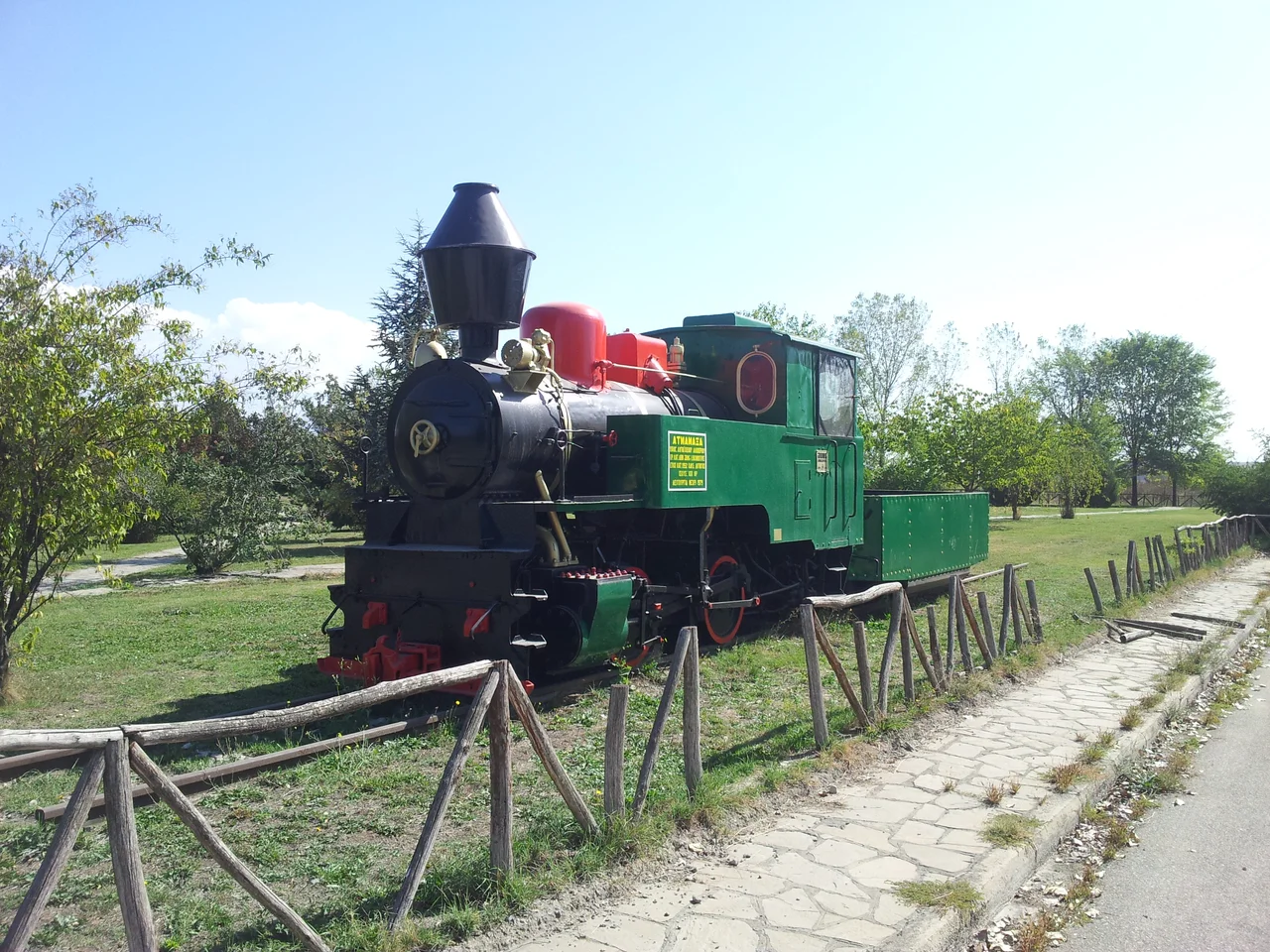
In a brick factory in Volos, a small steam locomotive sits where it once worked. It belonged to the Tsalapatas brick and rooftile works, and like dozens of its kind across Greece, it never carried a paying passenger. These were private industrial railways, built not to connect towns but to feed them: to drag lignite out of mines, clay into kilns, and ash back out again. They ran on narrow gauges, on tracks laid only as far as the work demanded, and they have almost entirely vanished. The Tsalapatas engine, now part of an industrial museum, is one of the rare survivors that lets you see how the machinery of modern Greece actually moved.
Railways With One Customer
Greece's main railways were built to carry people and goods between cities. The industrial lines were a different breed entirely. Each served a single owner, a mine or a factory, and went nowhere else. They threaded chromium mines at Eretria, marble quarries at Dionyssos, nickel works at Larymna, and the great lignite basins that powered the country's electricity. Some were laid only for a few years to build a public work and then torn up; the line at Heraklion in Crete existed solely to construct the port between 1922 and 1934, then disappeared. Most ran on metre or narrow gauge, small and cheap, because hauling coal a short distance never needed the heavy engineering of a national network.
The Coal Roads of Aliveri
The most extensive of these networks served the power station at Aliveri on Euboea. Built by the Public Power Corporation in 1958 on the bones of an earlier system, the metre-gauge line stretched twenty-two kilometers, carrying lignite from underground mines inland down to a seaside plant that drew cooling water straight from the Aegean. Five Jung steam locomotives worked it first, replaced around 1980 by Japanese-built Nippon Sharyo and German Diema diesels. Deeper inside the mines, an electrified Decauville system ran on three pairs of small AEG locomotives until 1970, when the tunnels flooded and the work moved to the surface. The whole network shut down in 1988, when the plant switched to fuel oil and the mines closed for good.
Brown Coal Country
Far to the northwest, around Ptolemais, lignite did not just support the economy; it was the economy. Fertilizer plants, power stations, and the LIPTOL works that dried brown coal into dust and briquettes all clustered around the open fields. A dedicated mining railway linked the Northern and Western lignite fields to the factories, worked by twelve German-built Bo-Bo electric locomotives and four shunters. Their end came not from exhaustion alone but from a quieter machine. As the old fields ran out, the new ones were served by conveyor belts, endless rubber rivers that never tired, never derailed, and never needed a driver. One by one the rail lines were lifted, and the locomotives fell silent.
What Outlasts the Work
Industrial machinery rarely earns a second life, but a few of these engines did. One of the Nippon Sharyo diesels from Aliveri survives in excellent condition and still runs at Velestino, just west of Volos, where the preservation society EMOS keeps it working on an abandoned stretch of the old Thessaly Railways. The Tsalapatas locomotive rests in its museum in Volos itself, a reminder of when the city's chimneys burned and its kilns roared. These survivors matter precisely because they were never glamorous. They are the working machines of ordinary industry, saved by people who understood that the history of a place is written not only in its temples and battles but in the trains that hauled its coal.
From the Air
This article spans several sites across Greece, but its surviving locomotives are anchored near Volos. The Tsalapatas industrial museum lies in Volos at roughly 39.365°N, 22.932°E, and the EMOS preserved railway runs at Velestino about 15 km to the west. The nearest airport is Nea Anchialos National (LGBL), some 10 km south of Velestino. From 2,500 feet, the flat Thessalian plain around Velestino contrasts sharply with the city of Volos pressed against Mount Pelion to the east and the Pagasetic Gulf to the south. The straight line of the old Thessaly Railways across the plain is a useful navigation feature in clear weather.
Nearby Stories
- Farsala 10 km away
- Oreus 10 km away
- Glossa 13 km away
- Archaeological Museum of Lamia 14 km away
- Tempi Train Crash 55 km away
- Mount Olympus 61 km away
- Siege of Euripos 62 km away
- Byzantine Empire under the Palaiologos Dynasty 112 km away