
Green Hill Fort
In 1885, Britain and Russia nearly went to war over a dusty Afghan border town called Panjdeh. The crisis played out thousands of miles from Australia, but it sent shockwaves through the six squabbling colonies at the bottom of the world. For once, they agreed on something: their northern coastline was dangerously exposed. The result sits on a hill above Thursday Island in the Torres Strait -- three six-inch breech-loading guns pointed out over water that no enemy warship ever entered.
A Fear Born in Central Asia
The Panjdeh incident of 1885 was a confrontation between the British and Russian empires over territory in what is now Afghanistan. For Australians, the crisis crystallized a growing anxiety. European powers -- Germany, France, Russia -- were expanding into the Pacific, claiming New Guinea and island chains uncomfortably close to the Australian mainland. Torres Strait, the narrow waterway separating Australia from New Guinea, was the obvious chokepoint. If a hostile fleet wanted to threaten Queensland's coast or disrupt the vital shipping lane to Asia and England, it would pass through these waters. The six Australian colonies, which normally could agree on almost nothing, recognized the danger and did something extraordinary: they pooled their money. Green Hill Fort is one of only two fortifications in Australian history where every colony contributed to the construction costs.
Guns on the Hill
Construction ran from 1891 to 1893, overseen by Major Druitt of the Queensland Permanent Artillery and guided by the defense plans of Colonel Sir W.F.D. Jervois and Lieutenant-Colonel Peter Scratchley. The fort follows the pattern of late Victorian British colonial fortifications, but what makes it remarkable is how little has changed. Three six-inch breech-loading guns sit on sunken working platforms behind protective abutment walls, exactly as they were positioned in the 1890s. Observation bunkers remain sunk into the hillside. Tunnels thread beneath the earthworks. The tracks that once carried munitions trolleys to feed the gun emplacements still run along their original routes. Unlike most Australian coastal forts, which were repeatedly modified as military technology evolved through two world wars, Green Hill Fort was never significantly altered. The guns were never fired in anger.
The Strait They Guarded
Thursday Island sits at the crossroads of some of the most contested waters in the Pacific. By the 1870s, Queensland had annexed the Torres Strait Islands to protect its pearl-shell and beche-de-mer fisheries, and the government settlement had moved from Somerset on the Cape York mainland to the island's sheltered harbor at Port Kennedy. Pearl luggers worked the strait in fleets, crewed by Japanese, Malay, and Pacific Islander divers. Trading vessels bound for Asia and England threaded through the inner channel. Green Hill Fort watched over all of it from the island's highest point, a position that offered clear sightlines across the approaches. The fort's purpose was as much about projecting sovereignty as repelling invasion -- a stone-and-iron statement that someone was watching the back door to Australia.
Frozen in Time
The fort saw service through both world wars, though Thursday Island's major wartime role came during World War II, when the island was evacuated of civilians and turned into a military base. Green Hill Fort itself was never the center of that action -- by the 1940s, its Victorian-era guns were obsolete. But the earthworks, the tunnels, the terreplein where the batteries once stood ready -- all survive. The Australian Commonwealth Heritage List recognized the site in 2008, noting its rarity as an intact example of 19th-century defense architecture and its significance as a symbol of pre-Federation cooperation. Today the Torres Strait Historical Society manages the fort, and visitors can walk the same tunnels that soldiers once patrolled while watching for warships from an empire that never came south.
From the Air
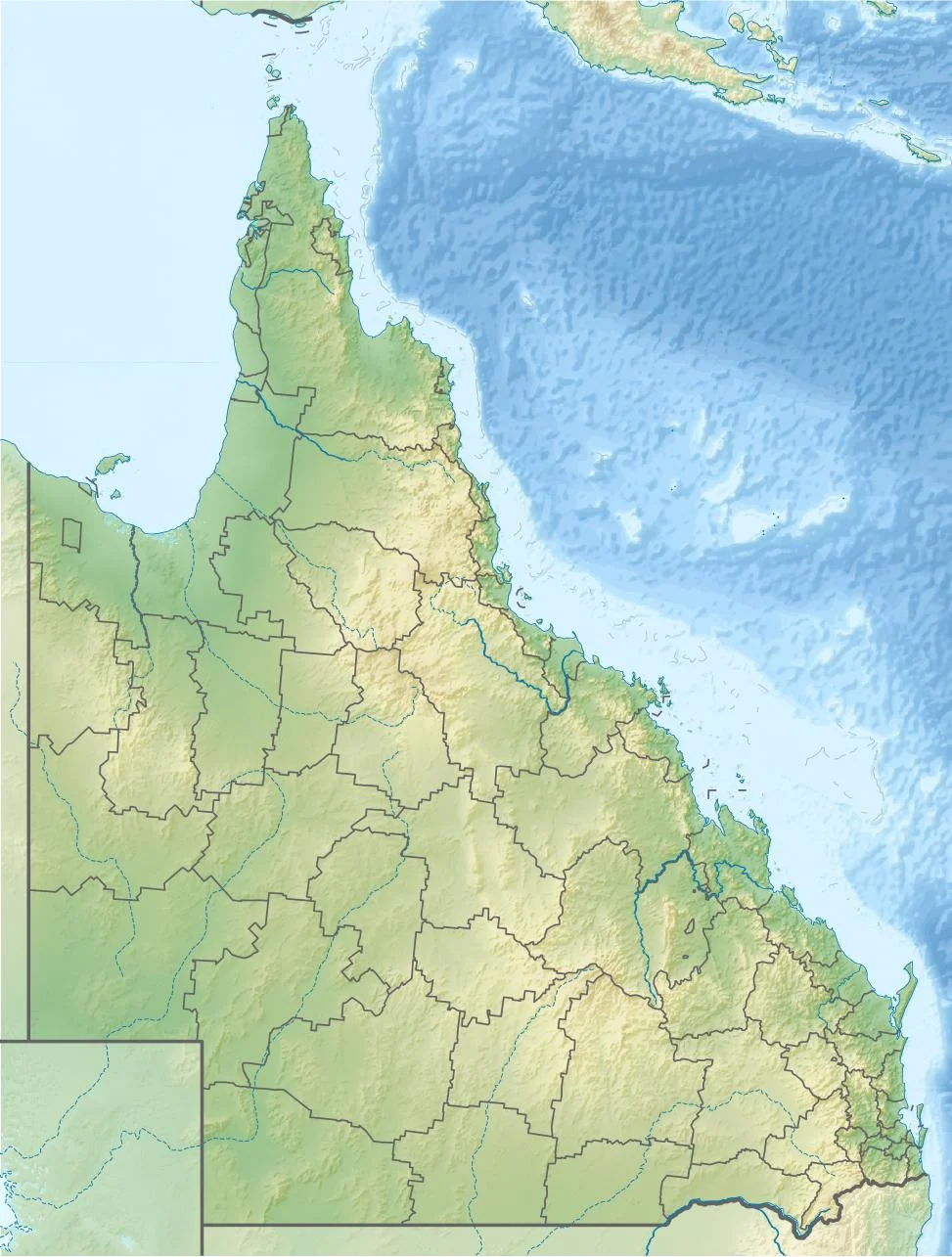
Green Hill Fort sits atop the highest point of Thursday Island at approximately 10.58S, 142.21E. From the air, Thursday Island is a small, hilly landmass in the Torres Strait, clearly visible among a scattering of neighboring islands including Horn Island to the east. The fort's earthworks are visible on the hilltop. Nearest airport is Horn Island Airport (YHID). Recommended viewing altitude: 2,000-3,000 feet for island detail. The Torres Strait waters between islands are shallow in places with visible reef structures.
Nearby Stories
- Jardine River 2.3 km away
- Badu Island 29 km away
- Yam Island 53 km away
- HMS Pandora (1779) 146 km away
- All Saints Anglican Church, Darnley Island 161 km away
- Duyfken Point 186 km away
- Wasur National Park 218 km away
- Australia–Indonesia Border 272 km away