
The Welshman Who Named a Town After a Hole in the Ground
His name was Griffith Griffith, which sounds like a clerical error but was, in fact, perfectly ordinary in nineteenth-century Wales. Born in 1823 at Ty Gwyn in the village of Llanllyfni, Carnarvonshire, he grew up in the shadow of the great slate quarries of North Wales, working at the Penrhyn Quarry by the age of nineteen and rising to foreman over thirty men. In 1847, he crossed the Atlantic. By 1864, he had found a granite outcropping near Stewart's Flat in the Sierra Nevada foothills of California, leased a quarter section of land from the Central Pacific Railroad, and established a quarry that would supply stone for some of the most important buildings on the West Coast. He named the place Penryn, after the quarry back home. In Welsh, penrhyn means headland -- a promontory jutting into the unknown. It suited the venture.
Stone Without Flaw
What Griffith found near Stewart's Flat was not just granite but granite of exceptional purity. The Penryn outcropping sat near the center of the Sierra Nevada's granite belt, producing stone that was virtually free of iron. This mattered enormously. Iron in granite causes discoloration over time -- rust stains that bleed through polished surfaces and darken facades exposed to weather. Penryn granite did neither. It held its color indefinitely, its polished surfaces resisting the atmospheric corrosion that degraded lesser stone. By 1870, the quarry was known throughout Northern California for the quality of its product, and by 1874, Griffith had erected California's first successful commercial granite polishing mill on the site. Finished slabs could now be shipped by rail -- loaded at Wildwood Station, transferred at Folsom to the Sacramento Valley Railroad, and floated by barge from Sacramento to San Francisco Bay.
Building the West in Stone
The list of structures built with Penryn granite reads like a tour of nineteenth-century California power. Portions of the California State Capitol in Sacramento. The foundation of the San Francisco Mint, where the gold pouring out of the Sierra foothills was coined into currency. The fortifications at Fort Alcatraz and Fort Point, guarding the entrance to San Francisco Bay. The Stockton Courthouse. The Mare Island Drydock, where the Navy built and repaired its Pacific fleet. Before Griffith moved to Penryn, he had already operated a quarry at Big Gulch near Folsom, supplying granite for Adams and Company's Express building in Sacramento and other structures of early statehood. The Penryn operation scaled that ambition dramatically. Griffith's stone was literally the foundation on which Gold Rush wealth was consolidated into permanent institutions.
A Quarry Becomes a Town
Griffith did not merely dig stone. He built a community around the digging. The quarry attracted skilled workers, and the railroad connection that carried granite out also brought supplies and settlers in. Penryn grew into a small but genuine town, anchored by the quarry operations and the families that depended on them. Griffith himself remained a central figure until his death in 1889, by which point the community he had named after a Welsh headland had taken on its own identity -- part mining settlement, part railroad stop, part foothill homestead. The granite industry in the area continued after him, with neighboring Rocklin developing its own quarries, but Penryn's identity remained inseparable from the man who had seen something valuable in an outcropping of iron-free stone and built a life around extracting it.
What the Stone Remembers
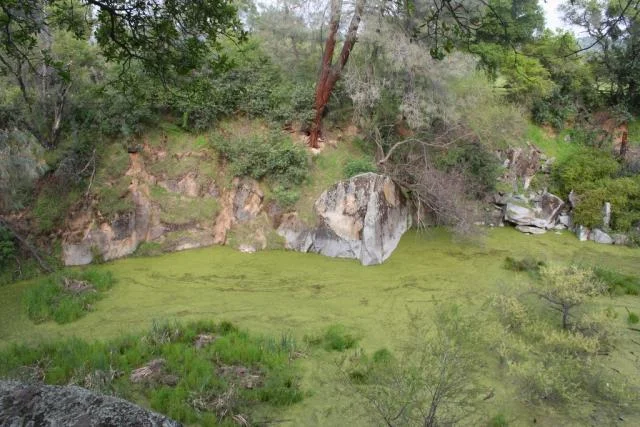
Today the quarry is a park and museum, designated California Historical Landmark No. 885 and listed on the National Register of Historic Places. The original Penryn Granite Works office, built by Griffith in 1864, still stands and serves as the museum building. Inside, some of the original office furniture remains -- the desk where contracts were signed, the shelves where ledgers tracked shipments to Sacramento and San Francisco. The museum tells the story of the Griffith family, the granite industry, and the broader history of the Penryn-Loomis Basin area. Outside, the quarry cuts themselves are visible, their clean-edged walls testifying to the precision of nineteenth-century stonework. It is a quiet place now, shaded by oaks that have grown up around the abandoned workings, but the stone Griffith pulled from this ground is still holding up buildings across California -- doing exactly what iron-free granite does. Enduring.
From the Air
Located at 38.85N, 121.16W near Penryn in Placer County, roughly 25 miles east of Sacramento in the Sierra Nevada foothills. The quarry park is a small green area visible from low altitude amid rural residential parcels along Taylor Road. Lincoln Regional Airport (KLHM) is approximately 10nm north. Sacramento Executive (KSAC) lies roughly 25nm southwest. The surrounding terrain is gently rolling foothill country with scattered oaks and granite outcroppings -- part of the same granite belt that Griffith recognized in 1864.
Nearby Stories
- The Only Home She Ever Owned 4.7 km away
- The Gate Between Two Rivers 10 km away
- The Middle Mountains Nobody Can Reach 15 km away
- The Image That Would Not Be Erased 17 km away
- Sutter National Wildlife Refuge 19 km away
- Donner Pass 48 km away
- New Melones Dam 81 km away