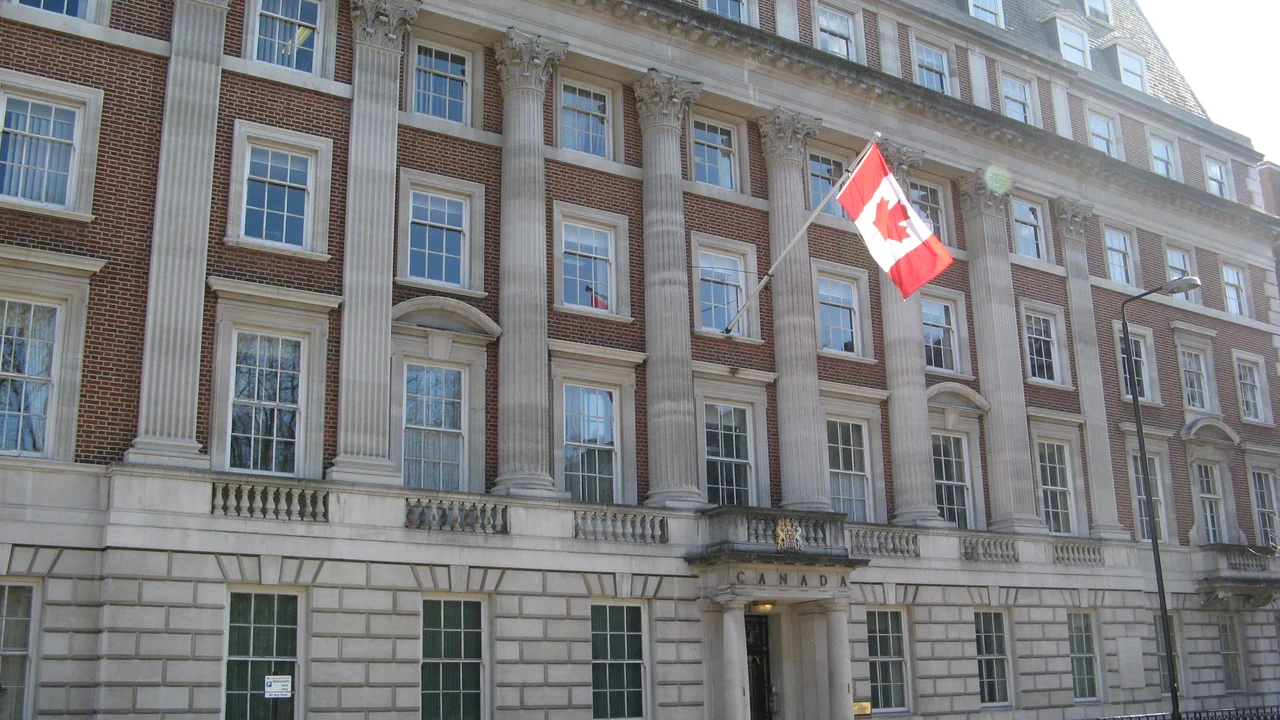

Grosvenor Square
John Adams arrived at Grosvenor Square in 1785 and hated it. Not the square itself — that he appears to have admired — but the awkwardness of being the first American diplomatic representative to the Court of St. James's, presenting credentials to the king whose authority his country had just repudiated. He lived on the corner of Brook and Duke Streets, in a house that still stands, for three years. Over the next two centuries, the square would remain entangled with American ambition and British power in ways Adams could not have anticipated.
Built on Bankruptcy
Sir Richard Grosvenor obtained a licence to develop Grosvenor Square and the surrounding streets in 1710, and construction ran from 1725 to 1731. The land was sold in individual plots to 30 different builders or partnerships. By 1738, roughly half of those builders had gone bankrupt. This inauspicious start did not prevent the square from becoming, by the time it was complete, one of the three or four most fashionable residential addresses in London, lined with five- and seven-bay houses occupied by the aristocracy. Robert Adam rebuilt one house for the 11th Earl of Derby in 1773-74; it was regarded as one of his finest works before its demolition in the 1860s. The original gardener, John Alston, designed the central space in the 1720s as what he called "wilderness worke" — a celebration of the countryside within the city.
Eisenhower Platz
During the Second World War, American general Dwight D. Eisenhower established his military headquarters at 20 Grosvenor Square, and Londoners quickly nicknamed the area "Eisenhower Platz." A statue of Franklin D. Roosevelt, sculpted by Sir William Reid Dick, stands in the gardens. Later statues of Eisenhower himself and Ronald Reagan, by Chas Fagan, joined it. The square had long housed the American Embassy — first in the building from 1938 to 1960, then in the modernist structure Eero Saarinen designed for the western side in 1960. That building, controversial at the time as a bold geometric insertion into a Georgian neighbourhood, was granted Grade II listed status in 2009, when the embassy prepared to leave for Nine Elms. Its 35-foot gilded aluminium eagle, hovering over the main entrance, stayed with the facade.
Protest and Memorial
In March and October 1968, large demonstrations against US involvement in the Vietnam War filled Grosvenor Square. On both occasions the protests turned violent, with clashes between demonstrators and police outside the Saarinen embassy. The square became, for a time, a symbol of transatlantic political friction as much as transatlantic alliance. A quieter memorial occupies the eastern gardens: since 2003, an elliptical granite block inscribed with names and bearing the poem For Katrina's Sun-Dial by Henry van Dyke commemorates the 67 British victims of the 11 September 2001 attacks. Underneath the stone is buried a piece of steel salvaged from the wreckage.
Oscar Wilde's Square
Oscar Wilde lived in Grosvenor Square between 1883 and 1884, and he returned to it repeatedly in his work — it appears in An Ideal Husband, The Importance of Being Earnest, Lady Windermere's Fan, and The Picture of Dorian Gray. The Grateful Dead's Robert Hunter began "Scarlet Begonias" with the line "As I was walkin' 'round Grosvenor Square." In 1965, while walking on the square with Marietta Tree, the U.S. Ambassador to the United Nations, Adlai Stevenson suffered a heart attack and died at the nearby St George's Hospital. His reported last words were a request to slow down. The square, which has contained more history than most city blocks can hold, continues to evolve: the former embassy is being converted to a luxury hotel, and Westminster City Council approved plans in 2022 to redesign the garden into what it called "an extraordinary garden with groundbreaking environmental credentials."
From the Air
Grosvenor Square is at approximately 51.511°N, 0.151°W in the Mayfair district of Westminster. The square's 2.5-hectare garden is visible from altitude as a green rectangle in the dense urban fabric. The former American Embassy building's roof with its distinctive eagle is a visual landmark. Nearest airports: London City (EGLC, approximately 9nm east) and Heathrow (EGLL, approximately 13nm west). Hyde Park is visible approximately half a mile to the south-southwest.
Nearby Stories
- Stevenage 5.7 km away
- Malling Abbey 5.7 km away
- 1952 Farnborough Airshow Crash 7.7 km away
- Ingatestone Hall 8.2 km away
- Hellfire Caves 9.1 km away
- The Carrington Event: The Solar Storm That Could Happen Again 9.8 km away
- Bletchley Park 16 km away
- Castle Hedingham 23 km away