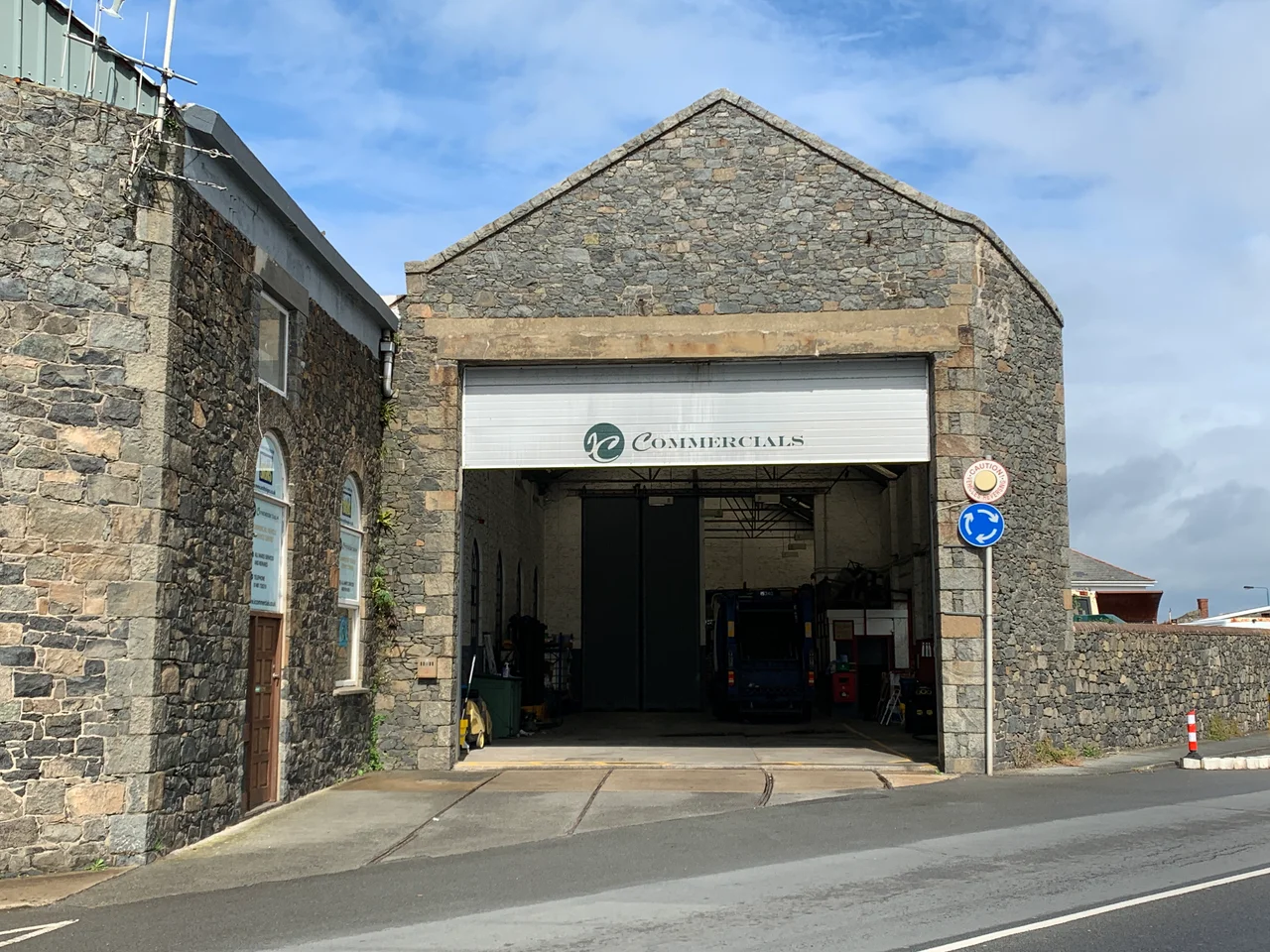

Guernsey Railway
For 55 years, between 1879 and 1934, Guernsey had a railway. It was three miles long. It connected St Peter Port at the south end to the granite-quarry port of St Sampson at the north. It started as steam and ended as electric, with a five-year financial collapse in the middle. At its peak, in 1922, it carried 1,276,913 passengers - roughly thirty times the entire population of the island. Then, six years before the Germans arrived and started running their own narrow-gauge lines along similar routes to supply coastal bunkers, the Guernsey Railway gave up. The tram cars went on sale eleven days after the last service ran.
The Watchman at Radford's Coffee House
The States of Guernsey granted the concession on 2 May 1877; an Order in Council confirmed it on 13 August 1877; the Guernsey Steam Tramway Company was registered in London on 29 May 1878. Before opening, Major-General Charles Scrope Hutchinson, the Board of Trade's Inspector of Railways, walked the line in the company of the contractor John Howard, the engineer Mr Yockney, and the State Surveyor Mr Duquemin. He approved the system with two charmingly specific conditions: speed was not to exceed four miles per hour between the Piette and the Salirie or near Radford's Coffee House at the corner of Bouët Road, and a watchman had to be permanently stationed at that corner during all train movements. Service started on 6 June 1879. Two thousand passengers rode in the first two days.
Steam, Then Sudden Silence
The first Merryweather steam tram and its carriage had only arrived on the S.S. Stannington two days before opening day. For the first four weeks, a single tram was the entire fleet. Manager William Gumbley reported 6,780 passengers in the week ending 23 August 1879, with takings of £67 1s 10d. By 1885 the company owned six locomotives: two Merryweathers and four built by Hughes of Loughborough. Each engine ran 72 miles a day. Then horse-bus competition - quieter, less smoky, more flexible - began to bite. On 22 January 1889, the trams simply stopped running. The company was wound up. It was reorganized, re-registered as the Guernsey Railway Company on 22 September 1889, and service resumed on 2 December 1889. The locals had been ten months without their trams when the new company brought them back.
Electric Trams and a Million Passengers
The electric tramway opened on 20 February 1892, replacing the steam fleet with cleaner, faster cars. The passenger numbers tell the story of how completely Guernsey's daily life ran along three miles of rail. In 1912 the trams covered 143,272 car-miles and carried 914,222 passengers. In 1922 they ran 150,924 car-miles and carried 1,276,913 passengers - more than a million people on an island whose total population was under 40,000. By 1932 the numbers had dropped to 783,647 passengers across 163,479 car-miles. Buses, cars, and the global depression were eating the railway from both ends. Fares had been 3d first class, 2d second class. Eighteen minutes between the harbors. A maximum gradient of 1 in 32. Single track with passing loops along the gentle coastal route.
Eleven Days to Disappear
The last day of service was 9 June 1934. Two days later, on 11 June, the contractors started lifting the track. The tramcar bodies went on sale almost immediately. Within a few months the entire system had been erased from the Guernsey landscape - rails, sleepers, overhead wires, the depot fittings. Six years later, the Germans would build a new railway across Guernsey, this time narrow-gauge military lines supplying their coastal bunkers. After liberation in 1945, that infrastructure was lifted too. In 2004 there was a brief proposal to restore some original Guernsey Railway trams for a heritage service. Nothing came of it. Alderney, the small island to the north, still runs the only working railway in the Channel Islands. Guernsey, where a million passengers a year once rode for tuppence, has not had a train in 92 years.
From the Air
The Guernsey Railway ran for approximately three miles along the east coast of Guernsey, from St Peter Port (49.45°N, 2.53°W) north to St Sampson (49.48°N, 2.51°W). From the air the old alignment is no longer visible as a continuous feature - the coastal road and modern development have absorbed it - but the two terminals at the harbors of St Peter Port and St Sampson are still working ports. Guernsey Airport (EGJB) lies about 6 km southwest of the route. Best viewed from over the Little Russell, where the entire length of the former line is visible as the strip of development between the harbors.
Nearby Stories
- Pallot Steam, Motor & General Museum 29 km away
- HMS Affray 29 km away
- Operation Donnerkeil 29 km away
- German Submarine U-672 35 km away
- Action of 18 June 1793 60 km away
- Mont Saint-Michel: The Abbey That Becomes an Island Twice a Day 78 km away
- Basilica of Sainte-Therese, Lisieux 209 km away
- 1941 Santander Fire 642 km away