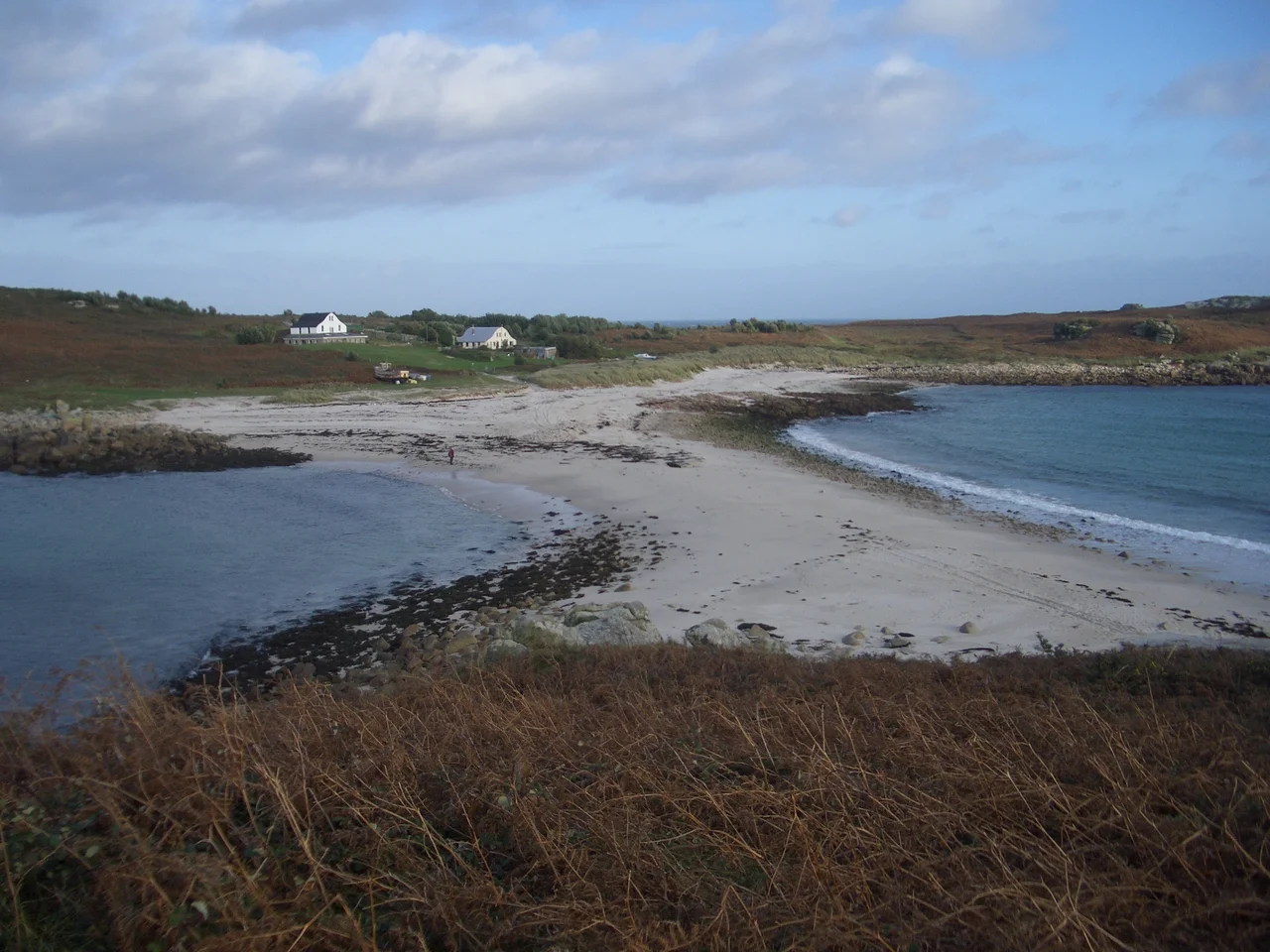

Gugh
Walk south from the church on St Agnes at low tide, and a strip of pale sand emerges from the sea. The tombolo is called The Bar, and for a few hours twice a day it joins one inhabited island of Scilly to another. The second island is Gugh, pronounced Goo, and it is barely a kilometre long, with two granite hills and a saddle of bracken between them. Two houses sit on the saddle, built in the 1920s and still occupied by a population that fluctuates around three. What you cannot see from the shore is what the island holds. Five entrance graves and fourteen cairns on the north hill. Nineteen more cairns and two more entrance graves on the south. A 2.7-metre standing stone at the foot of Kittern Hill called the Old Man of Gugh. An English Civil War battery built directly on top of one of the Bronze Age burial mounds. For an island most people have not heard of, Gugh has been holding human history for around four thousand years.
Stones the Bronze Age Left
Scillonian entrance graves are a distinctive form of late Neolithic and early Bronze Age burial monument, found almost nowhere else in Britain. They are low mounds, edged by upright slabs, with a narrow chamber accessible through an opening in the perimeter. The acid soils of Scilly have eaten most of the bones and finds that would tell us when these particular structures were built; what survives is the architecture itself and a few pottery sherds that point to roughly the late third or early second millennium BC. On Kittern Hill, the northern summit of Gugh, five entrance graves cluster together with fourteen cairns linked by prehistoric field walls or banks. The largest of the entrance graves is Obadiah's Barrow, excavated in 1901 by the British archaeologist George Bonsor. He found a crouching male skeleton in the middle of the chamber, along with cremated remains and pottery fragments near the entrance. The dead of Gugh were placed both intact and cremated into the stone - the grave held evidence of different burial practices across its long use.
The Old Man of Gugh
Down off the slope of Kittern Hill stands the only menhir on the Isles of Scilly that has ever been excavated - the Old Man of Gugh, a leaning granite slab 2.7 metres tall. The dig produced no features and no finds, which is a frustrating result but a common one for standing stones on acidic soils. What the stone was for, in detail, no one can say. Bronze Age communities raised menhirs as markers, as memorials, as boundary points, as ceremonial focal points - sometimes for one purpose, sometimes for several at once. What is striking about the Old Man is that he is still standing four thousand years later, leaning slightly, weathered to grey, exactly where the people who placed him decided he should be. The island around him has been farmed, fired, bombarded, evacuated and replanted. The stone has not moved.
Civil War, Kelp, and a Wimbledon Surveyor
On Carn of Works, halfway across the island, an English Civil War battery sits squarely on top of a prehistoric burial mound, and somebody at the time saw the original chamber and decided it would do nicely as a powder magazine. The deep-water approaches to Scilly mattered in the 1640s, and the islands ended the war as one of the last Royalist holdouts. Once the cannon and the powder went away, Gugh became grazing land for the residents of St Agnes, with two kelp pits where seaweed was burned for sodium carbonate from 1684 until the early 19th century, when industrial processes elsewhere made island kelp uneconomic. Then, in the 1920s, a retired surveyor and engineer from the Corporation of Wimbledon named William Hamlet Cooper secured the lease and built the two houses that still stand on the saddle. He farmed there with his housekeeper. His will asked that, if he died on Gugh, he be buried at Kittern Hill among the entrance graves. He died in 1932, and the October auction listed his animals: two Kerry cows, two farm horses, sixty-nine pigs, eighty fowls, mostly white leghorns. The new tenants were a couple named Theo and Margaret Bond, who had spent their honeymoon on Gugh and decided to stay.
The Rats Are Gone
Brown rats came to Gugh the way they came everywhere in Scilly - on the wreckage of ships. For two centuries they bred among the storm-tossed flotsam and stole the eggs and chicks of the seabirds nesting in burrows on Annet, a kilometre west. Scilly's breeding seabird populations dropped twenty-five percent between 1983 and 2006, and the most likely source of fresh rats reinfesting Annet was the population on St Agnes and Gugh. In October 2013, thirty volunteers led by Wildlife Management International from New Zealand began the systematic eradication. By December 2013 no signs of rats remained. By early 2015 both islands were officially declared rat-free, and in September 2014 the first Manx shearwater chicks in living memory fledged on Gugh and St Agnes - twelve of them, the seed of a recovering colony. Removing an invasive species from an island is among the most absolute conservation interventions humans can perform. Gugh is now, by deliberate choice, the island it has not been in two centuries.
A Library of Wind-Pruned Heath
Most of Gugh is wind-pruned maritime heath - heather, bell heather and western gorse, low and tight against Atlantic gales. A small dune system above The Bar grows sea holly, sea spurge, sea bindweed and the western clover that is one of Scilly's rare floral signatures. In the south of the island, the nationally rare orange bird's-foot trefoil still grows, and rare lichens like Lobaria pulmonaria and the bright tufts of golden-hair lichen cling to the granite. In July 1924 a man named W. N. Blair caught a small shrew on Gugh he did not recognise. He sent it to the British Museum, where Martin Hinton identified it as Crocidura suaveolens, a species not previously known from Britain - the Scilly shrew. The specimen Blair caught is still the type specimen, the standard against which every other Scilly shrew is measured. Few islands of a kilometre across give the world both a new species of mammal and a calendar of Bronze Age monuments. Gugh, walked end to end in twenty minutes, manages both.
From the Air
Gugh lies at 49.8941 N, 6.3326 W, joined to St Agnes by the tombolo of The Bar at low tide. The nearest airport is St Mary's (EGHE), about 4 km north-northeast, with Land's End (EGHC) some 47 km east on the Cornish mainland. The two cottages on the saddle and the leaning Old Man of Gugh at the foot of Kittern Hill are the most visible landmarks; the entrance graves themselves are low and easily missed from altitude. Recommended viewing altitude is 800-2000 ft AGL. The St Agnes lighthouse tower, 1 km north, is a useful visual marker.
Nearby Stories
- Wolf Rock Lighthouse 17 km away
- The Brisons 18 km away
- SS Irma (1905) 22 km away
- HMS Brisk (1851) 31 km away
- Cape Cornwall Mine 57 km away
- SM U-27 73 km away
- Wolfpack Prien 162 km away
- Tower of Hercules 696 km away