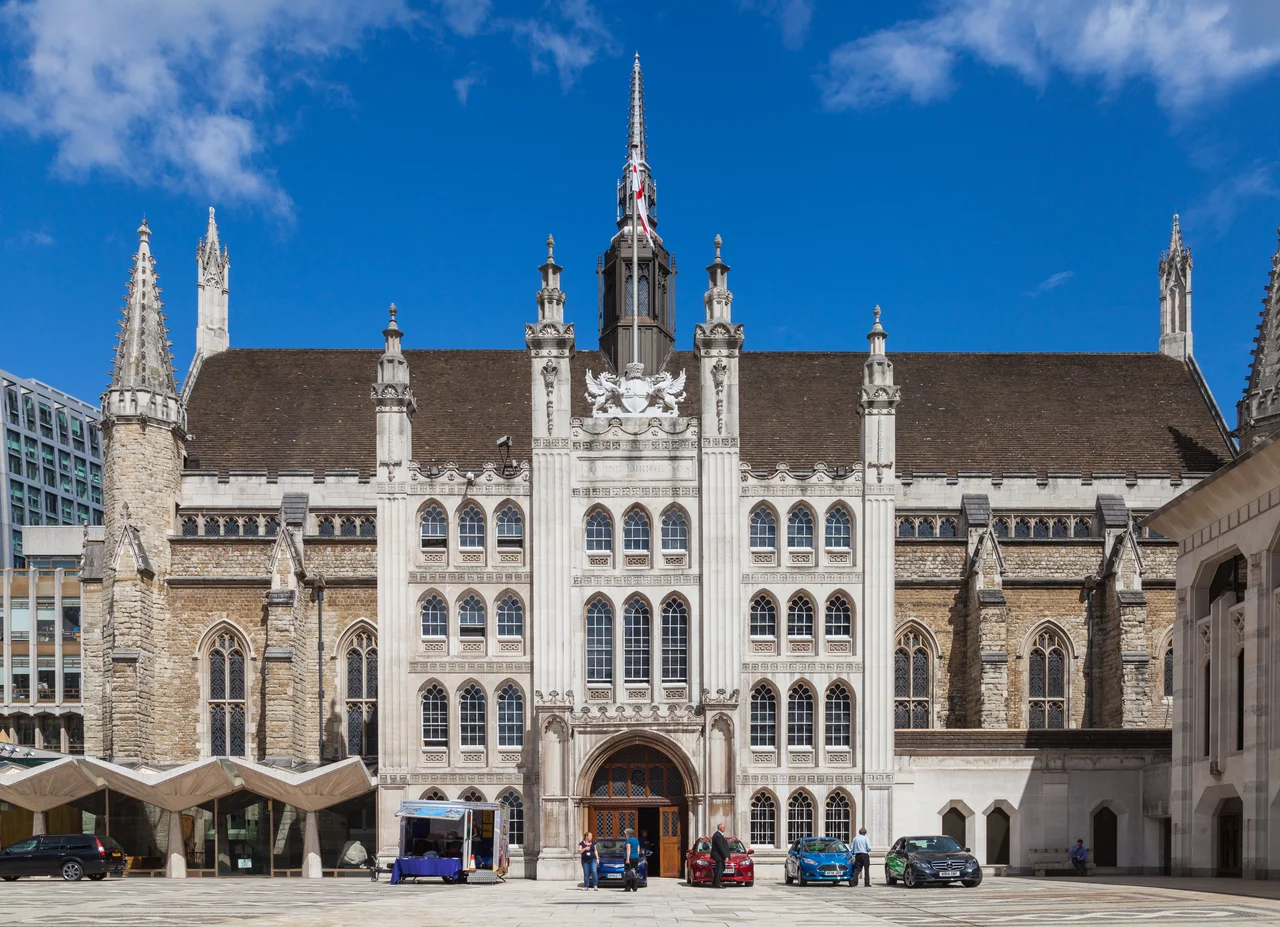

Guildhall, London
A black circle painted on the paving of Guildhall Yard marks the outline of an arena that almost no one walked over for nearly two thousand years. The Roman amphitheatre beneath, built around 70 AD and once the largest in Roman Britain, was rediscovered as recently as 1988. Archaeological excavations at the entrance to the yard later turned up the foundations of a great thirteenth-century gatehouse built directly over the amphitheatre's southern entrance, suggesting that medieval Londoners could still see enough of the Roman stones to plan around them. The strange alignment of the nearby church of St Lawrence Jewry may even shadow the buried elliptical arena. The Guildhall standing on the site today, begun in 1411, is at least the third major civic building to rise on that same Roman ground, and it has been the ceremonial heart of the City of London for at least nine centuries.
From Roman Stones to Anglo-Saxon Hall
The first documentary reference to a London Guildhall is dated 1127 or 1128; archaeologists have found foundations from around that time. The siting of the Anglo-Saxon Guildhall here was probably no accident, the Roman amphitheatre's remains likely still visible enough to inform where the new civic centre rose. One possible derivation of the word "guildhall" comes from the Anglo-Saxon "gild," meaning payment, so a gild-hall would be the place where citizens paid their taxes. A 1396 reference to John Parker as sergeant of "Camera Guyhalde" lends some weight to the theory. Legend, meanwhile, takes the story further back than the Romans. Geoffrey of Monmouth's Historia Regum Britanniae of 1136 places the palace of Brutus of Troy, the mythical founder of Britain, on this very site. According to that legend, Brutus founded New Troy here on the banks of the Thames. Two giants, Gog and Magog, were said to have been defeated by Brutus and chained to his palace gates.
The Hall the Trades Built
Construction on the present Great Hall began in 1411 and was completed in 1440 under the supervision of John Croxton. It was paid for in large part by the City's livery companies, the medieval trade guilds that gave the building its name. The Great Hall did not completely escape the Great Fire of London in 1666; it was partially restored with a flat roof in 1670. The grand entrance to the south, in a style sometimes called "Hindoostani Gothic," was added in 1788 by George Dance the Younger. The Great Hall has been the setting for some of England's most consequential trials. The Protestant martyr Anne Askew was tried here in 1546, sentenced and later burned at the stake. Thomas Cranmer, Archbishop of Canterbury, was tried at Guildhall in 1553. So was Lady Jane Grey, the Nine Days' Queen, condemned to death at sixteen years old. Henry Garnet was tried here in 1606 for his complicity in the Gunpowder Plot, then executed. In 1783 the hall hosted the infamous Zong case hearing, where the insurance claim on enslaved Africans deliberately thrown overboard from a slave ship fuelled growing public revulsion at the transatlantic slave trade and helped accelerate the abolition movement.
Chopin's Last Concert
On 16 November 1848, with his health failing, the Polish-French composer Frederic Chopin gave a benefit concert at Guildhall. The audience was small, the lighting was poor, and Chopin himself was so weak that he had to be carried up the stairs. It was his last public appearance on a concert platform anywhere. He died less than a year later in Paris. Within the Great Hall's long history, that single November evening stands out as a moment of unintended intimacy, the most famous pianist in Europe playing for what he must have known might be the final time, in a room better used to civic banquets and treason trials.
The Blitz and the Giants
The two great wooden statues of Gog and Magog, carved in 1708 by Captain Richard Saunders, stood in the Guildhall for more than two hundred years. They had replaced earlier carvings destroyed in the Great Fire. In December 1940, German bombs reduced the Saunders giants to ashes during the Blitz, along with significant portions of the Guildhall's roof and east wing. The medieval walls held. After the war, a new pair of Gog and Magog was carved by David Evans in 1953, modelled on the eighteenth-century pair. They were a gift to the City of London from Alderman Sir George Wilkinson, who had been Lord Mayor in 1940 when the previous statues were destroyed. As part of the post-war reconstruction, the architect Giles Gilbert Scott designed a new North Wing for Guildhall, built between 1955 and 1958, facing a new public square between Aldermanbury and Basinghall Street. The Guildhall Art Gallery was added to the complex in the 1990s, sitting directly above the Roman amphitheatre.
The Banquet and the Annus Horribilis
Guildhall remains the headquarters of the City of London Corporation, and the older parts of the building are still used for the City's grand ceremonies. The most famous is the Lord Mayor's Banquet, held each year in honour of the outgoing Lord Mayor and traditionally the venue for a major foreign-policy speech by the Prime Minister. The Worshipful Company of Carmen holds its annual cart-marking ceremony in the courtyard every July, a medieval ritual preserved largely intact. In 1992, during the Ruby Jubilee of Elizabeth II, a lunch at Guildhall marked her fortieth year on the throne. The Queen used the occasion to deliver one of her most quoted speeches, calling 1992 her "annus horribilis" after the Windsor Castle fire and the separations of two of her children. The marathon route of the 2012 Summer Olympics passed through Guildhall Yard. And every visitor who walks across that yard, whether they know it or not, walks across the buried oval of the Roman arena where Londoners gathered for spectacle nearly two millennia ago. The site keeps doing the same thing in different forms.
From the Air
Guildhall stands at 51.5159°N, 0.0918°W off Gresham and Basinghall Streets in the City of London. Best viewed from 1,500-2,500 feet AGL. Nearby airports include London City (EGLC) 5 nm east, London Heathrow (EGLL) 16 nm west, and London Biggin Hill (EGKB) 11 nm southeast. Look for the medieval Great Hall with its distinctive south porch and the modern North Wing across the public square. St Paul's Cathedral lies half a mile southwest, and the Bank of England is a quarter mile south.
Nearby Stories
- Stevenage 5.7 km away
- Malling Abbey 5.7 km away
- 1952 Farnborough Airshow Crash 7.7 km away
- Ingatestone Hall 8.2 km away
- Hellfire Caves 9.1 km away
- The Carrington Event: The Solar Storm That Could Happen Again 9.8 km away
- Bletchley Park 16 km away
- Castle Hedingham 23 km away