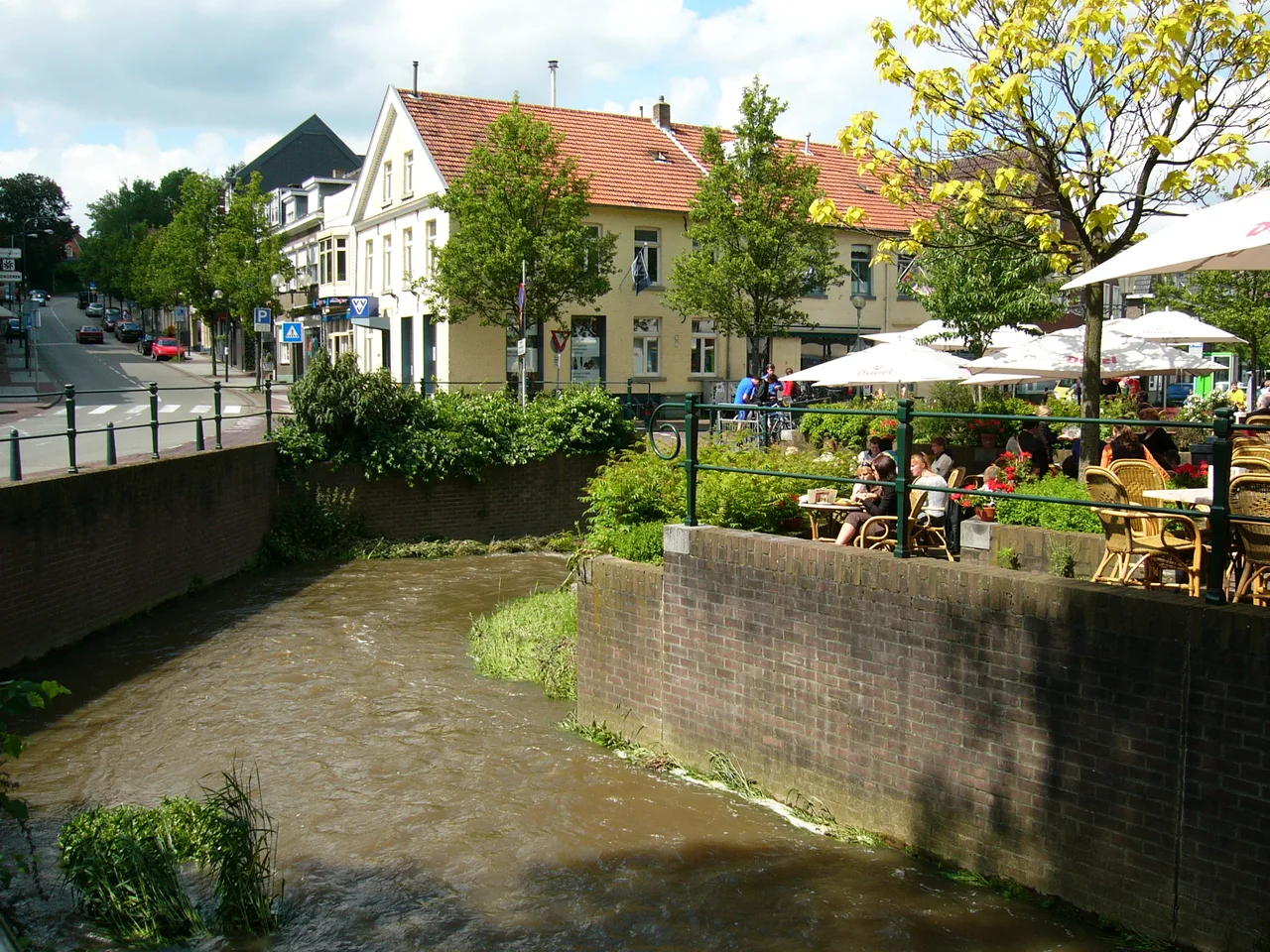

Gulpen
If you stand in the centre of Gulpen on a Thursday morning, you can watch a market unfold in front of you that was named the best small market in the Netherlands. Behind it the river Gulp - the stream the village is named after - runs through the heart of town. Around it, in every direction, the hills of South Limburg rise in gentle, surprisingly green waves. Roughly 4,700 people live here. In summer that number swells with day-trippers, cyclists, and the 15,000 visitors who turn up each year for the Gulpener Bierfeesten, a beer festival built around the village's hometown brewery.
Heart of the Heuvelland
Locals will tell you Gulpen is the heart of the Heuvelland - the 'hill country' of South Limburg, considered by Dutch standards the most beautiful and topographically interesting corner of the country. The Gulp and Geul valleys, where the village sits, are routinely cited as the most beautiful natural area in the Netherlands. None of this would impress someone from Switzerland. The hills are modest, the slopes manageable, the highest points more shoulder than peak. But after the flat polders that stretch over most of the rest of the country, the rolling green countryside around Gulpen feels almost theatrical. The village serves as a base camp for exploring: the surrounding hamlets of Wittem, Epen, Wijlre, Mechelen, and Eys all belong administratively to Gulpen, and each has its own draws.
The Old Road from Maastricht to Aachen
Gulpen sits on the N278 - the modern descendant of an ancient Roman road that ran from Maastricht to Aachen. Both cities are about half an hour away by car. The Romans chose the route for the same reason everyone else has since: it threads neatly through the hills along the easiest line, connecting the major settlements without forcing travellers up any unnecessary slope. Today it carries buses (Line 350, half an hour from Maastricht), tourist traffic in the summer, and a steady stream of cyclists. There is no train station. Bus 40 connects to Heerlen; line 51 runs to Brunssum. From Germany, take the train to Aachen and switch to the 350 westbound. Along the same road, between Gulpen and Maastricht, are villages worth a stop: Vaals, Vijlen, Wittem, and the American war cemetery at Margraten, where more than 8,000 US soldiers killed in the European theatre are buried.
Gulpener Beer
Most Dutch villages of 4,700 do not have their own brewery. Gulpen does, and Gulpener has been brewing in town since 1825. The brewery's role in local identity is hard to overstate. During the summer holidays, Gulpen hosts the Gulpener Bierfeesten, modelled loosely on a German beer fest, with outdoor terraces, long tables, live music, and Gulpener specialties on tap. Around 15,000 people show up - more than three times the village's permanent population. Access to the music stages is free; you pay for the beer. The brewery has built a reputation in recent decades for sourcing its grain and hops from local Limburg farmers, an approach the Dutch beer press tends to file under 'biodynamic' or 'fair beer'. Most of the cafes in the village centre double as restaurants and stay open late, especially in summer, especially when the festival is on.
Cycling Country
Bicycles outnumber cars on most weekends. The hills here are not the Alps, but they are not the flat Netherlands either, and a lot of riders use this country to train. Groups of cyclists in matching team kit roll into Gulpen at all hours, stop for coffee in the square, and roll back out toward Vaals or up the Gulpenerberg. The Amstel Gold Race - the one-day classic that finishes near the Cauberg in nearby Valkenburg every April - threads through this region every spring. For visitors who are not trained climbers, the village rents normal bicycles, mountain bikes, e-bikes, and scooters; the electric bike is the honest choice for most. Hiking trails run in every direction, and the public library, which serves as the closest thing to a tourist information centre, has free Wi-Fi and welcomes drop-ins.
Day Trips and Distant Views
From the top of the Gulpenerberg, the local high point, you can see most of the surrounding villages laid out across the rolling country, all within biking or walking distance. Simpelveld, ten minutes east, has a heritage steam train that runs to Valkenburg - itself a tourist town built around a ruined hilltop castle and the limestone caves of the Cauberg. Hoensbroek, north toward Heerlen, has one of the largest moated castles in the Netherlands. Landgraaf, slightly further north, has indoor ski slopes for the days when the actual hills do not provide enough vertical. And just across the border, Aachen offers a cathedral that holds the bones of Charlemagne. Gulpen itself sits at the centre of it all, quietly. The market still opens on Thursday mornings. The Gulp still runs through town. The beer is still local.
From the Air
Gulpen lies at 50.82 N, 5.89 E in the rolling chalk country of South Limburg, roughly midway between Maastricht (12 km west) and Aachen (12 km east). The village sits in the narrow valleys of the Gulp and Geul rivers, with the Gulpenerberg ridge rising just to the south. From the air, look for the N278 cutting east-west through a checkerboard of small fields and patches of beech forest. Nearest airport: Maastricht Aachen (EHBK), 12 km northwest. Liege (EBLG) is 30 km southwest. Aachen-Merzbrueck (EDKA) is 15 km east. The Dutch-German-Belgian tripoint at Vaals is only 6 km away - a useful landmark, with a small observation tower on the highest point in mainland Netherlands.
Nearby Stories
- Siege of Julich (1621-1622) 4.6 km away
- Wessem-Nederweert Canal 6.7 km away
- Monchengladbach 9 km away
- County of Duras 10 km away
- SCK CEN 15 km away
- Belgium 56 km away
- Marcinelle Mining Disaster 100 km away
- Marmoutier Abbey 228 km away