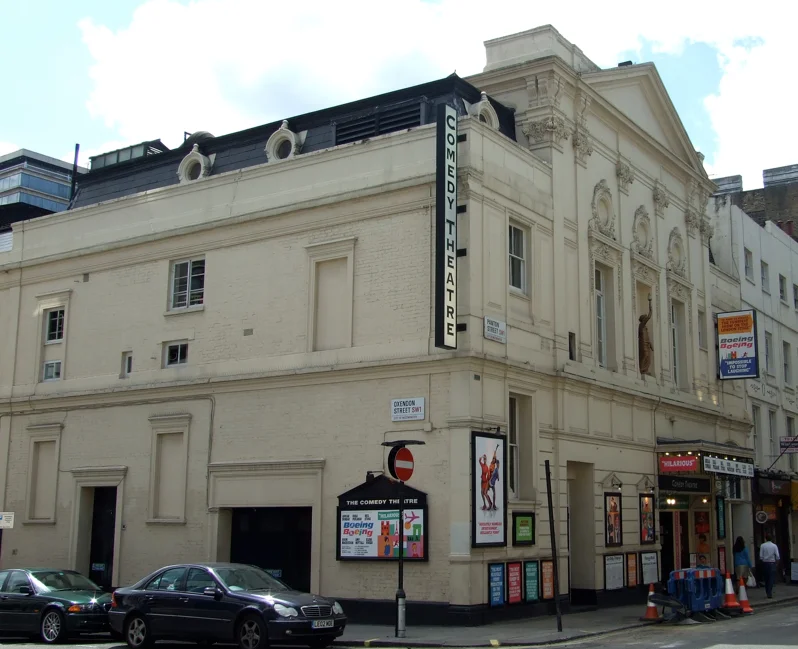

Harold Pinter Theatre
In 1956, a small West End theatre on Panton Street founded a private members' club called the New Watergate. The club had a single purpose: to perform plays that had been banned by the Lord Chamberlain. The Theatres Act of 1843 still required every script to be submitted for approval, and the Lord Chamberlain's Office routinely rejected anything that touched on homosexuality, marital infidelity, or politically sensitive subjects. Under "club conditions," however, plays could be performed for paying members in private. So the Comedy Theatre, as it was then known, became the London home for the UK premieres of Arthur Miller's A View from the Bridge, Robert Anderson's Tea and Sympathy, and Tennessee Williams' Cat on a Hot Tin Roof. The censorship law would not be fully repealed until 1968. The Comedy got there first.
Henderson's Opera House
The theatre opened in 1881 on Panton Street, just off Haymarket in the heart of the West End. The first lessee, Alexander Henderson, had worked with the architect Thomas Verity on the building's design. Henderson had intended the venue to be the home of comic opera; at one point he even planned to call it the Lyric. He assembled a strong team, with Lionel Brough as stage director and Auguste van Biene as musical director. The early years brought operettas: Francis Chassaigne's Falka in 1884, with Violet Cameron in the title role, and Erminie in 1885. Violet Melnotte took over as lessee that year, then leased it on to Charles Hawtrey from 1887, who ran the theatre until 1892 and produced Jane in 1890 alongside many now-forgotten farces. By 1899, the major productions included A Lady of Quality by Frances Hodgson Burnett, the author who would later write The Secret Garden, and Great Caesar by George Grossmith Jr. and Paul Rubens.
Edwardian Triumphs
In the first decade of the twentieth century, the Comedy was used for matinées of avant-garde plays and special seasons. Frank Benson and his Shakespeare company, with Lilian Braithwaite and Oscar Asche, played a Shakespeare season here in 1901. In 1902, Lewis Waller presented an adaptation of Monsieur Beaucaire that ran for 430 performances. In 1905, Charles Frohman presented John Barrymore in his London debut in The Dictator. Raffles with Gerald du Maurier ran for 351 performances in 1906. Marie Tempest starred in a series of six dramas by Somerset Maugham and others between 1907 and 1909. The final production to open before the First World War was Peg o' My Heart with Laurette Taylor, which ran for 710 performances. Then the war came, and like most West End houses, the Comedy turned to revue: Albert de Courville's Shell Out in 1915, four successive revues by Andre Charlot, the last two of which ran for 429 and 467 performances respectively.
The Censorship Club
The New Watergate Club was the producer Anthony Field's response to a censorship regime that had become absurd. The Lord Chamberlain's Office was rejecting serious plays by serious playwrights because they mentioned realities of adult life. Field formed a private club so that the theatre could perform these works for paying members in what was, legally, a private performance. The 1956 UK premiere of Tennessee Williams' Cat on a Hot Tin Roof, starring Kim Stanley, was a sensation. Arthur Miller's A View from the Bridge, Robert Anderson's Tea and Sympathy, and other prohibited plays followed. The club system was a brilliant work-around, but it was also an embarrassment to the authorities. By the late 1950s, the Lord Chamberlain's Office was visibly loosening its standards, and the New Watergate Club was dissolved when Peter Shaffer's Five Finger Exercise was permitted to premiere to a public audience. The censorship law itself was finally repealed in 1968. The theatre was Grade II listed by English Heritage in June 1972.
Becoming the Pinter
In 2011, the Ambassador Theatre Group renamed the Comedy after Harold Pinter, the playwright who had won the Nobel Prize in Literature in 2005 and died in 2008. Pinter's work had been performed there many times; he had directed and written for the venue across decades. The renaming was widely supported, though some traditionalists missed the old name. The theatre committed to honouring its new namesake: in 2018 and 2019 it ran the Pinter at the Pinter season, a comprehensive cycle of Pinter's one-act and short plays directed by Jamie Lloyd, including The Lover, The Collection, One for the Road, Mountain Language, Ashes to Ashes, Moonlight, and Night School. Many of Britain's leading actors took part. Lloyd then founded the Jamie Lloyd Company at the theatre, opening with a striking minimalist Cyrano de Bergerac starring James McAvoy in 2022, followed by The Seagull with Emilia Clarke later that year.
Recent Stages
The list of productions in the past two decades is staggering. Boeing-Boeing in 2007 with Mark Rylance and Roger Allam; The Misanthrope in 2009 with Keira Knightley and Damian Lewis; La Bête in 2010 with Rylance, David Hyde Pierce, and Joanna Lumley; Betrayal in 2011 with Kristin Scott Thomas; Death and the Maiden in 2011 with Thandie Newton; Mojo in 2013 with Brendan Coyle and Rupert Grint; Sunny Afternoon, the Kinks musical, running from 2014 until 2016; Who's Afraid of Virginia Woolf with Imelda Staunton in 2017; Hamlet with Andrew Scott in 2017; Oslo with Toby Stephens in 2017; The Birthday Party with Toby Jones in 2018; Ian McKellen On Stage in 2019; Prima Facie with Jodie Comer in 2022; Good with David Tennant in 2022; A Little Life in 2023 with James Norton; Dr. Semmelweis with Mark Rylance in 2023; The Hills of California in 2024 by Jez Butterworth; Macbeth with David Tennant and Cush Jumbo in 2024. In 2026, Romeo and Juliet opens with Sadie Sink and Noah Jupe. From Edwardian comic operas to a censorship-defying club to the theatre of menace itself, the building has been remarkably loyal to its name, whichever one it has worn.
From the Air
The Harold Pinter Theatre sits at 51.5094°N, 0.1317°W on Panton Street, just off Haymarket in the heart of London's West End. Best viewed from 1,500-2,500 feet AGL. Nearby airports include London City (EGLC) 7 nm east, London Heathrow (EGLL) 13 nm west, and London Biggin Hill (EGKB) 12 nm southeast. Look for the cluster of theatres around Leicester Square and Piccadilly Circus; Trafalgar Square lies just to the south.
Nearby Stories
- Stevenage 5.7 km away
- Malling Abbey 5.7 km away
- 1952 Farnborough Airshow Crash 7.7 km away
- Ingatestone Hall 8.2 km away
- Hellfire Caves 9.1 km away
- The Carrington Event: The Solar Storm That Could Happen Again 9.8 km away
- Bletchley Park 16 km away
- Castle Hedingham 23 km away