
Hartland, Devon
The high tower of St Nectan's at Stoke shows up first - a pale finger of Perpendicular stone pushing above hedge banks and wind-stunted oaks. Sailors in the Bristol Channel have used it as a landmark for six centuries, and from above it still functions the same way. The village it serves, Hartland, sits at the most north-westerly corner of Devon, where the coast makes a hard turn from facing north into the Channel to facing west into the Atlantic. Everything here is shaped by that turn - the cliffs, the weather, the slow drift of the place from medieval port to quiet village to film location.
Where the Channel Ends
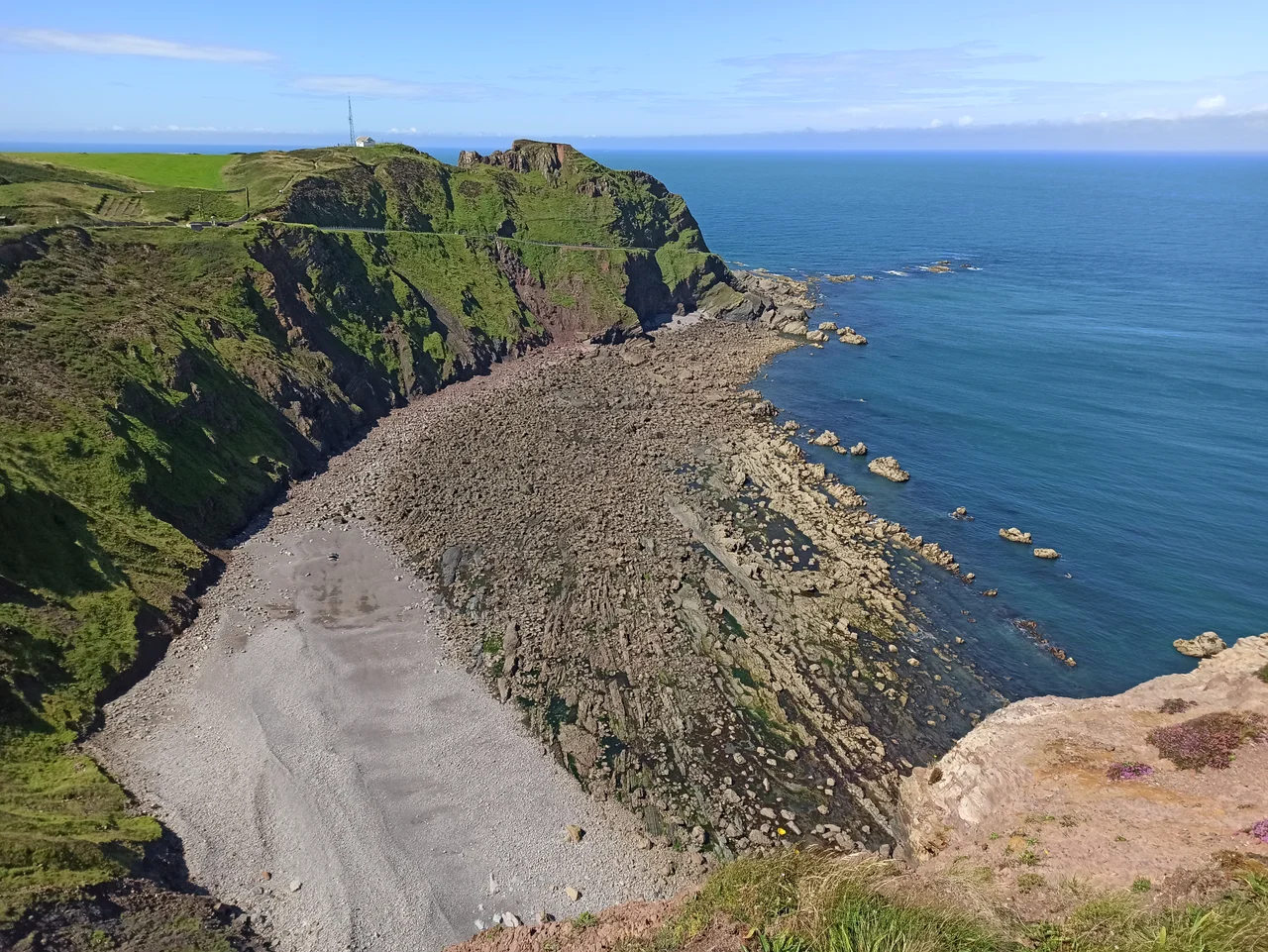
Hartland Point is the geographical hinge. The Bristol Channel runs east and the Atlantic opens west, and somewhere off the headland the two collide. Standing on the cliffs, you can sometimes see the seam in the water itself - one current the colour of weak tea, the other gunmetal grey. Lundy Island floats out in the distance, ten miles offshore, low and humped like a stranded whale. The Lundy Company runs a helicopter service from Hartland Point between November and March, when the seas are too rough for the boats. The cliffs around the point are some of the most dramatic on the South West Coast Path, which threads along the edge here in stages of constant ascent and descent.
An Abbey and a Saint
St Nectan was a 5th-century Welsh holy man who walked here from across the Channel and settled at Stoke. Hartland Abbey, built in 1157 and consecrated in 1160 by Bartholomew Iscanus, was raised on or near the spot where his shrine had drawn pilgrims for centuries. In 1539 it became the last English monastery to be dissolved by Henry VIII, who handed it to William Abbot - his Sergeant of the Wine Cellar at Hampton Court, a reward for service at the royal cup. The estate has stayed in private hands ever since. Gertrude Jekyll, the great Edwardian garden designer, laid out the grounds. The parish church next door has the tallest tower in Devon, a Norman font, and what is considered the finest rood screen in the north of the county.
The Quay That the Sea Took
Hartland Quay sits below the point, tucked into a slot in the cliffs at the bottom of a long zigzag road. The original quay went up in the late 16th century, when this coast still had real maritime traffic and Hartland counted as an important port. The Atlantic finished it in 1887, ripping the stonework apart in a single winter of storms. What remains is a hotel, a tiny museum, and the rough bones of what was rebuilt afterward. The buildings cling to a shelf above the surf, and on rough days the spray reaches the windows. In Tudor times this was a working harbour. Now it is mostly a place to watch weather.
On Film and in Memory
Hartland Abbey and Quay keep ending up on television. The 2008 BBC adaptation of Sense and Sensibility used a cottage on the estate. Episode two of The Night Manager in 2016 returned to the same cottage and walked its cameras down Fore Street past the Anchor Inn and O'Donnell's Grocers. HBO's House of the Dragon used the abbey and the quay for its own purposes. Mary Norton, who wrote The Borrowers, spent her last years here and is buried at St Nectan's. Satish Kumar, the long-time editor of Resurgence magazine, founded the Small School in Hartland in 1982 - a tiny experiment in human-scale education that ran for decades in a village school house. The Hartland Times ran from 1981 to 2014; its successor, the Hartland Post, took over in 2016.
Walking the Path
Most visitors arrive on foot, coming up from Bude or down from Clovelly along the coast path. The cliffs here are layered shale, tilted into vertical strata by ancient pressure, and they fall away in saw-toothed steps into surf that almost never stops. The 319 bus from Barnstaple runs infrequently and the 219 limps over from Bude. Beyond that, you walk or drive. The reward for the effort is a stretch of coast that has not been smoothed, paved, or developed. The 2011 census counted 3,019 people in the parish - a small community holding the western tip of England's most-visited county.
From the Air
Hartland village sits at 50.99 N, 4.48 W on the north Devon coast, with the headland and lighthouse a couple of miles northwest. Best viewed from 2,000 to 3,000 feet to take in the pivot of coastline from Bristol Channel to Atlantic, with Lundy Island visible 10 nm offshore on clear days. Nearest aerodromes are Eaglescott and Dunkeswell to the east, with Newquay (EGHQ) and Haverfordwest (EGFE) across the Channel as larger alternates. Expect strong westerlies and rapid cloud build-up off the Atlantic.
Nearby Stories
- HMHS Glenart Castle 11 km away
- Castle Drogo 12 km away
- Exmoor 13 km away
- North Cornwall Railway 14 km away
- Mumbles Lifeboat Disaster 21 km away
- Horton and Port Eynon Lifeboat Station 28 km away
- Padstow Lifeboat Station 29 km away
- Castlemartin Training Area 34 km away