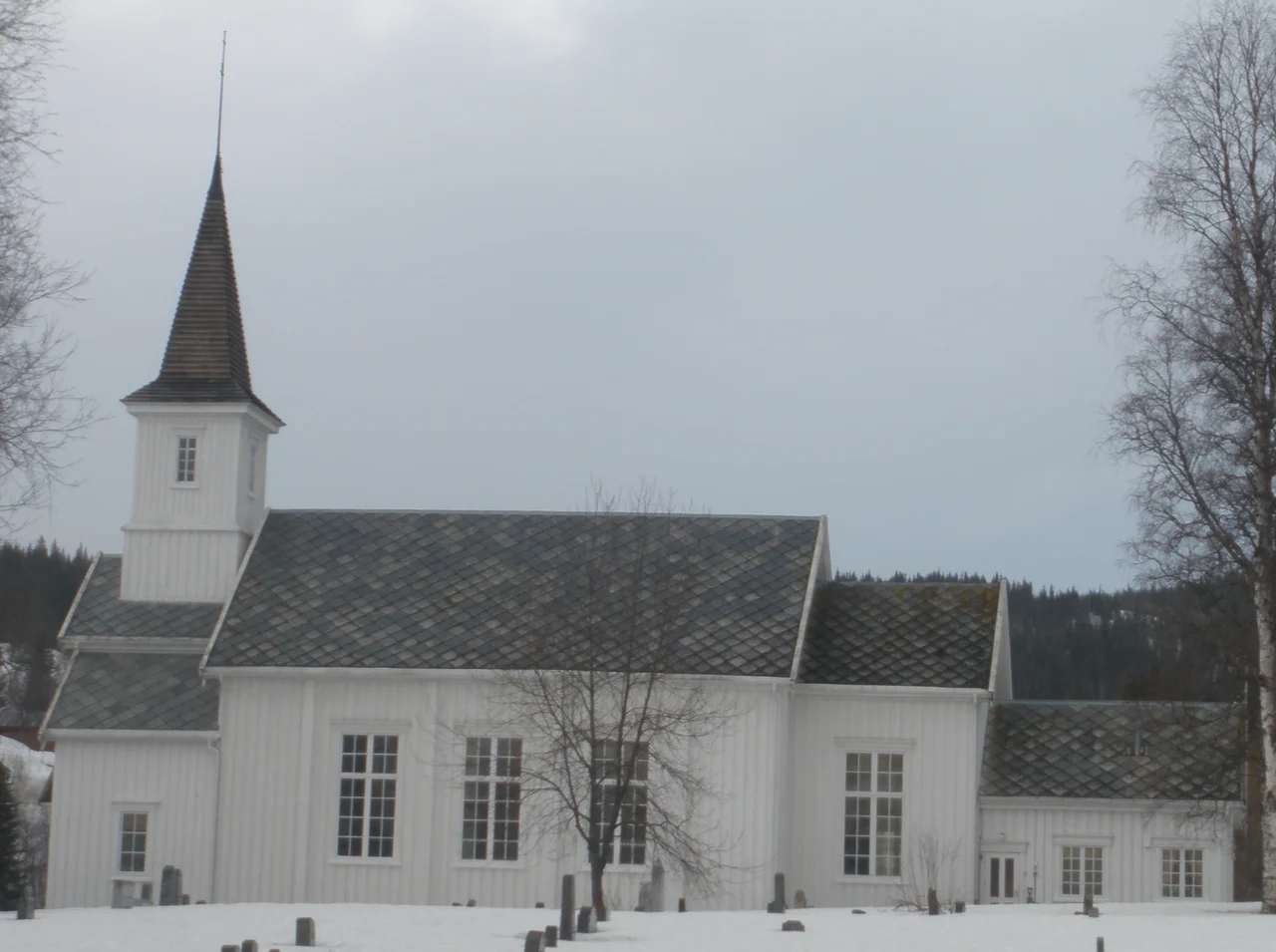

Hattfjelldal Church
One surviving photograph shows both churches at Hattfjelldal in the same frame. At the far right of the picture stands the new one, white timber, its walls freshly up. Away to the left is the church it replaced, built in 1788, which had a few years left to run. For a period the parish simply had two: the replacement finished on a plot a short distance north, the old building still on its original ground, unhurried about coming down. The demolition came in 1874. That photograph is the only moment when this parish's whole building history was visible at once — because the present church is the third to stand on this site, and its predecessors go back to a small chapel raised in 1727.
Three Buildings, One Patch of Ground
The sequence is unusually well recorded for a place this remote. A small chapel went up in 1727, in a mountain district that had until then possessed no church of its own — this was all part of Vefsn, and the parish church lay far downriver. That chapel was replaced by a larger one in 1788. Eighty years later the parish outgrew that too, and construction of the present church began in 1868 on a new plot a short distance to the north, following plans by the architect Jakob Nilsen Hagen.
What stands there now is a white timber long church — the rectangular nave-and-chancel plan used across rural Norway — with a churchyard beside it. The building has been maintained rather than transformed: a renovation in 1958 under the architect John Egil Tverdahl, and work on the sacristy in 1966 by Nils Toft. The bell in the tower dates from 1869 and is made of steel rather than bronze, which is unusual enough that it has long been described locally as the first steel church bell produced in Norway.
The Bishop Who Consecrated It
Hattfjelldal Church was consecrated on 12 August 1869 by Fredrik Waldemar Hvoslef, newly installed as Bishop of Tromsø. He arrived carrying a history that few bishops have.
Seventeen years earlier, Hvoslef had been the parish priest at Kautokeino, some five hundred kilometres north, when a group of Sámi caught up in the Laestadian revival rose against the merchants, the officials and the state church on 8 November 1852. They killed the trader Carl Johan Ruth and the lensmann Lars Johan Bucht, and they whipped Hvoslef before other Sámi in the village stopped them. Two of the leaders, Aslak Hætta and Mons Somby, were beheaded at Alta; others died in prison. Hvoslef attended Hætta and Somby at their execution in 1854 as their pastor. Whatever passed between those men, it is a heavy thing to carry into a valley at the heart of Southern Sámi country.
Aarborte
Kautokeino is Northern Sámi country. Hattfjelldal is Southern Sámi, a separate language with far fewer speakers, and this municipality is one of its last strongholds. That fact has slowly acquired official standing. A Sámi boarding school, Gaske-Nøørjen Saemienskovle, was established here in 1951. The cultural centre Sijti Jarnge opened in May 1987, from an idea first raised at a Nordic Sámi Council meeting in Utsjoki, Finland, in March 1972. In 2017 the municipality entered the administrative area for Sámi languages and became officially bilingual, and in 2019 it formally adopted Aarborte as its Southern Sámi name.
The Norwegian name is older and plainer. Hattfjellet is a mountain shaped like a hat, and the valley beneath it took the name. Both names describe the same place, and for the first century and a half of this church's life only one of them was written on anything official.
A Parish Larger Than Most Counties
Hattfjelldal Municipality separated from Vefsn in 1862 with 961 residents, seven years before the present church opened. It covers well over two thousand square kilometres of mountain, forest and water along the Swedish border, and Røssvatnet — Norway's second-largest lake — lies mostly inside it. The population peaked at 2,110 in 1963 and now runs closer to 1,300, which works out at roughly one person for every two square kilometres.
The church at Hattfjelldal is the main building of a parish that also includes Susendal Church, built by its valley on volunteer labour in 2001, and Varntresk. Farming and forestry still underpin the local economy, and the municipality is reckoned to hold the largest untapped agricultural potential of any in Nordland. What has survived here for three centuries — a church on one patch of ground, and a language on the mountains around it — has done so without much help from numbers.
From the Air
Hattfjelldal Church stands at 65.5969°N, 13.9916°E in the village of Hattfjelldal, inland Nordland, close to the Swedish border. Best viewed from 1,500–3,000 ft AGL: white timber walls and the churchyard read clearly against forest and, in winter, against snow. Terrain rises sharply around the valley — Kvigtinden reaches about 1,699 m (5,574 ft) to the south in the Børgefjell massif — so plan 8,000 ft for transit. Navigation cues: Røssvatnet, Norway's second-largest lake, lies north and east of the village and is the dominant water feature for tens of kilometres; the Vefsna forms just west of Hattfjelldal where the Susna and Unkerelva join, and National Road 73 runs west down that valley to Trofors and the E6, and east to the Swedish border. Nearest airports: Mosjøen Airport, Kjærstad (ENMS) to the west, Mo i Rana (ENRA) to the north, Namsos (ENNM) to the south. Weather over the border mountains changes fast, low cloud is common in the valleys, and midwinter offers only a few usable hours of light.
Nearby Stories
- Actions in Nordland 13 km away
- Joesjö 13 km away
- Okstindbreen 14 km away
- Toven Tunnel 17 km away
- Børgefjell National Park 23 km away
- Ume River 28 km away
- Stekenjokk 34 km away
- Namsskogan (village) 52 km away