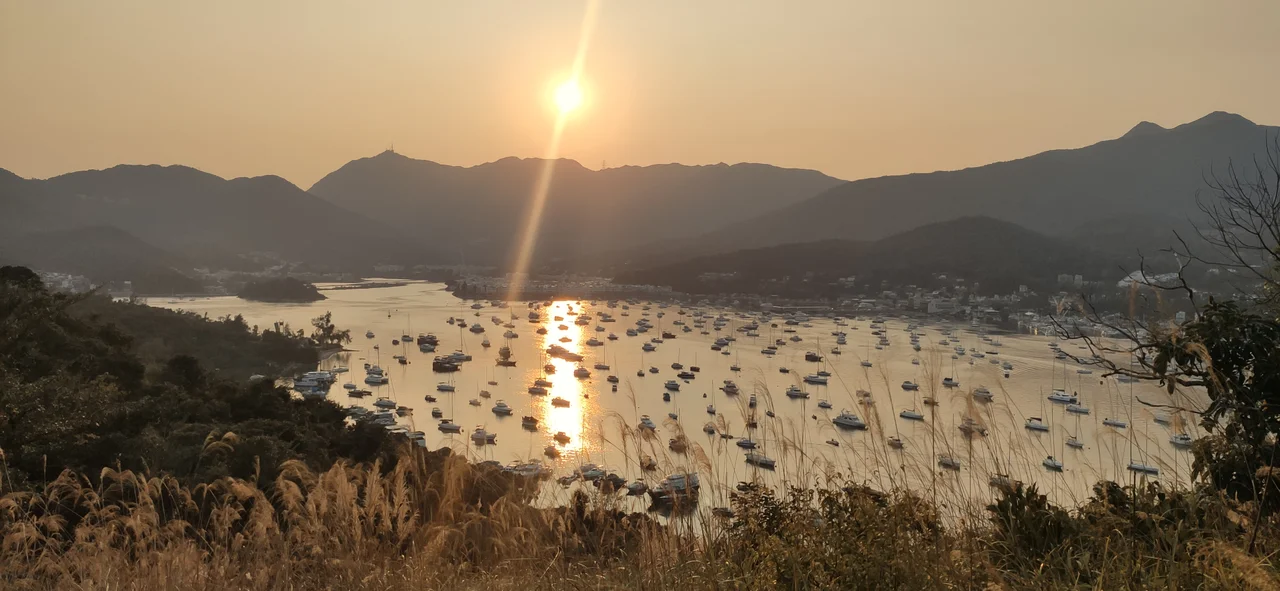

Hebe Haven
The name came from the beach, and the beach explained everything. The white sands of a cove at the northwestern edge of this harbour gave the place its Cantonese name: Pak Sha Wan, meaning 'white sand bay.' The English name came later — Hebe Haven, a poetic rendering that stuck — but the harbor itself was here long before either name mattered. Sheltered inside the southern shore of Sai Kung Peninsula, with a single opening to Port Shelter in the south and the Pak Sha Wan Peninsula curving around to embrace it on the east, this is exactly the kind of enclosed natural anchorage that sailors have sought out for as long as there have been boats in the South China Sea.
Water in Every Direction
Two rivers flow into Hebe Haven: the Ho Chung River from the west and the Tai Chung River from the northwest. Tides and river currents deposit sediment in the haven's sheltered corners, shaping small beaches and alleviating the bottom — though the tidal range here is modest and the currents are gentle. A cluster of smaller streams enters from the northern edge. One of them runs through a small mangrove area near Pak Sha Wan village, and this mangrove patch has a specific reputation: the black-capped kingfisher is regularly sighted here, making it one of the better places in Hong Kong to observe a bird that is rarely easy to find. The area is small and not especially scenic, accessible at high tide only by dinghy, but birders who know about it seek it out. That kind of specificity — the hyper-local knowledge that rewards those who look closely — is characteristic of the Sai Kung coast.
Villages Around the Shore
A ring of villages surrounds Hebe Haven, each with its own character and its own long history. Au Tsai Tsuen, Che Keng Tuk, Heung Chung, Ho Chung New Village, Kau Sai San Tsuen, Luk Mei Tsuen, Nam Wai, Pak Sha Wan, Pak Wai, Ta Ho Tun Ha Wai, Ta Ho Tun Sheung Wai, Tsiu Hang, Tsiu Hang Hau, Wo Mei — the list reads like a cadastral map of traditional Cantonese settlement. Many of these villages trace their origins to the eighteenth and nineteenth centuries, when Hakka and Punti families established communities along Hong Kong's rural coastlines. Nam Wai, on the eastern shore, holds a Tin Hau Temple that local fishing communities have maintained for generations, dedicated to the goddess of the sea. The marine orientation of these villages was not incidental: fish, boats, and the rhythms of the tidal calendar shaped life here long before Sai Kung became a weekend destination for city-dwellers.
The Sailing Life
Hebe Haven is above all a yachting harbor, and has been since British colonial society took an interest in the peninsula's natural anchorages. The Shelter Cove Yacht Club, affiliated with the Royal Hong Kong Yacht Club, operates here, as does the independent Hebe Haven Yacht Club. Numerous moorings are distributed across the haven's sheltered waters, with a clearly marked navigational channel — the marks are not lit at night, worth noting for anyone approaching after dark. Sea Scouting has a presence here too. On weekends, the harbor fills with boats at all stages of preparation and return: sails coming down, dinghies ferrying crews ashore, the particular social atmosphere of a sailing community where everyone is either arriving or departing or talking about both. The Marina Cove residential estate, built along the haven's shore, brings a more permanent residential population to what was once a working coastal landscape.
A Harbor Between Two Worlds
What makes Hebe Haven worth noting is how it holds two versions of Hong Kong in close proximity. On the water, the yacht clubs and their gleaming hulls represent the territory at its most internationally minded — a sailing culture rooted in colonial British leisure and maintained by a cosmopolitan community with deep money and a shared attachment to wind and tide. On the shore, the old villages maintain their own continuity: temple festivals, clan ties, farming plots, fishing boats pulled up on the beach. The Pier Hotel on the Pak Sha Wan waterfront, a 40-room property that opened in September 2018 and owned by the family of Francis Choi Chee-ming, captures the more recent layer — a boutique hotel with a single Japanese restaurant, inserting Sai Kung's particular brand of serene luxury into a harbor that has always been, at its core, about finding shelter from the open sea.
From the Air
Hebe Haven lies at approximately 22.367°N, 114.267°E on the southern shore of Sai Kung Peninsula in Hong Kong's Sai Kung District. Approaching from VHHH (Hong Kong International Airport, roughly 38 km to the west-northwest), fly northeast over Kowloon and the Tseung Kwan O hills to reach Port Shelter. At 1,500–2,500 feet, the enclosed harbor is clearly visible, hugged by the Pak Sha Wan Peninsula to the east. The Sai Kung town waterfront lies a few kilometers to the northeast. On clear days the outer islands of Port Shelter and beyond are visible to the south. The nearest airport is VHHH; no closer civilian airport serves this coastal area.
Nearby Stories
- Sha Chau and Lung Kwu Chau Marine Park 5.9 km away
- Wanshan Archipelago 22 km away
- Hong Kong 12 25 km away
- Second Battle of Chuenpi 27 km away
- Mount Guanyin (Dongguan) 43 km away
- Battle of Penghu 474 km away
- Penghu Air Raids 482 km away
- Checheng Fu'an Temple 592 km away