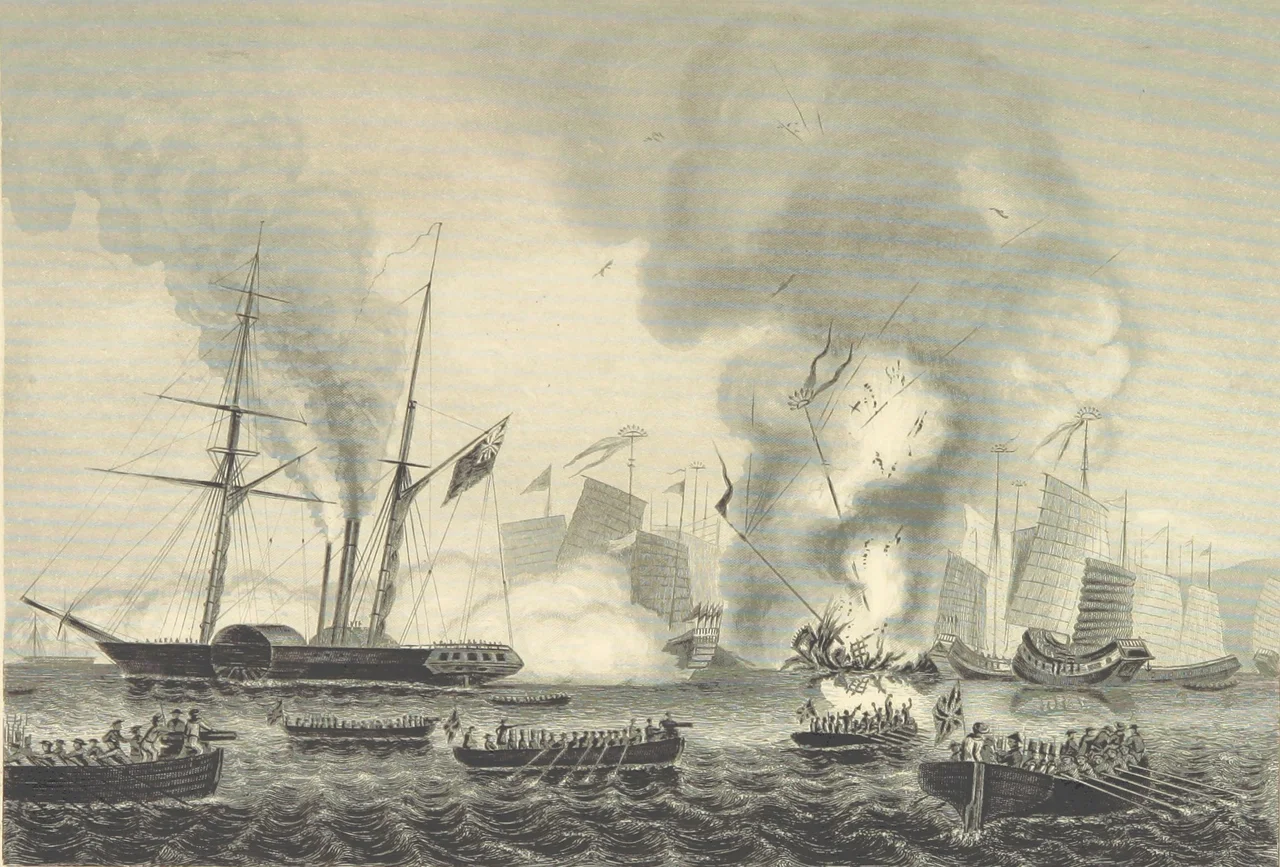

Second Battle of Chuenpi
January 7, 1841 began like any winter morning on the Pearl River — low mist over the water, the slow pulse of the tides through the Humen Strait. By midmorning, it was over. In roughly two hours, British warships had silenced the Qing forts on the islands of Chuenpi and Taikoktow, destroyed eleven Chinese war junks, and captured 191 cannons. The Second Battle of Chuenpi was not a long battle. But its consequences echoed for generations.
A Strait Worth Fighting For
The Humen Strait — known to Western traders as the Bogue — was the chokepoint through which all maritime commerce with Canton had to pass. The Qing dynasty had fortified it heavily, placing gun batteries on the low islands that flanked the channel. These fortifications were real and formidable in their own context, designed to control access to the Pearl River Delta and the wealth of Guangzhou beyond. What they were not designed for was what arrived on January 7: the steam-powered warship Nemesis — an East India Company vessel — and a flotilla of Royal Navy vessels carrying the latest British ordnance. The mismatch in firepower was stark, and Qing commanders — veterans of a military tradition shaped by very different conditions — had little room to adapt in the hours they were given.
Two Hours at the Bogue
Commodore Gordon Bremer commanded the British assault. His forces moved on both island forts simultaneously, combining naval gunfire with amphibious landing parties. The battle lasted approximately two hours. When it ended, the human cost was deeply uneven: 38 British soldiers were wounded, none killed. Qing casualties were far heavier — 277 soldiers died and 467 were wounded, according to Chinese records. The 744 Qing casualties represent soldiers who had stood at their posts under bombardment from weapons they could not match. Whatever the politics of the Opium War, these men died in defense of their country's territory, and that deserves to be remembered plainly.
The Convention That Almost Was
Thirteen days after the battle, on 20 January 1841, British Plenipotentiary Charles Elliot and Qing Imperial Commissioner Qishan negotiated what became known as the Convention of Chuenpi. The draft agreement proposed the cession of Hong Kong Island to Britain as a trading and military base, the reopening of commerce at Canton, and a payment of six million dollars in reparations. On 26 January, Commodore Bremer raised the British flag at Hong Kong. But the convention was never ratified. Both governments rejected it: the British felt Elliot had settled for too little, the Qing felt Qishan had given away too much. Both diplomats were dismissed. The war continued for another year and a half.
Opium, Empire, and Consequence
The First Opium War, of which this battle was a part, grew from a collision between Qing attempts to stop the illegal British opium trade into China and British demands for open commercial access. The trade had created widespread addiction among Chinese populations while generating enormous profit for British and Indian merchants. China's attempt to enforce its own laws against the trade was the trigger; the military response revealed how dramatically the industrial revolution had shifted the balance of power between nations. The Second Battle of Chuenpi was one of the earlier engagements of that war — a moment when the stakes became concrete, measured in lives lost on a river island most people in either country had never heard of.
What the River Remembers
The Pearl River Delta today is one of the most densely industrialized regions on Earth. Container ships pass through the Humen Strait where war junks once faced steam-powered warships. The nearby Humen Bridge now arcs over the same water the battle was fought on. Weiyuan Fort, built in 1835 just a few kilometers upstream, still stands — preserved as a reminder of the Opium War era. The islands of Chuenpi and Taikoktow have been absorbed by the sprawl of Dongguan. The battle that unfolded here helped set in motion a chain of events that remade the map of Asia: the eventual cession of Hong Kong, the Unequal Treaties, and the long reckoning with what China's historians call the Century of Humiliation. January 7, 1841 was a short battle. The questions it raised took much longer to settle.
From the Air
The battle site lies at approximately 22.76°N, 113.66°E, within the Humen Strait of the Pearl River Delta, about 60 km southeast of Guangzhou's city center. At 3,000 feet, the branching waterways of the Pearl River Delta spread visibly below, with the modern Humen Bridge crossing the strait where British ships once advanced. Weiyuan Fort is visible on the western bank a few kilometers north. Nearest major airport: ZGGG (Guangzhou Baiyun International Airport), approximately 70 km to the northwest. The low, flat islands of the delta offer few visual landmarks at altitude; the characteristic shape of the river's channels and the arc of the Humen Bridge are the primary navigation references.
Nearby Stories
- South China Mall 1.5 km away
- Sham Chung 7.1 km away
- Fengjian Village 7.4 km away
- Foshan Wong Fei-hung Memorial Hall 9 km away
- Nei Lingding Island 12 km away
- West Lake (Huizhou) 16 km away
- Horizontal Skyscraper – Vanke Center 19 km away
- Yamen, Guangdong 27 km away