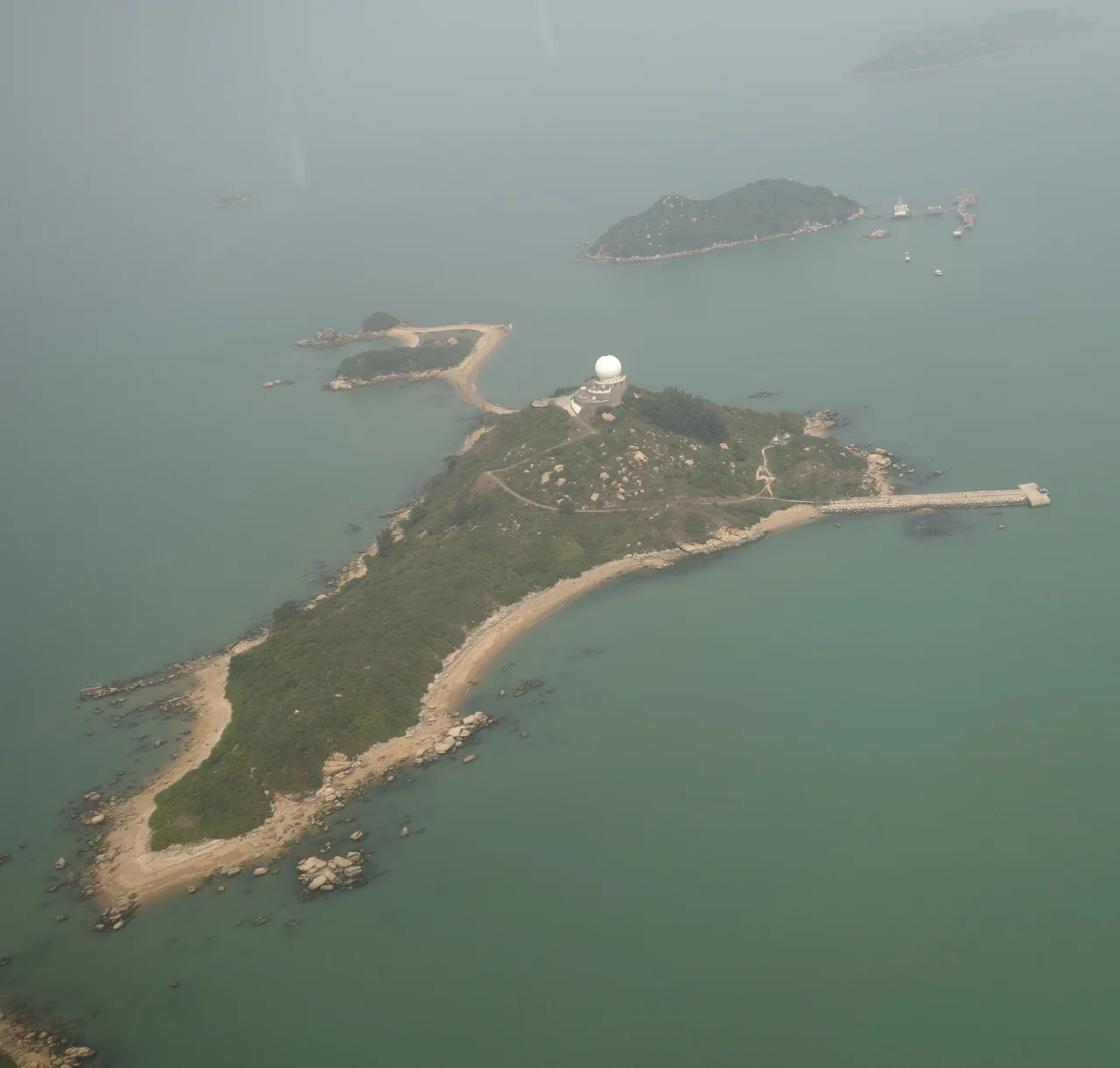

Sha Chau and Lung Kwu Chau Marine Park
Somewhere between Hong Kong and the mouth of the Pearl River, in waters that few visitors ever reach, dolphins surface in shades of pink and white. The Chinese white dolphin — *Sousa chinensis chinensis* — is not the city's most photographed animal, but it may be its most quietly remarkable. The Sha Chau and Lung Kwu Chau Marine Park was established in November 1996 specifically to protect these dolphins and the unusual ecological conditions that sustain them. Yellow buoys mark the corners of its 1,200 hectares. Inside those boundaries, something rare holds on.
Where Two Waters Meet
The marine park sits off the western coast of Hong Kong's New Territories, in a zone where the Pearl River's freshwater outflow pushes against the South China Sea. The result is water with a lower salinity than the open ocean and an unusually high load of organic nutrients — conditions that support dense blooms of the small fish and crustaceans that dolphins, seabirds, and other marine life depend on. It is not the clearest water in Hong Kong; visibility can be poor, the color often greenish-grey. But biological richness does not always look beautiful. The three islands within the park's boundaries — Lung Kwu Chau, Sha Chau, and Pak Chau (also called Tree Island) — rise as low, rocky shapes above this productive sea. They are not destinations for tourists. They are habitat.
The Pink Dolphins
The Chinese white dolphin is a misnomer twice over: the animals are born dark grey and lighten as they mature, eventually turning white — and in the Pearl River Estuary, many develop a distinctive pinkish flush from blood vessels close to the skin. Scientists have debated whether this coloring is thermoregulatory, a by-product of shallow-water UV exposure, or simply an individual variation. Whatever its cause, it makes the dolphins of this estuary visually unlike almost any other cetacean population in the world. They live year-round in the Pearl River delta and its flanking waters, including the area protected by this marine park. They are not migratory animals. This is home — and it is a home that has faced persistent pressure from land reclamation, shipping traffic, and coastal development. The marine park was one of the few formal protections placed around the habitat they rely on.
A Temple Built for the Sea
On the island of Sha Chau stands a Tin Hau Temple, built during the Qing dynasty in 1846. Tin Hau — known also as Mazu — is the goddess of the sea, widely venerated across southern China and Southeast Asia. Fishermen and sailors came to this remote island temple to make offerings and ask for safe passage, a practice that stretched back generations before the marine park existed and long before any conservation designation gave the island official protection. The temple has since been appraised as a historic building. It remains a place where the practical and the spiritual overlap: people who made their living from these waters understood, in their own terms, that the sea demanded respect and care. That understanding predates modern conservation by centuries.
A Reserve in a Working Sea
The Sha Chau and Lung Kwu Chau Marine Park is not a wilderness preserve in any straightforward sense. The waters around it are some of the busiest in the world. Hong Kong International Airport — built on reclaimed land at Chek Lap Kok, just to the south — handles millions of passengers a year, and the approach flight paths pass close to the park's boundaries. The Lantau Link connects Lantau Island to the mainland nearby, carrying a constant flow of road and rail traffic. Container ships move in and out of the Pearl River ports. Against this backdrop, the marine park is less a refuge and more a negotiated space — a formal acknowledgment that the dolphins' habitat has value, marked by buoys, and protected by rules that limit certain human activities within its boundaries. Whether that protection proves sufficient depends on pressures that extend far beyond the park's 1,200 hectares.
From the Air
Located at 22.3634°N, 113.883°E, in the waters west of Hong Kong's New Territories. From the air, the marine park is visible as open water between the islands of Lantau and the Pearl River delta shore. The three small islands — Lung Kwu Chau, Sha Chau, and Pak Chau — appear as low rocky outcrops. Hong Kong International Airport (VHHH) is approximately 8 km to the southeast on Lantau Island. Recommended viewing altitude is 1,500–3,000 feet for island identification; descending to pattern altitude on VHHH Runway 07L/25R will pass over or near the park boundary. The brownish-green discoloration of the Pearl River outflow is visible from altitude and marks the nutrient-rich mixing zone the dolphins favor.
Nearby Stories
- Sai Kung District 3.7 km away
- Second Battle of Chuenpi 12 km away
- Birds' Paradise 16 km away
- Hac Sa Beach 17 km away
- Yamen, Guangdong 20 km away
- Hong Kong 12 38 km away
- West Lake (Huizhou) 49 km away
- Jiangmen Underground Neutrino Observatory 72 km away