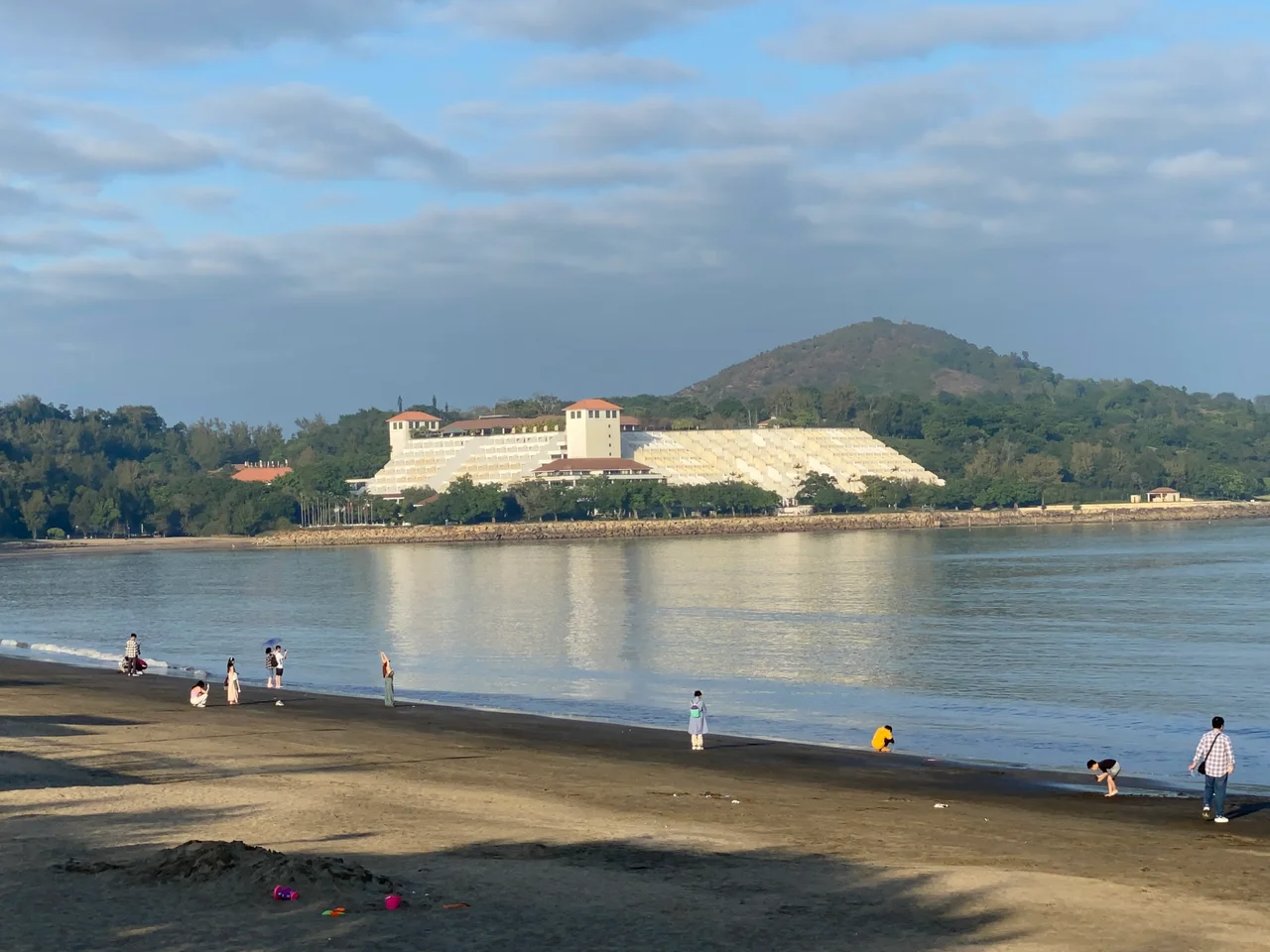

Hac Sa Beach
The sand is supposed to be black. That was always the point — *hac sa* means black sand in Cantonese, and the dark, mineral-laden grains that once covered this beach gave it both its name and its distinctive character. But the sea kept taking the sand. Erosion wore the beach down year by year until the Macau government intervened, trucking in yellow sand to rebuild what the tides had claimed. Today Hac Sa is a hybrid — a natural beach supplemented by human engineering, darker original minerals mixed with the brighter imported fill, the name preserved even as the color it described has been diluted.
The Color of Minerals
Black sand beaches are uncommon enough to draw curiosity wherever they occur. Hawaii's are formed by volcanic activity — basalt cooled rapidly by seawater, shattered into dark glass-like grains. Hac Sa's darkness has a different origin: the minerals carried down from the Pearl River and deposited along Coloane's southern shore over centuries. The color is lighter than volcanic black, closer to a deep iron gray, and the Wikipedia article notes it is less intensely dark than Hawaiian examples. None of that diminishes the effect. Walking onto Hac Sa from Coloane's interior, through the park and past the reservoir country trails, the beach announces itself as something visually different from the pale crescents typical of the South China Sea coast. The contrast with the surrounding green hills and blue water is part of why the beach became Macau's most visited stretch of coastline.
Coloane's Last Open Shore
Coloane was always the quieter of Macau's two offshore islands — less developed than Taipa, further from the mainland ferry terminals, its southern end still forested. Hac Sa sits near that southern end, backed by Hac Sa Reservoir Country Park, and a stream that originates from the reservoir runs through the beach's central area, draining into the sea. The park offers hiking trails through secondary forest, a contrast sharp enough to feel almost startling after the casino corridors of nearby Cotai, which sits just to the north on reclaimed land. Hac Sa is, in some sense, the thing that Cotai is not: unbuilt, unglamoured, shaped by water rather than money. That the two exist within a few kilometers of each other says something about the range Macau contains.
A Beach Rebuilt
Erosion is an old problem on this stretch of coast. The same Pearl River currents that deposited the dark minerals also carried them away, and over time Hac Sa shrank. The government's response — refilling the beach with yellow sand — is a common enough intervention at threatened beaches worldwide, but it carries a particular irony here. The name that drew visitors was rooted in something real, a geological characteristic of this specific place, and the remediation that saved the beach from disappearing altered the very quality that named it. The yellow sand imported to reinforce the shore mixes with remaining dark grains in a gradient that shifts with tides and seasons. On some days after storms, more of the original minerals surface. On others, the beach looks closer to gold. The place adapts, as all coastal places must.
Between Park and Sea
The Hac Sa Reservoir Country Park that borders the beach is one of Macau's few remaining patches of managed natural terrain. Trails loop through hillside woodland where migratory birds pass through in spring and autumn. The reservoir itself, built to serve Coloane's residents, feeds the stream that bisects the beach and empties near the waterline. It is a small hydraulic system, almost invisible to casual visitors, but it means the beach has a freshwater element that larger coastal parks often lack. Families use the shaded picnic areas that the government has maintained along the beach's northern edge. On summer weekends the beach fills with swimmers and children. In quieter months, early morning walkers have it largely to themselves — the dark-gray sand, the gray-green hills, the gray South China Sea stretching south toward open water.
From the Air
Hac Sa Beach lies at approximately 22.12°N, 113.57°E on the southern end of Coloane island in Macau. From the air at 2,000–3,000 feet, the beach is visible as a dark-sand crescent backed by green hillside — a clear visual contrast to the reclaimed Cotai Strip a few kilometers to the north. The Hac Sa Reservoir glints to the north of the beach. Nearest airport is VMMC (Macau International Airport) on Taipa, approximately 6 km to the north-northeast. The beach is best viewed from the southeast approach over open water, where the dark sand color is most visible against the surrounding terrain.
Nearby Stories
- Trio Beach 3.9 km away
- Po Toi 12 km away
- Nei Lingding Island 12 km away
- Battle of Yamen 27 km away
- Xinhui, Jiangmen 28 km away
- Battle of Nanpeng Island 107 km away
- Temple of the Five Lords 403 km away
- Mavulis Island 800 km away