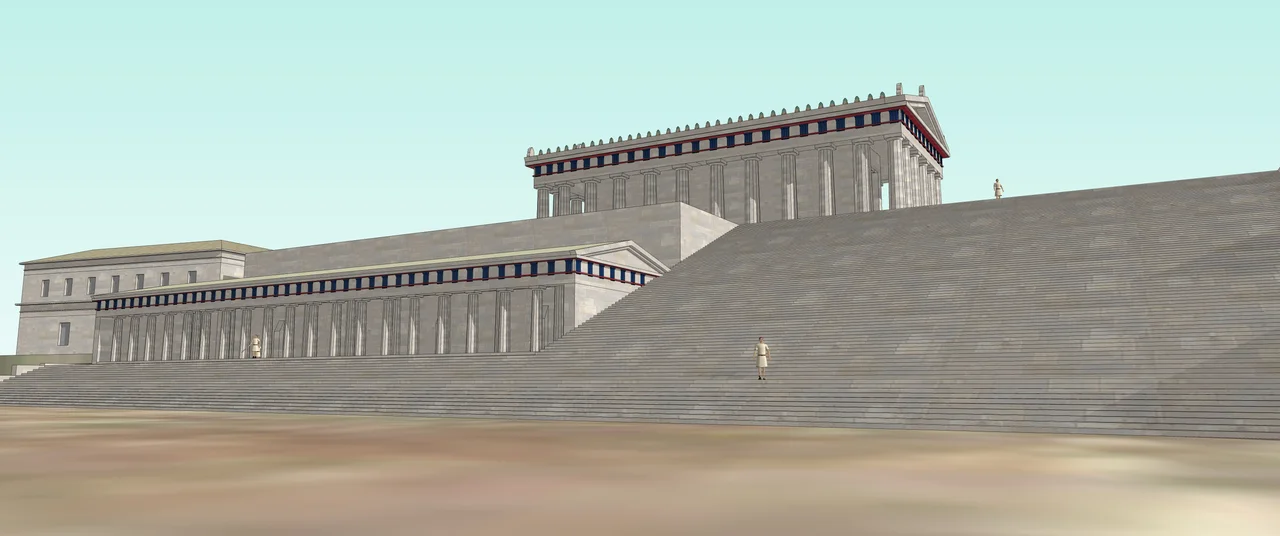

Heraion of Argos
In Homer's Iliad, Hera lists the three cities she loves best: Argos, Sparta, and Mycenae of the broad streets. The line is a statement of divine geography, a goddess claiming territory. And the place where that claim was most physically expressed — where Hera was honored with processions, bronze prizes, ritual baths, and stone temples built to impress across the plain — is a sanctuary on a hillside between Mycenae and Midea that Greeks called the Heraion of Argos. It was functioning as a sacred site before most of the buildings we call ancient were built.
Between the Citadels
The Heraion sits on the lower slopes of Mount Euboea in the northeastern Argolid, positioned with deliberate geographic intent. It lies roughly five miles from Argos, three miles from Mycenae, and six miles from Tiryns — equidistant, more or less, from the major powers of the plain. This was not an accident. The sanctuary served as shared sacred ground for communities that were often rivals. Walking trails and roads connected the Heraion to all of them, making it a meeting point as much as a worship site. The Argives constructed a massive terrace and retaining wall to create level ground on the hillside — a significant engineering project that itself echoed the Cyclopean masonry of the Mycenaean citadels visible from the sanctuary's heights. Nearby Mycenaean chamber tombs suggested to later Argives that the area had always been sacred, and they were right to think so: evidence of use goes back to the Neolithic period.
How Argos Built Its Past
The Old Temple Terrace, measuring 55.80 by 34.40 meters, was the first substantial structure built at the Argive Heraion, established from the 8th century BCE onward. Its builders made a pointed choice: they constructed it in a style deliberately evoking Cyclopean masonry, piling large stones of irregular shapes as the Mycenaeans had done. The scholar Tilton, examining the remains in 1903, concluded that Argos was consciously imitating Mycenaean construction — connecting its emerging civic identity to the heroic prestige of the Bronze Age civilization that had preceded it. This was political architecture. Argos was a small collection of towns emerging from the Greek Dark Age, and building a sanctuary that looked like it belonged to the age of heroes was a way of claiming inheritance over the plain. The Mycenaeans were by then revered and half-mythologized. To build like them was to argue that Argos was their legitimate heir.
The Goddess and Her People
Hera at the Argive Heraion was not simply the wife of Zeus. She was a multifunctional deity whose authority extended across family, fertility, marriage, childbirth, military victory, and the protection of the polis itself. Scholars describe her role as encompassing the full arc of civic life: 'protectress of childbirth, growing up, and marriage,' as one analysis puts it. Men and women both worshipped her, bringing votives that illuminate the everyday concerns of people in the Argive Plain. Small figurines of children and nursing mothers were left in the sanctuary. Warrior figurines and miniature shields acknowledged Hera's role as protector of the state. Terracotta pieces depicting weaving and food preparation confirmed her association with the household. The votives are, in aggregate, a portrait of an entire society laying its concerns before a goddess they believed was listening — which, in the social sense, she always was.
Procession and Festival
Once a year, a procession left the city of Argos and climbed the sacred way to the Heraion. Called the Procession of the Hera Argeia, it moved through the landscape with young women, cows, and armed young men in a parade that drew participants from communities across the plain. Before the ceremonies of the Hieros Gamos — the sacred marriage of Hera and Zeus — the Argives bathed the goddess's cult statue, a ritual explained by the belief that the spring of Kanathos near Nauplion was sacred to Hera and that she bathed there to renew her virginity before each reunion with Zeus. Sacred games were held at the Heraion as well. Archaeologists have recovered bronze water vessels inscribed with texts identifying them as prizes — physical objects that once changed hands in athletic competition, testimony to the Heraion's role as a center for the competitive culture that would eventually crystallize into the Olympics.
What Remains
Argos conquered Mycenae, Tiryns, and Midea in 468 BCE, and the Heraion expanded accordingly. A new classical temple replaced an earlier one destroyed by fire. Stoas connected levels. A West Building with columns on three sides was added. The traveler Pausanias, visiting in the 2nd century CE, described what he saw with a thoroughness that helps archaeologists today correlate ruins to descriptions. Thomas Gordon found the site in 1831. The stones on the hillside are now weathered to the color of the plain below — warm limestone grey, not the white we imagine when we think of ancient temples. They have been there long enough to look as if they grew there. Standing on the terrace at evening, when the light flattens across the Argolid and the citadel of Mycenae catches the last sun on its ridge, the Heraion feels less like a ruin than a continuation: the same hills, the same plain, the same human impulse to build something worthy of the landscape.
From the Air
The Heraion of Argos sits at approximately 37.692°N, 22.775°E on the lower slopes of Mount Euboea in the northeastern Argolid, Peloponnese. From the air at 3,000–5,000 feet, the site is visible as a terraced hillside with identifiable structural remains northeast of Argos and southwest of Mycenae. The Argive plain — one of the most fertile in Greece — spreads below. The nearest major airport is LGAV (Athens International Eleftherios Venizelos), approximately 110 km to the northeast. Best approach for visibility is from the north, where the full terrace profile shows against the hillside. Morning light illuminates the eastern face of the terrace; afternoon haze can obscure the plain.
Nearby Stories
- Villa of Herodes Atticus 3 km away
- Sicyon 3.5 km away
- Battle of Megalopolis 4.5 km away
- Hermione: The City at the Edge of the World 7.5 km away
- Agia Lavra 7.7 km away
- Megara 13 km away
- Agistri 13 km away
- Teuthis 15 km away