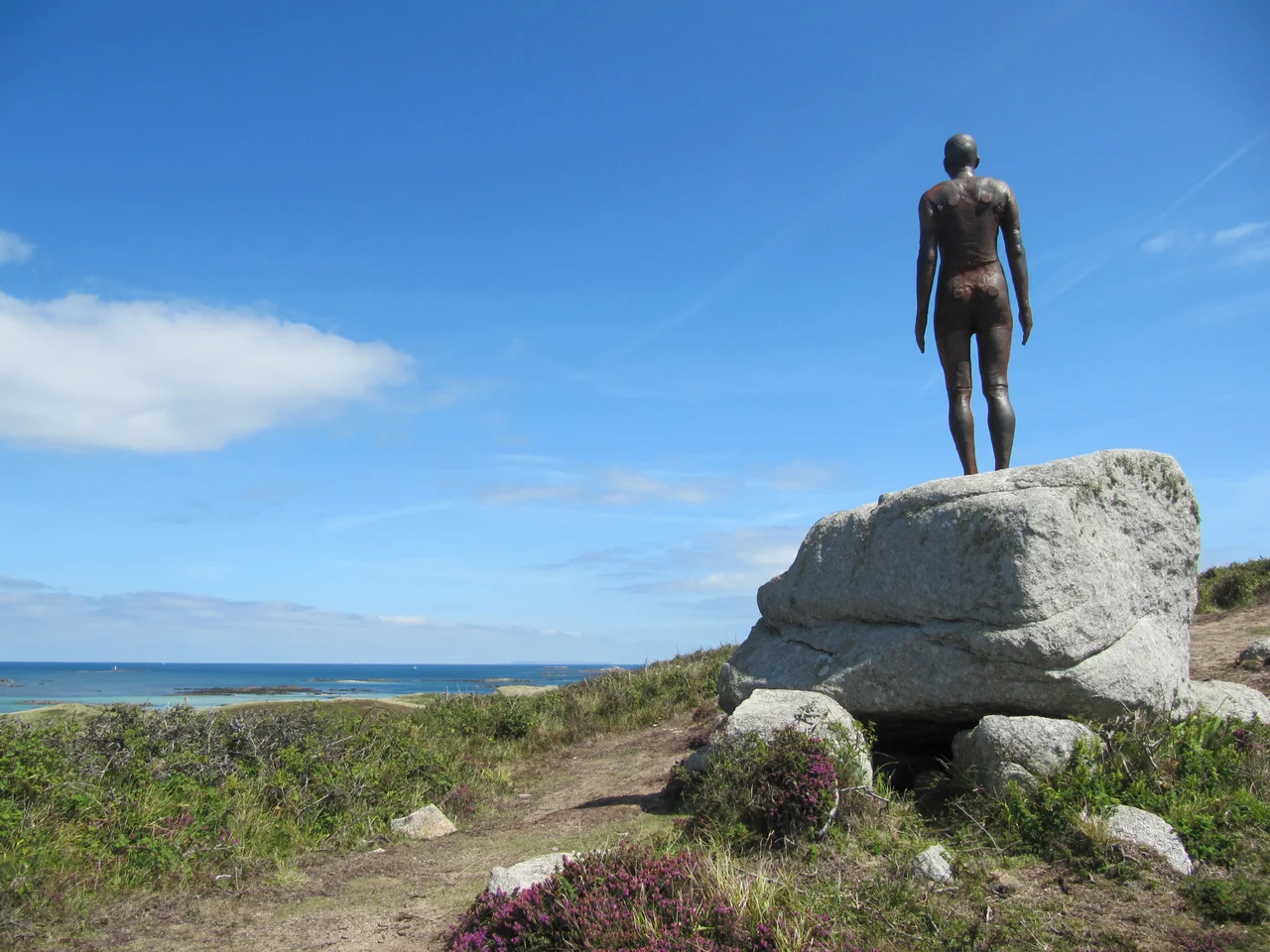

Herm
A Prussian prince looked at Herm in the early twentieth century and decided what this small Channel Island really lacked was wallabies. Prince Blucher, descended from the Field Marshal whose late-arriving Prussians helped save Wellington at Waterloo, brought them in and turned them loose. The wallabies are mostly gone now. Almost everything else on Herm is older than they were and will outlast their absence. It is the smallest publicly-accessible Channel Island, a mile and a half long by half a mile wide, with a population of about 65 and a rule against motor vehicles that extends even to bicycles. The only way around is your feet.
Crossing Over
The Trident Ferry from Saint Peter Port on Guernsey is the only way in. The crossing takes twenty minutes. In summer there are eight sailings a day; in November to March, often only one. The boat takes seventy passengers and runs to a tide-dependent schedule that means departing and returning from different berths depending on the water level. At low tide on Herm you land at Rosaire Steps, half a mile south of the main harbor. At high tide you walk straight off at the harbor itself. Visitors who get sloppy about reading the chalkboard schedule can find themselves walking faster than they planned to make the last boat. The locals' alternative to walking is a tractor or a quad. Even bikes are not allowed.
Saint Tugual and the Cows
The eleventh-century chapel of Saint Tugual sits in the middle of the island, named for a Breton saint who died in 564 AD. Inside, the stained glass windows tell strangely local stories: Noah's Ark, Guernsey cows, Jesus speaking with fishermen on Herm's own harbor. The chapel is non-denominational and unconsecrated, restored in 2011 and generally open. Outside, Spine Road runs the length of the island, a green lane shaded by trees that Herm calls bosky. North of the chapel the road opens onto a coastline that suddenly turns sandy: Shell Beach, where the sand really is mostly broken shells from the warm currents that wash this side of the island; Belvoir Bay, sheltered and shallow; smaller coves all the way around the northern half. The south, by contrast, is rocky and dramatic. Half a mile off the south end sits the smaller island of Jethou, privately owned, governed as part of Saint Peter Port rather than Herm. You can look at it from a distance. That is the closest you will get.
Compton Mackenzie's Refuge
The novelist Compton Mackenzie, best known for Whisky Galore, lived on Herm for a time in the 1920s after the First World War. He was looking for the same thing many of his guests at the White House were looking for, then and now: somewhere quiet enough to think. The hotel is still the center of island life. Inside it are the Ship Inn, open noon to nine from April through October, and the Conservatory Restaurant for dinner and Sunday lunch. The local family firm runs all the accommodation, from self-catering cottages at about 500 pounds a week to a campsite with eighty pitches, open May through September. There is one island shop near the ferry jetty, selling clothes, jewellery, sweets, souvenirs. There is no ATM, no chain anything, and almost no signal in some parts of the island. The dialing code is +44, the same as the mainland, but the place feels much further away than the twenty-minute ferry suggests.
What Little Happens
An island guide to Herm warns visitors that little has ever happened here, even during the wartime occupation. The Germans took the Channel Islands in June 1940 and held them until May 1945, but Herm was a sideshow even within that sideshow. The garrison was small. The disruption was largely an absence of mail and supplies. The wallabies escaped. The cows kept being milked. After the war the island slipped back to its quiet rhythm, broken only by the brief interruption of Rock on Herm, the annual September music festival held among the trees. You can hire a kayak or a paddleboard from Outdoor Guernsey. You can join the garden tour at the White House for eight pounds, Tuesdays at 11 from mid-April to mid-September. You can walk the entire coast in an afternoon. You will probably do almost nothing else. That, the brochures gently suggest, is the point.
From the Air
Herm sits at 49.4724 N, 2.4493 W, about 3 miles east of Saint Peter Port on Guernsey and 6 miles northwest of Sark. From altitude the island appears as a small green oblong with a sandy northern coast and a rocky southern half, the smaller island of Jethou clearly visible half a mile to the south. Best viewed from 1,500 to 3,000 feet to see Herm in context with Guernsey to the west and Sark to the southeast. Nearest airport: Guernsey (EGJB), about 5 nautical miles west. There is no airport or helipad open to the public on Herm. The Trident Ferry runs from Saint Peter Port; expect crossing-traffic between Guernsey and Herm, plus the southeasterly ferry track to Sark.
Nearby Stories
- Battle of Cherbourg (1864) 4.6 km away
- Action at Cherbourg (1692) 19 km away
- Operation Donnerkeil 35 km away
- HMS Affray 55 km away
- HMS Formidable (1898) 56 km away
- Mont Saint-Michel: The Abbey That Becomes an Island Twice a Day 67 km away
- Basilica of Sainte-Therese, Lisieux 184 km away
- 1941 Santander Fire 645 km away